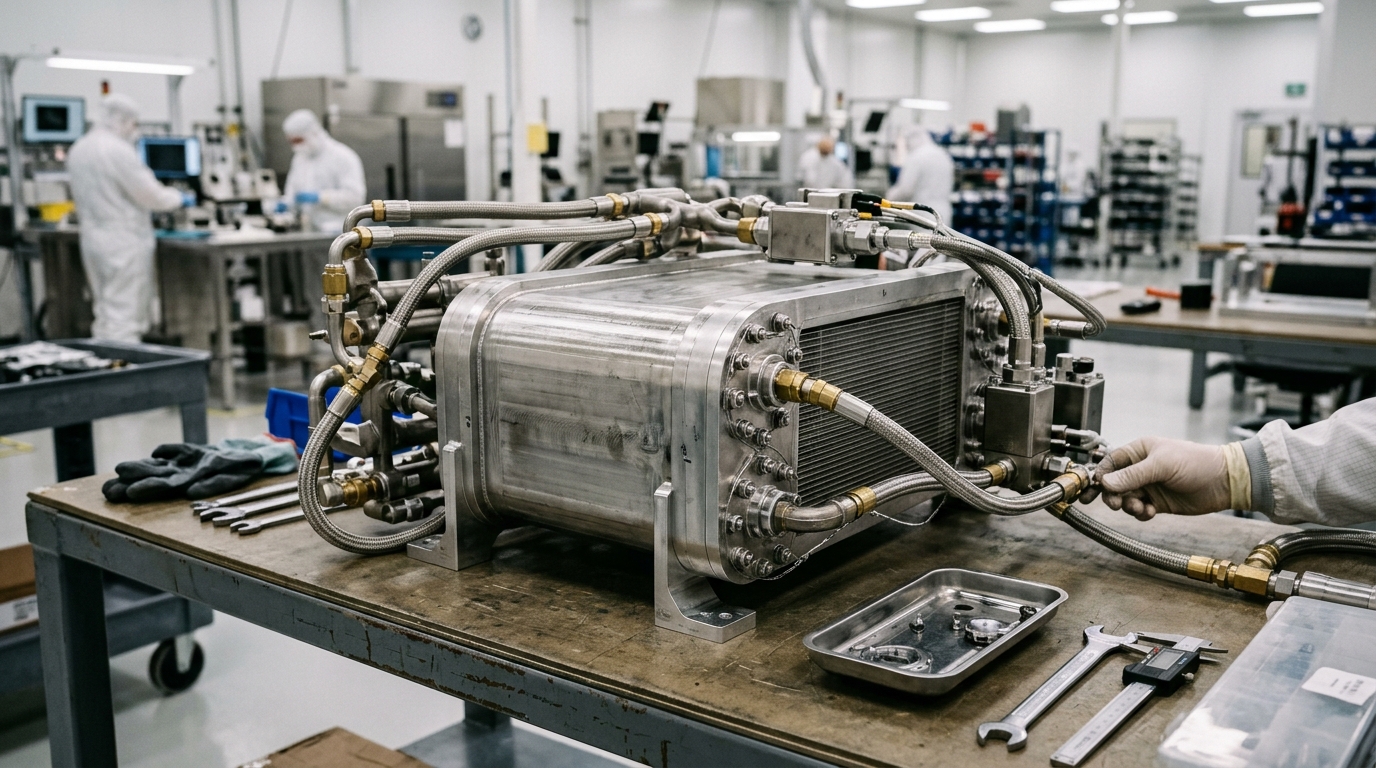
Published in Advanced Modeling and Simulation in Engineering Sciences, the study explores the Quadratic Unconstrained Binary Optimization (QUBO) framework as a tool for solving thermo-fluid dynamics problems associated with compact heat exchangers and ejectors. The work aims to provide design engineers with an efficient alternative to traditional iterative numerical methods and computational fluid dynamics simulations, particularly during the preliminary design phases of rotary- or fixed-winged aircraft.
The environmental control system of an aircraft is responsible for thermal management, including ventilation, heating, cooling, and humidity control in occupied and cargo compartments. These systems typically rely on a refrigeration cycle coupled with air mixing devices. In aeronautical applications, weight and dimension constraints necessitate the use of compact heat exchangers, which are characterized by a high heat transfer area-to-volume ratio, large heat transfer coefficients, and small flow passages. These devices are designed for efficient heat transfer from one fluid to another without mixing them.
Ejectors, also known as jet pumps, are another critical component used to mix high-pressure, high-temperature flows from engines with low-pressure, low-temperature ambient air. Operating on Bernoulli’s principle and the Venturi effect, ejectors utilize the pressure energy of a driving fluid to entrain a secondary flow. The design of these devices involves solving a nonlinear system of equations based on the conservation of mass, momentum, and energy. Traditionally, this is achieved through iterative numerical solutions or detailed computational fluid dynamics models, both of which present challenges such as numerical instability or high computational costs.
The proposed QUBO approach reformulates these thermo-fluid dynamics problems into a combinatorial optimization task suitable for quantum annealing hardware. For compact heat exchangers, the method discretizes the possible range of enthalpy into ordered discrete values, avoiding the direct fixed-point arithmetic conversion typically required in quantum procedures. The heat exchanger is divided into finite elements where enthalpy is considered uniform, and the energy balance is expressed as a function of binary variables representing the enthalpy index within each element. This formulation allows the quantum annealer to minimize a Hamiltonian function that includes energy balance constraints and boundary conditions, such as the continuity of enthalpy variation between adjacent elements.
For ejector modeling, the study applies a similar QUBO strategy to the SAE 1168-6 design procedure. The governing equations, which include the entrainment ratio, non-dimensional pressure rise, and compressibility, are rearranged into a set of three equations. By introducing binary conversions for these unknown quantities, the system is transformed into a higher-order unconstrained optimization problem. The quartic and cubic terms resulting from the squaring of the error norm are reduced to quadratic and linear terms using auxiliary qubits, enabling the problem to be solved in the standard QUBO format. This approach eliminates the need for iterative resolution of nonlinear equations, potentially reducing numerical instability.
The research team validated the proposed models using Fujitsu’s Digital Annealer Unit, a custom application-specific integrated circuit hardware architecture designed for solving large combinatorial optimization problems. The codes were executed using Fujitsu’s proprietary software development kit. For the compact heat exchanger, the model was validated against experimental data and computational fluid dynamics results for a single-pass crossflow heat exchanger. The heat transfer coefficients were retrieved using a finite volume sub-model with the ANSYS CFX solver, which implemented a Lee model for evaporation and condensation. The QUBO results were compared with these traditional numerical simulations to assess accuracy and computational efficiency.
For the ejector, the model was validated using a device designed and manufactured at FIMAC for use on a rotary-wing aircraft. A dedicated two-dimensional axis-symmetric computational fluid dynamics model was developed in ANSYS CFX, treating air as a compressible ideal gas with the Sutherland model for dynamic viscosity. The numerical simulation used a RANS steady-state approach with the K-ω SST turbulence model. The QUBO code was executed for sea-level, International Standard Atmosphere standard day operational conditions. The results showed that the QUBO algorithm achieved percentual differences of 2 to 3% compared to analytical and numerical simulation results, demonstrating comparable precision.
In terms of computational efficiency, the QUBO approach proved significantly faster than traditional computational fluid dynamics simulations. For the compact heat exchanger, the computational time for the analytical and QUBO approaches was on the order of a few dozen minutes, including setup, whereas the thermal transient analysis with ANSYS CFX required several hours. Similarly, for the ejector, the QUBO execution time was a fraction of the approximately six hours required for the CFD simulation, including problem setup, mesh generation, and execution. This speed-up suggests that quantum annealing could allow design engineers to evaluate more detailed solutions in the early stages of project development.
Despite the heavily simplified and discretized enthalpy range used to reduce the model size, the algorithm was able to retrieve physically reasonable results, including a continuous variation of enthalpy and a final enthalpy consistent with experimental data. The study notes that the method can be extended to various types of heat exchangers, such as parallel flows, counter flows, and cross flows. The flexibility of the QUBO formulation allows for the introduction of additional physical laws and constraints in an automated manner, making it a versatile tool for design engineers who need to compare several possible solutions quickly.
However, the study highlights significant limitations regarding the current state of quantum hardware. The primary constraint is the availability of machines with enough qubits to simulate a well-refined lumped model. The total number of qubits required is determined by the number of elements, the qubits for the coin generator, and the qubits used to discretize enthalpy and energy variation. A detailed engineering model can easily exceed hundreds of qubits, which hinders the achievement of practical results until affordable quantum computers with sufficient capacity become available. The technology is currently at a relatively low technology readiness level, with a manufacturing readiness level of 4.
The authors conclude that while quantum computing is a promising technology for thermofluid dynamics applications, it remains in an early stage of development. The QUBO approach offers a valid alternative to traditional methods, providing comparable results in a fraction of the time, even when executed in a simulated quantum environment. The simplicity of implementation and the potential for speed-up make it an attractive option for preliminary design, although the hardware limitations currently restrict its application to simplified models. Future advancements in quantum hardware may enable the resolution of more complex, real-life engineering problems.
This research contributes to the growing body of work on quantum computing applications in engineering, specifically in the field of computational fluid dynamics. By demonstrating the feasibility of using quantum annealing for the design of aircraft environmental control system components, the study provides a proof-of-concept for the integration of quantum algorithms into industrial design workflows.
Contextualizing the operational requirements, the underlying system architecture examined in the study draws directly from an environmental control system developed by FIMAC for the Piaggio P180 Avanti EVO passenger turboprop. This system incorporates a motor condensing unit installed in the baggage compartment, housing an electrical compressor, two axial fans, and a 28 to 270 VDC direct-current converter, alongside dedicated cockpit and cabin evaporator modules subject to strict weight, packaging, and retrofit interface constraints. Within this framework, microchannel heat exchangers serve as a compact subclass where surface area density exceeds 400 square meters per cubic meter for liquid-to-liquid or phase-change regimes, surpassing conventional fin-and-tube or shell-and-tube assemblies. Their flow passages, characterized by hydraulic diameters spanning a few hundred micrometers to several millimeters, leverage enhanced microscale shear forces and surface tension while an all-aluminum body and reduced refrigerant charge minimize structural weight.
To construct the compact heat exchanger lumped model, the researchers assumed steady-state phenomena, negligible wall thickness relative to lateral dimensions, unmixed working fluids, and absence of external heat exchange with the surrounding environment, with fluid temperatures varying solely along flow lengths. In their physical validation, the heat exchanger was segmented into twenty-three finite elements paired with sixteen discrete enthalpy levels, requiring 368 logical qubits across the lumped mesh. For the ejector equations evaluated under single-engine passenger helicopter conditions, converting the higher-order unconstrained formulation into standard quadratic form required auxiliary qubit expansion: each cubic term was recast using one auxiliary binary variable, whereas each quartic term required the recursive addition of seven auxiliary qubits. Furthermore, mapping the ejector entrainment ratios between zero and five via fixed-point arithmetic utilized an eight-qubit representation with four decimal places, establishing a maximum representable value of 7.96875 and constraining deviations against baseline computational fluid dynamics below 3 percent. Physical conservation laws such as thermal gradient continuity were enforced through unconstrained penalty terms that evaluate to zero upon satisfaction, scaled by dedicated lagrangian multipliers while neglecting invariant constant parameters.
Subject of Research: Quadratic unconstrained binary optimization for environmental control system equipment design and assessment
Article Title: Quadratic unconstrained binary optimization for environmental control system equipment design and assessment
Article References: Malinverno, G., & Alberto, J. B. (2025). Quadratic unconstrained binary optimization for environmental control system equipment design and assessment. Advanced Modeling and Simulation in Engineering Sciences, 12(1), Article 26. https://doi.org/10.1186/s40323-025-00310-9
Image Credits: AI Generated
DOI: 10.1186/s40323-025-00310-9
Keywords: Quadratic, unconstrained, binary, optimization, environmental, control, system, equipment, design, assessment, scientific research
News Source: Denise Maddox. (November 13, 2026). Quadratic Unconstrained Binary Optimization for Environmental Control System Equipment Design and Assessment. Scienmag.