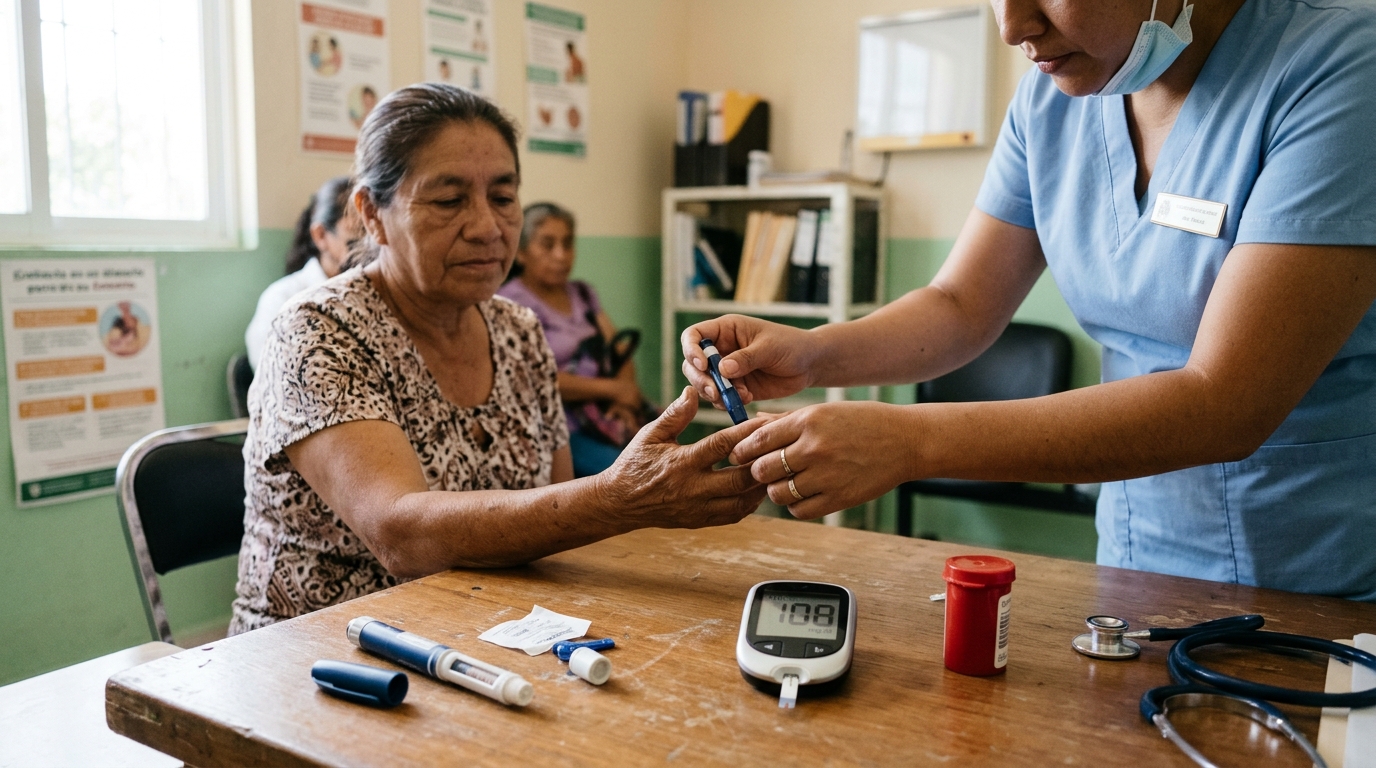
A comprehensive ecological analysis of 2,454 Mexican municipalities indicates that type 2 diabetes mortality is heavily shaped by broader state-level governance environments rather than local community socioeconomic conditions alone. Investigating deaths registered across Mexico in 2024, researcher Oswaldo Sinoe Medina-Gómez evaluated how institutional contexts and local material deprivations converge to produce marked territorial disparities. Type 2 diabetes represents a severe public health burden nationally, where it constitutes the second leading cause of mortality with an age-adjusted death rate exceeding 70 per 100,000 residents. The newly reported findings demonstrate that beyond the individual and neighborhood socioeconomic factors often cited in epidemiological research, the broader regional architecture of healthcare organization and social protection directly accounts for major gaps in chronic disease survival.
To rigorously disentangle municipal population characteristics from higher-level administrative influences, the investigation employed an ecological design with cross-sectional structural covariates nested within all 32 Mexican federal entities. Mexican federal states maintain constitutional autonomy over their health system operations, expenditure decisions, and social protection programs, rendering them critical institutional environments rather than mere aggregates of municipal populations. Municipal mortality figures attributed to diabetes under International Classification of Diseases codes E11 through E14 were matched with official population denominators for residents aged 20 years and older. The analysis assessed an analytical dataset of 2,454 complete municipal observations, evaluating the standardized mortality ratio through indirect age standardization using the national population of 2024 as the baseline standard.
The statistical strategy drew upon social epidemiology and Latin American social medicine to separate compositional effects, which denote the specific characteristics of resident populations, from contextual effects, which capture unobserved territorial governance and physical environments. Baseline characterization of the study sample highlighted profound dispersion in mortality counts and demographic features across the country. Across all analyzed municipalities, the average number of registered diabetes deaths stood at 34.58 with a standard deviation of 98.92, ranging from areas with zero recorded fatalities to major urban hubs concentrating up to 1,628 deaths. The municipal adult population exhibited similar wide variation, averaging 36,037 adults but spanning from 61 individuals in smaller rural jurisdictions to more than 1.47 million residents in dense metropolitan centers.
Initial modeling began with a null multilevel Poisson model with state-level random intercepts and a log population offset, designed to estimate baseline territorial heterogeneity prior to the inclusion of explanatory variables. This null model revealed pronounced geographic clustering, producing a statistically significant state-level variance of 0.134. Notably, the intraclass correlation coefficient indicated that 51.6 percent of the total unexplained variability in municipal diabetes mortality was attributable directly to structural differences between federal entities. The corresponding median rate ratio was calculated at 1.42, demonstrating that if two municipalities with identical socioeconomic profiles were selected at random from two different states, their diabetes mortality rates would differ by a median of 42 percent solely due to the differing state contexts in which they operate.
Structural municipal explanatory variables were subsequently integrated to determine how much of this regional variance was mediated by local living conditions. These covariates, derived from the 2020 municipal poverty measurements compiled by the National Council for the Evaluation of Social Development Policy, included income vulnerability, food vulnerability, educational marginalization, access to health services, the proportion of female residents, the share of Indigenous residents, low educational attainment, and the mean age of the population. In the descriptive survey, municipal income vulnerability averaged 0.354, educational marginalization averaged 0.396, and food vulnerability reached an average of 0.298. Collinearity diagnostics demonstrated that all variance inflation factors remained below 5, confirming acceptable levels of independence among the structural indicators.
When these municipal-level structural covariates were incorporated into an adjusted multilevel Poisson model, the state-level variance fell from 0.134 to 0.083, representing a proportional reduction in variance of 38.1 percent. Although controlling for local material factors accounted for more than a third of the geographic variation, substantial contextual heterogeneity persisted, yielding an adjusted median rate ratio of 1.32. Across this specification, the mean age of the municipal population exhibited a robust positive association with mortality, showing an incidence rate ratio of 1.024. Food vulnerability also demonstrated an independent positive relationship, yielding an incidence rate ratio of 1.011, while educational marginalization showed an incidence rate ratio of 1.012.
Because goodness-of-fit assessments revealed substantial overdispersion within the Poisson specification, where the observed variance markedly exceeded the conditional mean, the investigation subsequently estimated multilevel mixed-effects negative binomial regressions to avoid underestimating standard errors. In this refined negative binomial specification, state-level variance remained statistically significant at 0.098, corresponding to a median rate ratio of 1.36. Food vulnerability retained its significant independent association with diabetes mortality, producing an incidence rate ratio of 1.006. Likewise, mean population age maintained an incidence rate ratio of 1.020, confirming that municipalities with older populations experience higher mortality rates in alignment with the biological progression of chronic metabolic disease.
Conversely, certain structural covariates demonstrated shifts between specifications or displayed counterintuitive patterns that require cautious sociological and epidemiological interpretation. In the negative binomial model, municipal income vulnerability attenuated to non-significance with an incidence rate ratio of 0.994, suggesting that broad financial deprivation may operate primarily through more immediate mediating mechanisms such as food insecurity and physical infrastructure access. Similarly, while the municipal proportion of Indigenous residents showed an inverse relationship in the Poisson model, its association became statistically non-significant in the negative binomial model, yielding an incidence rate ratio of 0.963 with a 95 percent confidence interval spanning 0.868 to 1.068. Geographic mapping further illustrated that municipalities with high proportions of Indigenous residents are heavily concentrated in southern states such as Oaxaca, Chiapas, and Guerrero, which diverged spatially from clusters of high standardized mortality ratios found in northern and north-central regions.
Low educational attainment also retained an inverse association in the negative binomial regression, showing an incidence rate ratio of 0.705. The author noted that at an ecological scale, such aggregate inverse patterns must not be interpreted as individual-level protective effects. Instead, they may reflect complex demographic transitions, selective survival, or structural reporting artifacts, such as the underreporting and underdiagnosis of diabetes-related deaths in severely marginalized rural municipalities possessing minimal clinical diagnostic infrastructure. Furthermore, the loss of statistical significance for Indigenous composition in the negative binomial model reflects how ethnic concentration is deeply intertwined with overlapping material deprivations, acting as a structural marker of historical disadvantage rather than an independent biological risk factor.
The study highlights specific methodological limitations inherent to its design, emphasizing that ecological correlations cannot establish individual causal pathways or rule out ecological fallacies. Because the mortality data were drawn from a single cross-sectional registry year in 2024, the analysis could not evaluate longitudinal temporal trajectories or track how mortality trends interact over time with changing governance policies. Additionally, while structural indicators demonstrate interannual stability, a four-year interval separated the 2020 poverty measurements from the 2024 mortality outcomes, preventing strict temporal precedence. The absence of individual-level health records similarly precluded examination of within-municipality disparities or direct clinical adherence behaviors.
Despite these analytical boundaries, the persistent state-level residual variance underscores that institutional environments function as decisive structural determinants of chronic disease outcomes in Mexico. Disparities in health system financing, primary care facility density, pharmaceutical supply chains, and broader social safety nets between northern regions and historically marginalized southern states configure differentiated territorial survival profiles. Addressing diabetes mortality consequently demands policies that reach beyond individual medical compliance, requiring structural reforms in regional food distribution systems, coordinated investments in public healthcare capacity, and targeted reductions in historical territorial stratification across federal states.
Subject of Research: Territorial and socioeconomic determinants of type 2 diabetes mortality across Mexican municipalities
Article Title: Diabetes mortality in Mexico: socioeconomic and contextual gaps
Article References: Medina-Gómez, O. S. (2026). Diabetes mortality in Mexico: socioeconomic and contextual gaps. Frontiers in Clinical Diabetes and Healthcare, 7, 1818448. https://doi.org/10.3389/fcdhc.2026.1818448
Image Credits: AI Generated
DOI: 10.3389/fcdhc.2026.1818448
Keywords: type 2 diabetes, mortality disparities, Mexico, multilevel analysis, social epidemiology, territorial inequality, food vulnerability, public health, municipal health, median rate ratio, health geography, state governance, demographic aging, social medicine, chronic disease mortality, INEGI mortality data
News Source: Phoebe Ingram. (November 13, 2026). Mexican State Contexts Drive Substantial Disparities in Municipal Diabetes Mortality. Scienmag.