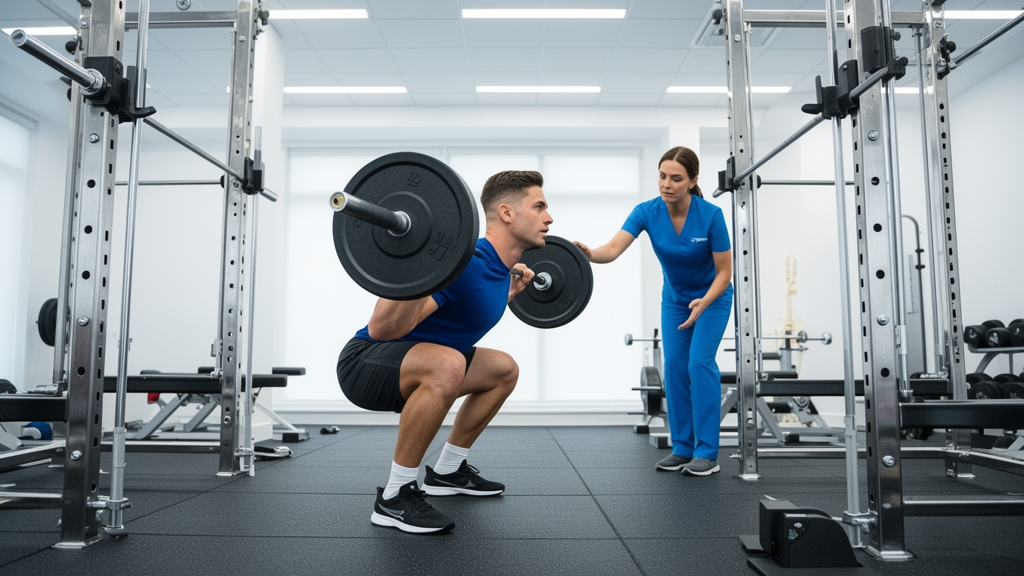
A single session of high-velocity, low-amplitude joint manipulation targeting the lower limbs does not produce statistically significant improvements in maximal back squat strength or ankle mobility when compared against an inert sham procedure, according to a double-blind randomised cross-over trial published in Chiropractic and Manual Therapies. Conducted by researchers at Murdoch University, the investigation evaluated whether manual adjustments directed at the ankle and knee joints could acutely enhance one-repetition maximum barbell back squat performance and range of motion among resistance-trained individuals presenting with asymptomatic dorsiflexion restrictions. Although participants registered modest numerical increases in squatting capacity following both authentic joint manipulations and mechanical sham procedures, comparative statistical analyses revealed no meaningful treatment-specific advantage. The findings challenge common assumptions within sports chiropractic and physical therapy circles regarding the immediate ergogenic utility of passive extremity adjustments for augmenting acute force production during compound closed-kinetic-chain lifts.
The barbell back squat serves as a foundational exercise widely prescribed across athletic conditioning programs to build lower-body muscular strength, refine neuromuscular coordination, and enhance athletic movements such as sprinting and jumping. Achieving proper squat depth, classically defined as lowering the hip joint below the level of the knee, requires substantial sagittal-plane mobility across the hip, knee, and ankle joints. In dynamic squatting tasks, the ankle complex plays an indispensable role through talocrural dorsiflexion, which typically demands between 23.4 and 30.8 degrees of motion. When individuals exhibit restricted dorsiflexion range of motion, defined clinically as less than 44 degrees during a weightbearing lunge test, they frequently experience premature depth arrest, compensatory trunk lean, or undesirable kinetic deviations that impair mechanical efficiency. Manual therapy advocates have long proposed that high-velocity low-amplitude extremity adjustments might restore posterior talar glide, enhance capsular compliance, and reduce joint stiffness, thereby optimising muscular length-tension relationships and facilitating increased motor unit recruitment during maximal exertion.
Scientific literature examining extremity joint manipulation has historically yielded conflicting and equivocal outcomes, creating substantial debate over its genuine clinical efficacy. Prior investigations assessing single sessions of isolated talocrural joint manipulation in asymptomatic participants have largely failed to demonstrate notable improvements in passive or active dorsiflexion range of motion. Conversely, certain multi-joint protocols or serial treatment interventions delivered across several consecutive weeks to individuals with chronic ankle instability have noted improvements in range of motion, stepping reaction speed, or functional hop performance. Other comparative investigations evaluating lower extremity manipulation against sham controls found no significant differences in vertical jump displacement. Compounding the ambiguity in the literature, earlier trials frequently relied on non-weightbearing range-of-motion assessments or examined cohorts presenting with clinical joint pain, leaving unresolved whether asymptomatic, resistance-trained lifters performing heavy closed-chain compound movements could derive acute performance benefits from localized articular adjustments.
To rigorously test the acute performance effects of manipulative therapy, the Murdoch University research team recruited a convenience sample of twenty-six physically active adults aged eighteen to fifty-five years, with twenty-four ultimately completing the full experimental sequence. Inclusion criteria required volunteers to demonstrate a static weightbearing lunge test angle of less than 44.0 degrees in at least one ankle, while also maintaining the ability to squat to parallel depth with a load at least equivalent to their own body weight. Participants were required to possess at least twelve months of consistent resistance training experience, including performing barbell back squats at least once weekly over the prior two months. The researchers deliberately enforced these performance thresholds to eliminate confounding motor-learning phenomena characteristic of novice lifters, while acknowledging that examining highly trained participants introduces a potential physiological ceiling effect that diminishes the likelihood of observing rapid, dramatic strength enhancements following passive interventions.
Strict screening exclusions eliminated individuals presenting with contraindications to extremity manipulation, systemic neurological or rheumatoid diseases, osteoarthritis of the spine or lower extremities, lower limb injuries sustained within the prior six months, or major surgeries within the prior year. Candidates who had received lower extremity joint manipulation within the previous six weeks, those scoring below eighty percent on the Foot and Ankle Disability Index, and female volunteers during the follicular bleeding phase of their menstrual cycle were likewise excluded. The sample size was determined through an a priori statistical power calculation using G-Power software based on comparative lower limb tape research, setting statistical power at eighty percent with an alpha level of 0.05 to detect an effect size of 0.62. Allowing for a ten percent dropout buffer, the investigators targeted twenty-six participants across three structured laboratory visits at the Murdoch University Performance Laboratory, mandating complete physical rest during the twenty-four hours preceding every testing session.
The experimental protocol commenced with an initial familiarisation and baseline testing session, during which anthropometric measures were recorded and baseline dorsiflexion was documented using an EasyAngle digital goniometer during the weightbearing lunge test. Participants subsequently executed a standardised dynamic warm-up protocol consisting of bodyweight walking lunges, side squats, ankle grabs, and progressive jumping tasks over ten to fifteen minutes before establishing baseline one-repetition maximum high-bar back squat performance. Lifting conditions were strictly standardized: barbell depth thresholds were visually verified and photographed against spotting rails, foot placement was catalogued via a reference floor grid, and lifting equipment—including weightlifting shoes with up to a one-inch heel lift, lifting belts, and knee sleeves—remained identical across all visits. Three to five days following baseline testing, participants attended their first randomized treatment session, followed seven to eight days later by the alternative treatment arm.
The experimental interventions were administered bilaterally by one of two registered chiropractors, each possessing more than eight years of clinical practice experience. In the active manipulation arm, therapists delivered high-velocity low-amplitude thrusts bilaterally to five anatomical targets: talocrural long-axis distraction, talocrural anterior-to-posterior glide, subtalar medial-to-lateral glide, tarsometatarsal anterior-to-posterior movement, and proximal tibiofibular posterior-to-anterior glide. Practitioners were permitted up to three attempts per joint based on perceived manual success rather than audible cavitation, averaging 1.8 thrust attempts per joint overall. For the sham control condition, the clinicians executed mock thrusts utilizing the mechanical drop-piece mechanism of the treatment table, intentionally applying broad, non-specific contacts directed primarily into the table surface rather than articular structures. The mechanical clatter and sensation of table movement effectively mirrored the sensory cues of authentic clinical drop-piece adjustments while withholding true articular thrust dynamics.
Data collection during lifting trials incorporated high-precision kinematic analysis alongside traditional load monitoring. Reflective anatomical markers positioned across key landmarks were tracked using a twelve-camera Qualisys motion capture system operating alongside Visual 3D modeling software, with raw trajectory coordinates smoothed through a 6-Hertz low-pass Butterworth filter. Sagittal ankle kinematics were calculated as foot rotation relative to the tibial coordinate axis during maximal lifts. In accordance with CONSORT reporting guidelines, statistical analyses were conducted through repeated measures analyses of covariance incorporating treatment sequence as a covariate. The primary outcome focused on changes in absolute one-repetition maximum squat load, while secondary outcomes examined maximal dorsiflexion achieved at parallel depth during maximum-load squats and changes in static dorsiflexion during post-intervention weightbearing lunge assessments evaluated relative to warm-up baseline measures.
The primary outcome analysis indicated that although the overall within-subject repeated measures model showed statistical significance, direct pairwise comparisons revealed no statistically significant between-group difference in one-repetition maximum squat strength between active manipulation and sham conditions, yielding a mean difference of 2.00 kilograms with a p-value of 0.27. From an average baseline squat strength of 130.2 kilograms, participants experienced a mean increase of 4.75 kilograms, representing a 3.6 percent improvement following high-velocity manipulation, accompanied by a small Hedges g effect size of 0.143. Following the mechanical sham intervention, participants achieved a mean increase of 2.74 kilograms, corresponding to a 2.1 percent improvement with a negligible effect size of 0.087. The researchers noted that these minor strength gains failed to surpass the 4.8-kilogram threshold established for minimal detectable change in trained athletic populations, indicating that observed fluctuations reflect normal test-retest variation, subtle motor potentiating effects, or general expectancy rather than specific manual therapeutic mechanisms.
Secondary kinematic and mobility parameters mirrored the neutral findings observed during maximal strength assessments. Motion capture analysis of maximal ankle dorsiflexion during one-repetition maximum squats showed no statistically significant difference between intervention conditions, yielding a p-value of 0.239 across the nineteen participants whose marker trajectories remained fully tracked. Similarly, active dorsiflexion range of motion assessed through the weightbearing lunge test immediately following interventions demonstrated no statistically significant treatment-specific variance, producing a p-value of 0.39. Blinding verification through Bang’s Blinding Index revealed that while overall blinding remained adequate under James’ Index at 0.53, participants were more prone to identify the real manipulation correctly, whereas the sham arm elicited a negative index of minus 0.50, demonstrating that while subjects generally perceived the sham as active care, subtle differences in physical force application or the absence of joint cavitations may have influenced participant expectation.
In their discussion, the study authors highlighted several methodological nuances, including the unvalidated status of the mechanical drop sham, which might possess mild non-specific mechanoreceptive stimulation that attenuates observable between-group variance. Furthermore, permitting lifters to utilize weightlifting shoes with elevated heels accommodated anterior tibial advancement while reducing the absolute dorsiflexion requirement needed to attain parallel depth, potentially muting any kinematic benefits conferred by joint mobilisations. The investigators concluded that strength and conditioning professionals, athletic trainers, and sports chiropractors should exercise discretion when incorporating passive extremity adjustments into competition preparation routines. While manual therapy may serve as an adjunct during broader athletic training cycles, localized passive joint manipulations should not be expected to acutely heighten maximal neural drive or provide meaningful short-term strength gains during maximal barbell squatting tasks in healthy, resistance-trained individuals.
Subject of Research: Evaluation of lower limb joint manipulation on back squat strength and ankle mobility
Article Title: Effects of lower limb joint manipulation on squat strength and ankle range of motion: a sham-controlled double-blind randomised cross-over trial
Article References: Morley-Hart, R., Losco, B., Dempsey, A. R., Haff, G. G., & Aspinall, S. L. (2026). Effects of lower limb joint manipulation on squat strength and ankle range of motion: a sham-controlled double-blind randomised cross-over trial. Chiropractic & Manual Therapies, 34(1), Article 38. https://doi.org/10.1186/s12998-026-00659-7
Image Credits: AI Generated
DOI: 10.1186/s12998-026-00659-7
Keywords: joint manipulation, back squat, ankle dorsiflexion, sports biomechanics, resistance training, manual therapy, randomised controlled trial, exercise science, Effects, lower, limb, joint
News Source: Ophelia Keating. (November 13, 2026). Lower Limb Joint Manipulation Does Not Boost Squat Strength in Trial. Scienmag.