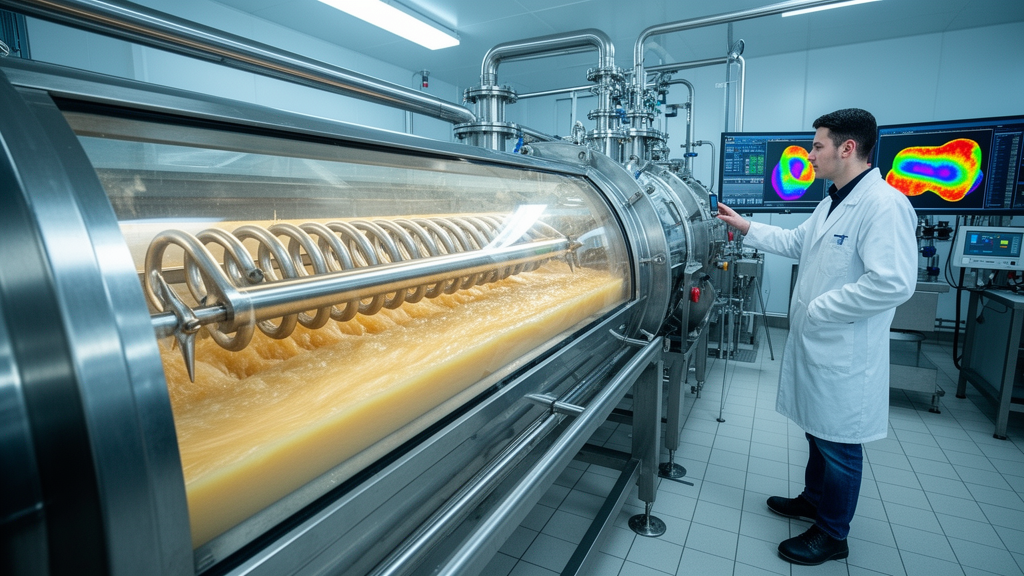
A newly published comprehensive scientific review in Food Production, Processing and Nutrition evaluates the expanding role of COMSOL Multiphysics as an advanced numerical simulation platform designed to resolve complex coupled physical phenomena across modern food engineering operations. Food manufacturing relies on unit operations such as heating, cooling, drying, mixing, fermentation, and packaging, which are simultaneously governed by heat transfer, fluid dynamics, mass transport, and reaction kinetics. Since the earliest computational food engineering study in 1969, where finite difference methods were applied to evaluate nutrient retention during conduction heating, mathematical modeling has progressively replaced costly and labor-intensive trial-and-error laboratory experimentation. The review examines how finite element modeling platforms solve interconnected systems of partial differential equations to quantitatively predict internal temperature fields, moisture migration pathways, chemical degradation rates, and microbial safety profiles. By capturing bidirectional physical interactions in complex three-dimensional matrices, numerical multiphysics simulations provide a physics-based foundation for improving energy efficiency, standardizing quality parameters, and translating laboratory-scale innovations into robust industrial-scale processing workflows.
The authors emphasize that mechanistic multiphysics modeling provides distinct advantages over empirical and data-driven methods, including machine learning algorithms that have gained popularity in food process optimization. Although empirical and machine learning models can be rapidly trained to predict kinetics in drying, frying, baking, canning, and extrusion, their applicability is fundamentally restricted to specific food products and narrow operating boundaries. A critical drawback of purely data-driven algorithms is their lack of physical interpretability; for instance, while machine learning can accurately forecast apple drying rates, it cannot explain the underlying mechanistic roles of pore structure, porosity changes, or variable thermal conductivity during moisture migration. In contrast, mechanistic finite element models formulated in COMSOL directly integrate governing equations, such as Fourier’s law for heat conduction, Fick’s second law for molecular diffusion, and the Navier-Stokes equations for fluid flow. This physics-based approach allows researchers to simulate untested operating conditions, identify localized thermal hotspots and cold spots, model irregular geometries such as whole shrimp, and couple microbial inactivation kinetics with novel processing methods.
In their technical comparison of computational platforms, the reviewers analyze the architectural trade-offs between COMSOL Multiphysics, Ansys Fluent, OpenFOAM, and MATLAB or Simulink across food engineering applications. While Ansys Fluent utilizes finite volume discretization highly optimized for industrial-scale turbulent fluid flow in cold storage facilities or piping networks, coupling external physics such as electromagnetics or structural mechanics requires complex user-defined functions. OpenFOAM offers open-source code transparency and solver customization but requires advanced programming expertise that can impede interdisciplinary collaboration. MATLAB and Simulink focus on system dynamics and empirical control logic but lack spatially resolved multiphysics capabilities. COMSOL bridges these gaps through modular equation coupling, its Application Builder, and the LiveLink integration suite. The Application Builder enables researchers to create standalone graphical simulation apps that allow students and industrial plant operators to manipulate parameters—such as retort temperatures and food geometry—without accessing the underlying computational model. Furthermore, LiveLink facilitates bidirectional data exchange with external tools; for example, integrating COMSOL with MATLAB reduced computation time by 60 percent during packaged sausage electromagnetic-thermal simulations by eliminating repetitive full-field calculations.
Heat transfer investigations across conventional and novel thermal operations illustrate the capacity of numerical modeling to determine critical temperature distributions that govern food safety and structural quality. In conventional processing, researchers implemented a two-dimensional axisymmetric finite element model to simulate the complete thermal history of salted-smoked loin pork during consecutive drying, smoking, steam cooking, and cooling stages. The simulations revealed that the pork geometric center was the most critical thermal point during heating, reaching 74.4 degrees Celsius after 333.33 minutes to satisfy the mandatory 72-degree safety standard, whereas the surface governed cooling dynamics. In novel processing technologies, electromagnetic heating models resolve problematic non-uniform energy distributions characteristic of microwave, radio frequency, and infrared systems. A three-dimensional model coupling Maxwell’s equations with heat transfer simulated microwave heating in carrot slices with a maximum deviation of only 7 percent compared to experimental data, predicting three distinct microbial inactivation phases. However, the review notes that treating vegetable tissues or berry purees as homogeneous matrices overlooks dynamic temperature-dependent dielectric properties, cellular anisotropy, and corner overheating effects that induce severe thermal gradients.
Mass transfer modeling in drying processes provides essential insights into moisture migration, solute redistribution, and internal shrinkage phenomena that dictate finished product texture and stability. In multilayer solar grain drying, numerical models of paddy rice containing distinct husk, bran, and endosperm layers demonstrated that the endosperm exhibits the highest effective moisture diffusion coefficient at 2.95 times ten to the negative eleventh square meters per second, compared to 8.66 times ten to the negative twelfth for bran and 6.00 times ten to the negative twelfth for the husk, confirming the protective barrier function of outer layers. In solar pineapple drying, coupled fluid flow and thermal simulations showed that airflow vortices in flat-plate collector chambers generated dead zones, requiring 2.5 additional hours to reach a 10 percent wet-basis moisture content compared to finned collector configurations. Numerical simulations of walnut drying in fixed-bed columns revealed that lower layers dried significantly faster than upper layers, with drying efficiency decreasing at bed heights exceeding 0.8 meters. Similarly, three-dimensional models of convective mango pulp drying accurately captured vertical temperature and moisture gradients, confirming that top surfaces dried faster than interior regions.
The review demonstrates that numerical mass transfer formulations are equally critical for optimizing bioactive compound extraction and designing gas-controlled active food packaging systems. In microwave-assisted extraction of bioactive compounds from mango waste and plant rhizomes, two-step kinetic models distinguished an initial rapid surface washing stage from a slower matrix diffusion stage, assisting in the geometric optimization of microwave chambers, waveguides, and operating temperatures. In packaging engineering, finite element analysis resolves complex multi-component moisture migration and convective-diffusive gas permeation. Investigations into heterogeneous multi-component foods—such as biscuit, hawthorn, and agar gel assemblies—revealed that moisture migration is driven primarily by water activity gradients rather than simple moisture concentration, with agar-biscuit systems reaching moisture equilibrium within 48 hours compared to 72 hours for hawthorn-biscuit pairings. For modified atmosphere packaging, microperforated film models incorporating scanning electron microscopy geometry coupled Navier-Stokes fluid dynamics with Maxwell-Stefan multicomponent gas transport. Recent two-dimensional cheese packaging simulations demonstrated that oxygen and carbon dioxide headspace concentrations follow dual-regime dynamics governed by initial food sorption followed by film permeation, where tray polymer permeability proved to be the primary determinant of equilibrium.
Advanced multiphysics modeling in food engineering increasingly addresses non-Newtonian fluid mechanics, complex rheological shifts, and moving physical boundaries across dynamic manufacturing operations. In continuous extrusion and additive manufacturing, simulations of single-screw extruders integrate laminar non-isothermal flow with temperature-dependent viscosity to predict pressure drops and viscous dissipation in shear-thickening dough and protein matrices. In three-dimensional food printing, numerical flow comparisons between syringe-based and screw-based extrusion mechanisms showed that syringe systems deliver stable, controllable deposition for high-viscosity food inks such as mashed potatoes, whereas rotating screw mechanisms induce disruptive backflow patterns and shear stresses. To capture moving physical interfaces and large structural deformations, researchers employ the Arbitrary Lagrangian-Eulerian method. This moving mesh technique enabled researchers to model material rotation during microwave pyrolysis to minimize destructive thermal hotspots. Furthermore, Arbitrary Lagrangian-Eulerian models of steamed bread during vacuum cooling coupled porous media flow with heat and mass transfer, revealing that structural shrinkage and volume reduction were driven primarily by rapid moisture loss rather than viscoelastic material relaxation, despite requiring hours of computational runtime.
Multiphase flow dynamics, single-droplet particle tracking, and solid-liquid phase changes represent another vital domain where numerical simulations replace speculative design with predictive physics. For liquid-liquid emulsions, the Level Set method tracks sharp interfacial boundaries between immiscible phases, allowing engineers to correlate acoustic pressure fields with droplet breakup regimes and optimize droplet size distributions while minimizing surfactant usage. In milk spray drying, coupled Eulerian airflow models and Lagrangian particle tracking trace individual drying droplets, accurately predicting crust formation, vapor diffusion, and particle buckling phenomena that dictate powder reconstitution and solubility. For preservation processes, phase change simulations employing apparent heat capacity formulations realistically predict freezing and thawing trajectories in irregular meat cuts and seafood. Notably, numerical investigations of industrial potato freezing demonstrated that asymmetric airflow across conveyor belts displaces the final thermal freezing point away from the geometric center of the product, invalidating conventional single-center temperature sensor placement protocols. Incorporating moving mesh formulations during drying also allows researchers to predict external crust cracking, structural warping, and boundary distortion that standard static diffusion models fail to capture.
Simulating microbial inactivation kinetics alongside chemical reaction networks enables simultaneous verification of microbiological safety and nutritional quality preservation under thermal and nonthermal processing conditions. In ultrasonic batch pasteurization, multiphysics simulations coupling high-frequency acoustics with fluid dynamics identified low-pressure passive zones that typically impair microbial lethality in conventional reactors; redesigned reactor geometry eliminated these dead zones, achieving a 5-log reduction of Escherichia coli in just 0.38 minutes and Staphylococcus aureus in 0.55 minutes. Hybrid models combining pulsed electric fields with ohmic heating successfully predicted Salmonella Typhimurium inactivation in solid matrices by coupling electric field distributions with thermal dissipation. In chemical reaction modeling, finite element models successfully link temperature distributions with the degradation kinetics of ascorbic acid, polyphenols, and anthocyanins. Numerical studies of beer fermentation integrated spatial temperature profiles with yeast kinetics and protein consumption, successfully predicting that cooling rates directly dictate ester flavor formation and protein depletion timelines across 210, 110, and 90 hours at operating temperatures of 12.5, 18, and 20 degrees Celsius, respectively.
Despite these widespread engineering capabilities, the review identifies critical challenges that currently hinder broader industrial deployment, while outlining transformative future perspectives. The fundamental obstacle remains the intrinsic variability and dynamic behavior of food properties during thermal processing, where moisture content, thermal conductivity, specific heat, and dielectric properties change nonlinearly. These physical variations frequently cause discrepancies between simulated predictions and experimental measurements, especially when constant material properties or idealized boundary conditions are assumed. Furthermore, COMSOL currently lacks dedicated, pre-configured food engineering modules, compelling practitioners to manually customize partial differential equations, configure delicate boundary layers, and perform computationally taxing mesh independence tests on irregular food geometries. Looking forward, the authors highlight three emerging frontiers: integrating machine learning for automated multi-parameter optimization, incorporating internet-of-things sensors for real-time model updating during dynamic processing, and developing high-fidelity digital twins. By combining multistage sequential simulations with multidisciplinary metabolic and transport models, computational multiphysics modeling is positioned to transition from an isolated academic diagnostic tool into a cornerstone of intelligent, sustainable industrial food manufacturing.
Subject of Research: Numerical multiphysics simulation applications in food process engineering
Article Title: COMSOL multiphysics for food processing: advances, challenges, and future perspectives
Article References: Wei, S., Hailu, G. G., Kumar, A., Daliri, E. B.-M., Arumugam, D., Khan, I., Choi, S.-I., Lee, O.-H., Oh, D.-H., & Liu, S. (2026). COMSOL multiphysics for food processing: advances, challenges, and future perspectives. Food Production, Processing and Nutrition, 8(1), Article 52. https://doi.org/10.1186/s43014-026-00404-w
Image Credits: AI Generated
DOI: 10.1186/s43014-026-00404-w
Keywords: COMSOL Multiphysics, Food Engineering, Finite Element Analysis, Thermal Processing, Mass Transfer, Microbial Inactivation, Computational Fluid Dynamics, Food Safety, COMSOL, multiphysics, food, processing
News Source: Audrey Campbell. (November 13, 2026). Numerical Multiphysics Modeling Drives Advances In Industrial Food Processing Systems. Scienmag.