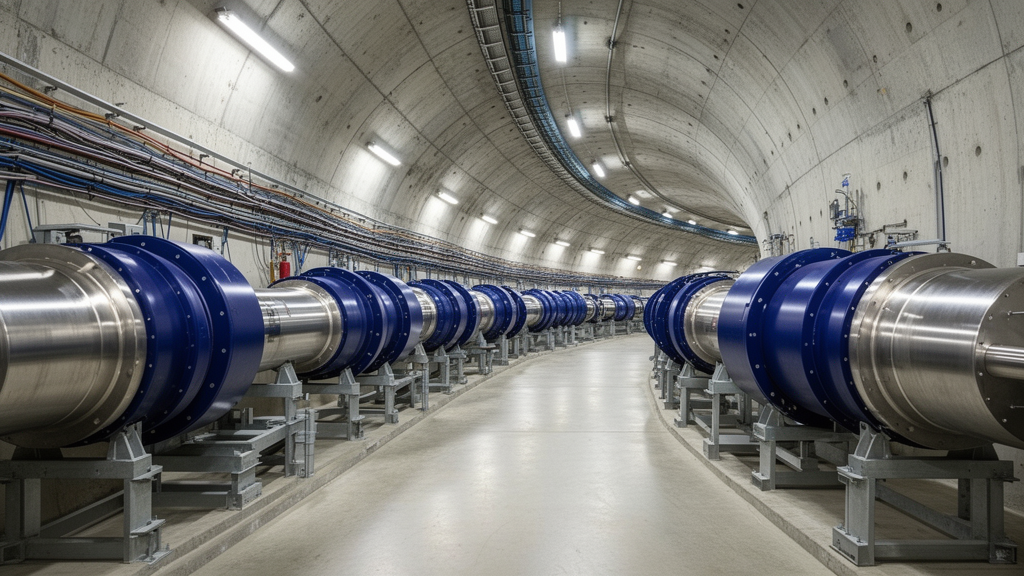
A recent theoretical study published in EPJ Techniques and Instrumentation demonstrates that adopting combined-function optics for the periodic arc cells of the proposed Future Circular Hadron Collider, known as the FCC-hh, can increase the effective bending field by approximately seven percent compared to the baseline separate-function configuration. In modern circular accelerators, bending and focusing functions are typically separated across discrete dipole and quadrupole magnets arranged in a standard periodic lattice known as a FODO cell. By configuring individual magnets to generate dipolar bending fields and quadrupolar focusing fields simultaneously within the same physical volume, the overall fraction of the arc cell occupied by bending fields increases significantly. Computational modeling indicates that an optimized combined-function cell spanning approximately 260 meters and containing 16 main magnets fully satisfies the strict mechanical and beam aperture requirements established for the machine while providing substantial margins for future energy upgrades or tunnel circumference reductions.
The standard architecture in modern high-energy synchrotrons relies on the FODO structure, alternating focusing and defocusing quadrupoles interspersed with sequences of dipole bending magnets. This separate-function design was adopted in early superconducting accelerators because it decoupled the primary operating parameters and allowed hardware designers to optimize dipoles and quadrupoles independently. However, historical accelerators such as the CERN Proton Synchrotron, the Brookhaven National Laboratory Alternating Gradient Synchrotron, and the CERN Intersecting Storage Ring successfully utilized combined-function magnets where bending and focusing forces acted concurrently. Re-evaluating this older paradigm for energy-frontier machines has become increasingly relevant because the planned 16-Tesla bending dipoles for the FCC-hh push beyond the current state of the art in superconducting magnet technology. Alleviating these severe technological requirements requires identifying lattice designs that maximize the efficiency of magnetic field utilization within every periodic cell of the accelerator arcs.
A central advantage of replacing dedicated quadrupoles with combined-function units is the substantial improvement in the dipole filling factor. The filling factor is formally defined as the ratio of the total magnetic length of bending elements to the overall physical length of the periodic cell. In a conventional separate-function FODO cell, the physical space occupied by main quadrupoles, auxiliary correction magnets, diagnostic instruments, and drift spaces between elements reduces the fraction of the cell actively contributing to beam deflection. In the baseline FCC-hh FODO cell design, which incorporates twelve dipoles and two quadrupoles across an overall cell length of approximately 213 meters, the filling factor is approximately 0.8. By eliminating the standalone quadrupoles and extending the active length of combined-function main magnets across the cell, the filling factor rises to approximately 0.9. This structural modification also simplifies industrial production lines by standardizing the arc lattice on a single fundamental type of main magnet that exhibits only two alternating quadrupolar field polarities.
Superconducting magnet capabilities are intrinsically constrained by the physical interaction between conductor current density and the localized peak magnetic field generated within the superconducting coils. Superimposing an active quadrupolar field gradient onto a primary dipolar bending field necessarily elevates the peak field experienced at the coil surface by an amount proportional to the field gradient multiplied by the coil aperture radius. For the geometric parameters and aperture requirements established for the FCC-hh lattice, calculations assuming a characteristic geometric parameter of 1.15 indicate that the quadrupolar component adds approximately 0.73 Tesla to the peak field. As a consequence, the achievable dipolar bending component in a combined-function magnet operating near superconductor limits drops to 15.27 Tesla, compared to the 16.0 Tesla achievable in a dedicated separate-function dipole. Nevertheless, the simultaneous increase in the filling factor from 0.8 to 0.9 more than compensates for this modest field penalty, lifting the effective integrated dipole field from approximately 12.8 Tesla to 13.7 Tesla across the periodic cell.
Determining the optimum physical dimensions for the combined-function cell involved parametric sweeps of optical properties, focusing requirements, and physical beam envelope constraints. Because the injection energy into the FCC-hh is substantially higher than that of the Large Hadron Collider, the ratio of transverse beam sizes between the two machines scales favorably, indicating a clear geometric margin to lengthen the periodic cell without infringing on available aperture limits. The evaluation examined cell configurations differing by integer multiples of four main magnets to preserve necessary lattice symmetries. Optical simulations were executed using the standard accelerator physics design tool MAD-X. The computations mapped maximum values of the betatron amplitude function, horizontal dispersion, beam size, and available aperture against overall cell length, incorporating the actual asymmetric geometry of the proposed FCC-hh beam screen along with mechanical fabrication tolerances, alignment deviations, closed-orbit distortions, and optical beta- and dispersion-beating.
The optical tracking and aperture evaluations revealed that a combined-function periodic cell incorporating 16 main magnets, corresponding to an overall cell length of approximately 260 meters, represents the optimal configuration. In this 260-meter arrangement, the computed beam clearance precisely matches the minimum target aperture requirement defined in the baseline FCC-hh design criteria. Although the maximum values of the horizontal betatron amplitude function and horizontal dispersion in the 260-meter cell slightly exceed those observed in the 213-meter nominal FODO lattice, these minor increases remain fully acceptable because the aperture target is satisfied. Lengthening the cell also generates crucial physical benefits for accelerator performance, including an increase in the magnitude of the phase slip factor, which helps elevate instability thresholds during high-intensity beam operations. Furthermore, the longer cell structure substantially decreases the required quadrupolar field gradient that must be superimposed onto the bending field, directly mitigating peak field concentrations in the superconducting coils.
A critical operational improvement resulting from the lengthened combined-function architecture is a dramatic reduction in the magnetic strength demanded from chromaticity correction sextupoles. In circular storage rings, chromatic sextupoles counteract chromatic aberrations and stabilize transverse betatron tunes against momentum spread, aiming for an operational chromaticity target of ten units based on collision experience at the Large Hadron Collider. In the optimized 16-magnet combined-function cell, the necessary sextupolar gradient is roughly half of that required in the nominal separate-function FCC-hh FODO lattice. Halving the required sextupole strength allows accelerator designers to reduce the physical longitudinal space reserved for sextupole magnets between main cryostats, recovering additional drift space along the arcs.
Extending combined-function optics into a complete collider architecture requires resolving the dispersion suppressor, an optical transition section that steers the horizontal dispersion function and its derivative to zero at the entrance of dispersion-free straight sections where experimental detectors and radio-frequency cavities are housed. Historically, circular storage rings employing combined-function arcs, including the CERN Intersecting Storage Ring, completely lacked specialized dispersion suppressors because their straight sections were extremely short. Standard dispersion suppression techniques in modern separate-function colliders rely on reducing dipole field strengths or omitting selected dipoles within otherwise standard FODO cells while preserving regular transverse focusing. Because the bending and focusing properties are physically coupled within combined-function magnets, conventional missing-dipole and half-field suppressor schemes cannot be implemented directly without requiring non-standard magnet hardware variants that undermine the industrial manufacturing benefits of the arc lattice.
To solve this integration challenge while respecting strict hardware standardization constraints, the study examined several dispersion suppressor layouts that exclusively utilize the regular arc combined-function magnets supplemented by standalone quadrupoles matching those already planned for insertion regions. An initial baseline suppressor design derived from traditional half-field geometries achieved dispersion cancellation across two full cells spanning approximately 550 meters, but it violated manufacturing criteria by demanding half-strength bending dipoles. Subsequent iterations resolved this limitation by utilizing standalone quadrupoles to sustain 90-degree phase advances while halving the total count of combined-function main magnets operated at full nominal strength. Further lattice optimizations compressed the transition into a compact one-and-a-half-cell architecture spanning approximately 330 meters, closely approaching the 301-meter footprint of the nominal FCC-hh separate-function dispersion suppressor. These compact designs introduce empty drift regions that can host auxiliary collimators to capture diffractive beam losses before they reach sensitive superconducting equipment.
While optical feasibility and dispersion suppression have been successfully established, translating the combined-function concept into an operational machine requires further engineering and beam dynamics investigations. In conventional FODO lattices, main quadrupoles provide convenient structural mounting locations for beam position monitors and dedicated magnetic corrector packages that manage closed-orbit distortions, betatron tunes, linear coupling, chromaticity, and Landau damping octupoles. The removal of standalone quadrupoles leaves the physical integration and distribution of these essential correction packages within the combined-function cell as an open problem to be resolved in future lattice models. Additionally, high-energy hadron colliders experience intense synchrotron radiation emission within the arcs, and the precise interaction between radiation damping, quantum excitation, and combined-function magnetic fields must be thoroughly assessed before finalizing the definitive cell length and magnet parameters.
Subject of Research: Combined-function magnet optics and dispersion suppressor designs for the Future Circular Hadron Collider
Article Title: Considerations on combined-function optics for high-energy storage rings and colliders
Article References: Giovannozzi, M. (2022). Considerations on combined-function optics for high-energy storage rings and colliders. EPJ Techniques and Instrumentation, 9(1), Article 5. https://doi.org/10.1140/epjti/s40485-022-00081-2
Image Credits: AI Generated
DOI: 10.1140/epjti/s40485-022-00081-2
Keywords: Future Circular Collider, FCC-hh, combined-function optics, accelerator physics, storage rings, dispersion suppressor, dipole magnets, quadrupoles, filling factor, MAD-X, beam aperture, hadron colliders, FODO lattice, synchrotron design, chromatic sextupoles, beam optics
News Source: Denise Maddox. (November 13, 2026). Combined-Function Magnet Optics Boost Effective Dipole Field for Future Collider Arcs. Scienmag.