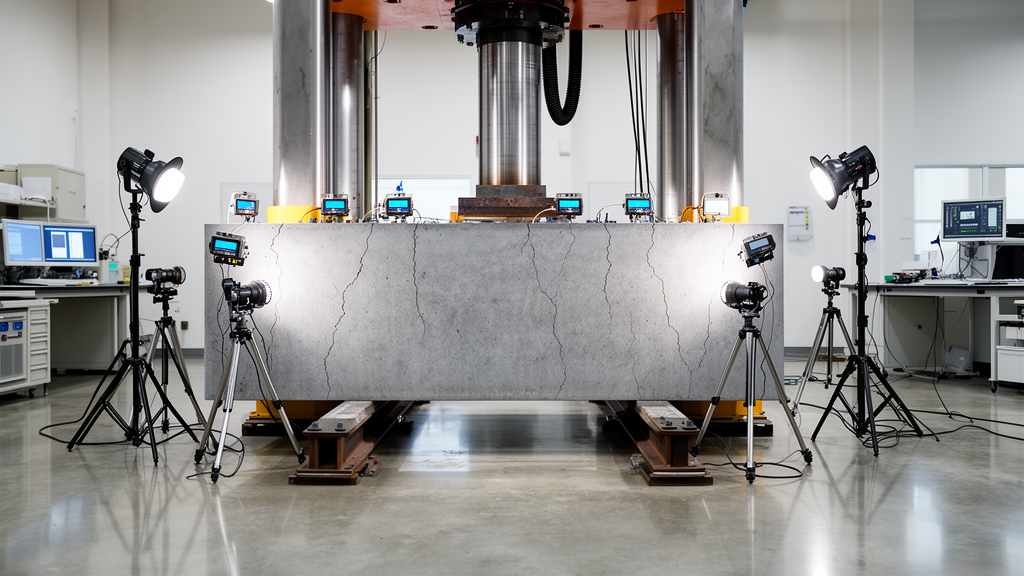
A research team has demonstrated an artificial intelligence framework that couples high-resolution visual inspection with mechanical sensor measurements to detect and grade structural damage in prestressed concrete beams. Published in Advances in Bridge Engineering, the investigation evaluated full-scale beam specimens subjected to progressive monotonic loading in a controlled laboratory environment. The newly cast structural elements were monitored using synchronized four-kilopixel digital cameras alongside dynamic strain gauges and linear variable displacement transducers. Across rigorous specimen-disjoint testing partitions where models were evaluated strictly on unseen structural beams, the primary vision-based detection network achieved a mean average precision at an intersection-over-union threshold of 0.5 of 96.3 percent and a mean intersection over union of 0.82. When surface imagery was fused with time-series mechanical signals, the integrated pipeline achieved an overall damage severity classification accuracy of 94.5 percent and a macro-averaged F1-score of 95.6 percent, providing an automated diagnostic architecture designed to overcome the limitations of conventional manual inspection protocols.
Aging prestressed concrete infrastructure, particularly structural systems incorporating unbonded internal post-tensioning tendons, presents complex engineering challenges that complicate routine condition assessments. Over years of service life, concrete elements experience time-dependent volumetric shrinkage, viscous material creep, and progressive prestress force decay that alter internal stress trajectories and induce subtle geometric camber alterations. These mechanical mechanisms frequently manifest as composite surface cracking patterns, concrete spalling, or delamination along interfaces reinforced with externally bonded carbon fiber-reinforced polymer composites. Traditional structural evaluation protocols rely heavily on manual visual assessments conducted by certified inspectors, which remain labor-intensive, inherently subjective, and prone to error when identifying subvisible micro-cracks or internal load-path anomalies. While embedded physical instrumentation such as strain gauges and vibration accelerometers can identify global stiffness loss, conventional signal-processing techniques frequently struggle with operational noise, environmental temperature drifts, and sparse spatial visibility across extensive structural geometries.
To establish a realistic experimental baseline for structural deterioration, the researchers engineered and tested five full-scale prestressed concrete beams measuring 3.6 meters in length with rectangular cross-sections of 150 millimeters by 300 millimeters. The experimental matrix incorporated diverse reinforcement and rehabilitation configurations to replicate varied damage phenomena observed in civil structures. Beam B1 served as an unstrengthened control specimen to establish natural flexural cracking behavior under monotonic four-point loading. Specimen B2 featured externally bonded carbon-fiber sheets affixed to the tension soffit to examine flexural strengthening and soffit delamination, while specimen B4 incorporated composite side U-wraps targeting shear-critical spans. Beam B3 replicated a rehabilitated member through tendon re-anchoring coupled with localized composite patches to evaluate stress recovery detection. Specimen B5 was configured to induce concurrent, complex failure modes, combining flexural cracking, composite sheet rupture, concrete crushing, and tendon slippage within a single continuous load history.
The experimental data acquisition stack simultaneously recorded surface visual deformation and dynamic mechanical responses through a unified LabVIEW master timebase. Surface visual features were captured at five frames per second using an overhead four-kilopixel industrial video camera with a spatial resolution of 3840 by 2160 pixels, supported by constant artificial illumination to eliminate transient ambient shadows. Concurrently, six resistive foil strain gauges installed along the beam depth and two linear variable displacement transducers positioned at midspan and quarter-span recorded local strains and vertical deflections at a sampling rate of one kilohertz. The testing protocol produced 2,435 native high-resolution image frames containing 4,872 expert-annotated defect instances. The annotated damage instances comprised surface cracking at 43 percent, composite debonding at 27 percent, composite rupture at 12 percent, compressive concrete crushing at 11 percent, and internal tendon anomalies at 7 percent, partitioned strictly by physical specimen into seventy percent training, fifteen percent validation, and fifteen percent testing subsets.
Before feeding images into deep learning architectures, the researchers applied a rigorous preprocessing chain to mitigate projective bias and irregular surface finish artifacts. Raw camera frames underwent radial and tangential lens distortion correction, geometric rectification, and contrast-limited adaptive histogram equalization to ensure consistent photometric responses across concrete surfaces. When necessary, image denoising and single-image super-resolution algorithms were applied to enhance high-frequency micro-crack edges, accompanied by image registration mosaics for extended observation spans. In parallel, time-series sensor signals from displacement transducers and strain gauges were converted via fast Fourier transform to extract dominant spectral frequencies and normalized against sensor-specific standard deviations. To expand training diversity, data augmentation introduced random affine rotations between negative ten and positive ten degrees, photometric color jittering, copy-paste oversampling of thin crack annotations, and synthetic crack textures generated through an adversarial CycleGAN model.
The core computational pipeline uses a selective-compute cascade that balances edge inference speed with hierarchical representational capacity. At the first stage, a lightweight YOLOv8-s object detection network processes rectified image tiles using a backbone composed of C2f blocks, spatial pyramid pooling, and a path aggregation feature pyramid network neck. Rather than passing entire high-resolution frames through computationally heavy attention layers, the decoupled detection head outputs bounding box coordinates, class probabilities, and confidence scores across multi-scale feature strides of 8, 16, and 32 pixels. The proposed bounding box crops are subsequently routed to a Swin Transformer encoder that calculates shifted-window multi-head self-attention across hierarchical stages with embedding dimensions of 96, 192, 384, and 768. This ROI-specific transformer extracts compact latent surface descriptors that capture localized crack sharpness, aperture variation, and fiber debonding boundaries without incurring the prohibitive memory footprint of full-frame global attention models.
For deployment scenarios equipped with physical sensor arrays, the architecture features an optional secondary processing branch designed for time-series feature extraction. Synchronized dynamic strain and displacement segments are fed into a hybrid network comprising one-dimensional convolutional layers for short-term temporal trend extraction followed by multi-layer transformer blocks to capture long-range load-response dependencies. The resulting temporal feature vector is combined with attention-pooled visual descriptors from the Swin Transformer through a modality-aware late-fusion gating mechanism. This attention gate dynamically assigns adaptive weights to the optical and mechanical feature streams, effectively suppressing sensory noise, surface dust, or image motion blur. The concatenated latent vector feeds two final analytical heads: a multi-layer perceptron softmax classifier that assigns discrete damage severity ratings of minor, moderate, or severe, and a continuous regression head configured to estimate structural degradation indices.
In comparative object detection evaluations on the held-out test specimen, the YOLOv8 detector demonstrated superior speed and localization precision over baseline architectures. Achieving an mAP at 0.5 of 96.3 percent, a precision of 94.8 percent, and a recall of 92.3 percent, YOLOv8 markedly outperformed both YOLOv5, which attained 92.1 percent mAP, and Faster R-CNN, which recorded 91.6 percent mAP. YOLOv8 achieved an average inference latency of 9.5 milliseconds per image, operating more than six times faster than Faster R-CNN at 60.1 milliseconds while maintaining an average intersection over union of 0.82 compared to 0.76 for Faster R-CNN. Class-specific breakdowns revealed robust localization across complex structural anomalies, with concrete crushing attaining the highest spatial intersection over union of 0.85, surface cracking exceeding 0.80, and tendon anomalies achieving 95.6 percent precision, although subtle visual cues limited tendon anomaly recall to 88.5 percent.
Evaluations of damage severity classification revealed substantial performance gains from hierarchical attention modeling and multimodal sensor fusion. Operating strictly on visual image crops, the fine-tuned Swin Transformer achieved an overall classification accuracy of 90.7 percent, a macro-averaged F1-score of 93.1 percent, and an area under the receiver operating characteristic curve of 0.941, surpassing standard vision transformers at 89.2 percent F1-score and convolutional ResNet50 models at 82.7 percent F1-score. Gradient-weighted class activation mapping confirmed that the Swin model consistently concentrated attention on domain-relevant structural cues, specifically crack tip singularity zones, composite delamination fronts, and anchorage boundary distress. Integrating the mechanical sensor branch through multimodal fusion further elevated overall classification accuracy to 94.5 percent and macro F1-score to 95.6 percent, with receiver operating characteristic area reaching 0.972. Sensor ablation experiments confirmed that while standalone strain sensors provided a modest 0.9 percent accuracy increase, displacement measurements contributed an additional 1.4 percent gain, and full multi-sensor fusion yielded a 3.8 percent cumulative improvement over vision-only baselines.
Despite these favorable laboratory findings, the authors emphasized critical methodological boundaries and practical operational constraints governing the interpretation of their results. The entire experimental dataset was derived from a single laboratory campaign utilizing newly cast concrete beams tested under short-term monotonic loading. Consequently, the specimens did not exhibit the complex chemo-physical degradation mechanisms typical of real-world infrastructure, such as chloride-induced rebar corrosion, alkali-silica reactions, carbonation embrittlement, freeze-thaw spalling, or decadal creep-shrinkage prestress relaxation. Furthermore, the synchronized high-precision strain gauges and displacement transducers utilized in the laboratory setup are rarely pre-installed on existing highway bridges or commercial structures. To address this limitation, the authors emphasized that the vision module is designed to function as an independent, standalone edge-triage tool capable of running at 8 to 15 frames per second on portable rugged laptops, treating dynamic sensor fusion as an optional diagnostic upgrade for specialized infrastructure assets.
Subject of Research: Multimodal deep learning framework for structural defect localization and severity classification in prestressed concrete beams
Article Title: AI-based damage detection in prestressed concrete beams: a vision-integrated deep learning framework for crack localization and severity classification
Article References: Nguyen, T. Q., Phan-Vu, P., & Nguyen, P. T. (2026). AI-based damage detection in prestressed concrete beams: a vision-integrated deep learning framework for crack localization and severity classification. Advances in Bridge Engineering, 7(1), Article 6. https://doi.org/10.1186/s43251-025-00194-0
Image Credits: AI Generated
DOI: 10.1186/s43251-025-00194-0
Keywords: prestressed concrete, structural health monitoring, deep learning, YOLOv8, Swin Transformer, sensor fusion, crack localization, FRP debonding, tendon anomaly, concrete crushing, strain measurements, displacement transducers, damage severity classification, computer vision, infrastructure inspection, convolutional neural networks, modal analysis
News Source: Blake Davidson. (November 13, 2026). Multimodal AI Detects Prestressed Concrete Beam Defects in Controlled Laboratory Tests. Scienmag.