Researchers in China have developed a compact automated liquid exchange system called MAPLES to address one of the most variable and labor-intensive stages of super-resolution optical microscopy. Every high-resolution fluorescence image depends on an exacting sequence of manual pipetting steps, including cell fixation, blocking, antibody application, and repeated washing cycles. In high-precision techniques, any irregularity during these preparation phases can generate visible artifacts, causing physical flaws such as membrane creases to become indistinguishable from genuine biological structures in the finished image. To standardize this process, the team engineered a device roughly the size of a thick book capable of executing delicate sample-preparation protocols with minimal human intervention.
Published in the journal The Innovation, the experimental study evaluates the Multi-Channel Automated Programmable Liquid Exchange System, or MAPLES, which measures 19 by 17 by 7 centimetres and weighs 1.6 kilograms. Conventional super-resolution sample preparation has historically relied either on meticulous manual pipetting, which remains slow and heavily operator-dependent, or on commercial robotic autostainers that carry high purchase costs. Meanwhile, lower-cost open-source rigs typically either force different reagents to share fluidic tubing—raising the risk of cross-contamination—or require a separate dedicated pump for each individual liquid channel.
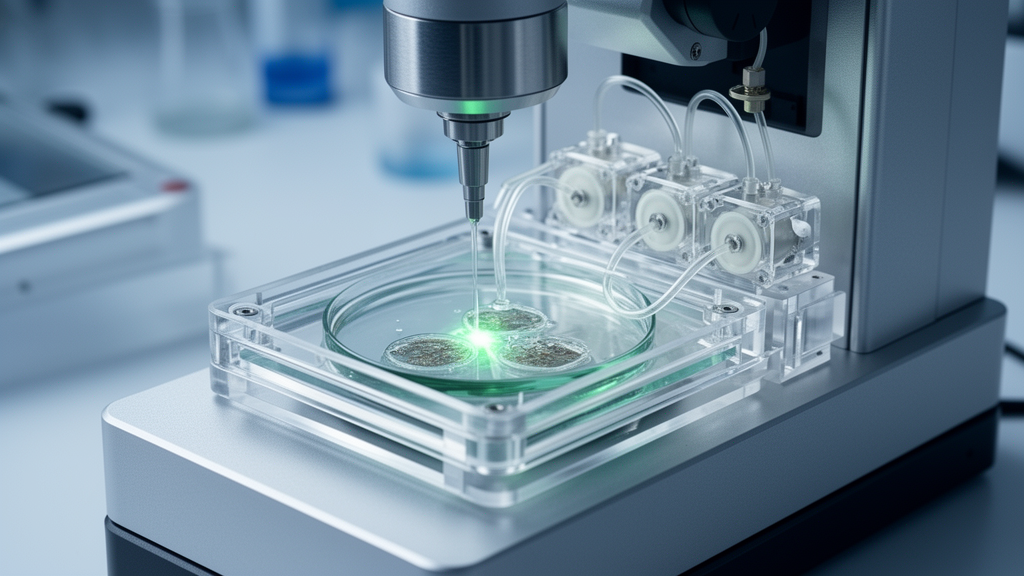
MAPLES sidesteps these mechanical trade-offs by utilizing two peristaltic pumps paired with an eight-channel solenoid valve block to direct fluid movement. In this architecture, each reagent is stored in its own disposable syringe and dispensed via air pressure rather than flowing through shared liquid supply lines. The design incorporates a deliberate air gap above the sample bath to isolate reagents and eliminate carry-over contamination between sequential steps. To accommodate different laboratory experimental setups, the compact system features interchangeable stage adapters compatible with standard glass coverslips, confocal dishes, and conventional microscope slides.
Quantitative evaluations demonstrated that the platform delivers consistent fluidic performance with low volumetric error. Across dispensing trials at 500 microlitres, liquid delivery error remained approximately 3 percent and stayed reliably within that 3 percent margin across ten consecutive washing cycles. Fluidic dead volume held between 7 and 12 microlitres, an essential efficiency metric given the high cost and limited quantities of specialized antibody reagents. The platform’s waste removal mechanism leaves less than 4 percent of residual fluid behind after aspiration, meaning that three successive rinses reduce residual reagent concentration to just 0.0064 percent.
The system was tested under demanding conditions using human red blood cells, which lack internal organelles and possess delicate plasma membranes that easily rupture during violent fluid motion. The cells successfully withstood 12 continuous automated rinse cycles delivered at a flow rate of 1,000 microlitres per minute without detaching or lysing. Following this rigorous wash procedure, stochastic optical reconstruction microscopy—an advanced super-resolution technique known as STORM that resolves features separated by approximately 20 nanometres using fluorescent antibodies on fixed cells—resolved the membrane-skeleton protein tropomodulin into approximately 70 clusters per square micrometre spaced roughly 80 nanometres apart, accurately recovering the expected hexagonal lattice of the erythrocyte cytoskeleton.
In a dynamic demonstration running from living cells directly into fixed states, researchers used MAPLES to monitor real-time protein redistribution in breast cancer cells. Applying a bivalent secondary antibody crosslinked the immune-checkpoint protein PD-L1, with time-lapse microscopy tracking its reorganization into discrete surface patches within 40 minutes. The cells were then immediately fixed and fluorescently stained in place inside the device chamber. Post-fixation STORM analysis revealed that blinking events per cluster increased from 13.8 to 127.4 while overall cluster density decreased from 8.3 to 0.6 per square micrometre. In a related experiment, cells were filmed during calcium influx through store-operated channels, fixed precisely at the signal peak, and stained to quantify STIM1 puncta in the exact cells filmed live.
The authors outlined several clear boundaries regarding the current experimental scope and operational parameters of the MAPLES platform. The comparative benchmarks reported in the study rely on published instrument specifications rather than head-to-head empirical testing against rival automated platforms. Additionally, the device processes one sample at a time per unit, though multiple units can be operated simultaneously in parallel arrangements to increase throughput. The present validation is restricted to a small number of cultured cell types and a single tissue protocol. Ultimately, underlying biological parameters such as fixation chemistry, antibody specificity, and buffer formulations still govern whether an acquired image achieves high scientific quality.
By transforming an exhausting multi-hour manual workflow into an automated programmable protocol, MAPLES demonstrates that liquid exchange can be executed uniformly across experiments and between different laboratories. While the physical chemistry of the staining reagents remains decisive, automating fluidic delivery removes the significant operational variability introduced by manual pipetting, establishing a repeatable baseline for super-resolution microscopy sample preparation.
Subject of Research: Automated liquid exchange system for super-resolution microscopy sample preparation
Article Title: A book-sized robot takes over the washing that decides whether a super-resolution image is real
Article References: A book-sized robot takes over the washing that decides whether a super-resolution image is real. Original publication (Bibliographic details unavailable.)
Image Credits: AI Generated
DOI: Not provided
Keywords: super-resolution microscopy, MAPLES, sample preparation, STORM, immunofluorescence, liquid exchange, laboratory automation, fluorescence microscopy, peristaltic pumps, solenoid valves, red blood cells, tropomodulin, PD-L1, STIM1, The Innovation, biochemical washing, microfluidics
News Source: Drew Townsend. (November 13, 2026). Compact Automated Liquid Exchange System Standardizes Immunofluorescence Washing for Super-Resolution Microscopy. Scienmag.