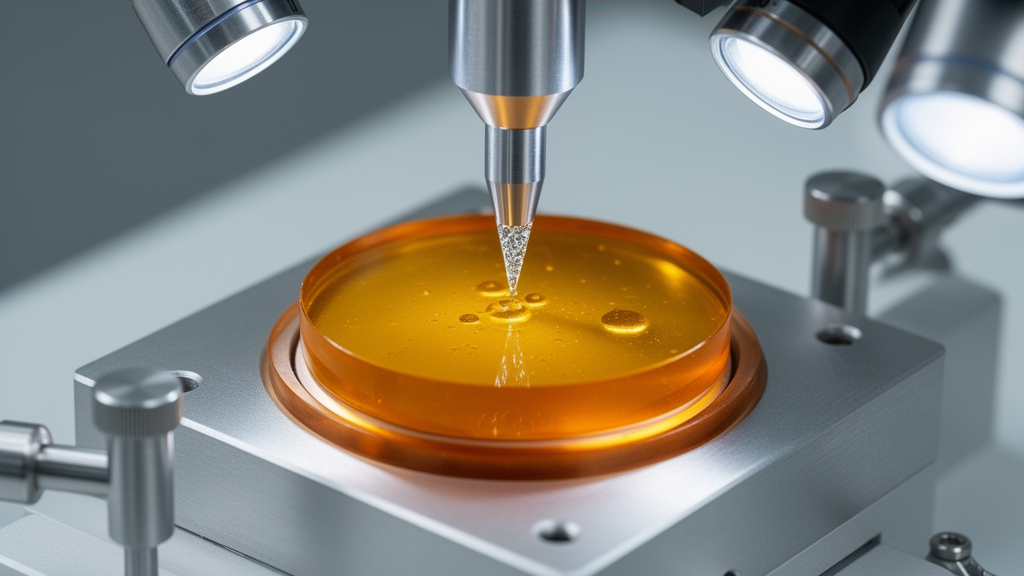
Researchers have demonstrated that measuring the glass transition temperature of epoxy resin using three distinct testing methods on a single nanomechanical test instrument yields practically identical values of approximately 50 degrees Celsius. Published in Discover Polymers, the experimental study conducted by Yuanbin Qin, Zhen Wang, Chao Ma, Qinqin Fu, Pengcheng Zhang, and Xiaohua Cheng applied thermal dilation analysis, dynamic mechanical analysis, and thermomechanical analysis within the same hardware platform. By executing all three characterization techniques on the same instrument at the microscale, the research team directly eliminated the calibration discrepancies and inter-instrument temperature errors that have historically generated conflicting thermal data for identical polymeric materials.
The glass transition temperature, denoted as Tg, represents the critical temperature region where an amorphous polymer transitions from a rigid, glassy state into a compliant, rubbery state. Because this transition governs polymer stability under light, heat, and mechanical stress, Tg serves as the primary descriptor dictating maximum service temperature in engineering applications. Epoxy resin in particular is foundational to modern microelectronics, where it encapsulates more than 90 percent of industrial and civil integrated circuits due to its processing ease, low cost, favorable dielectric properties, minimal shrinkage, chemical corrosion resistance, adhesive strength, and electrical insulation. Accurately determining and comparing the Tg of epoxy formulations is therefore vital for ensuring reliable device operation in demanding operational environments.
Despite its technical importance, measuring Tg has historically been plagued by substantial data scatter across different testing laboratories and methodologies. Standard evaluation procedures—including differential scanning calorimetry, differential thermal analysis, thermomechanical analysis, dynamic mechanical analysis, and thermal dilation analysis—regularly yield divergent results for the exact same substance. In previously published literature, an identical epoxy composition exhibited measured transition temperatures of 125.81 degrees Celsius by differential scanning calorimetry, 146.47 degrees Celsius by thermomechanical analysis, and 156.76 degrees Celsius by dynamic mechanical analysis. These large discrepancies, which frequently span tens of degrees, stem from variations in specimen dimensions, heating rates, operational test conditions, differing mathematical definitions of the transition point, and systematic temperature calibration offsets between separate instruments.
To overcome these inter-instrument errors, the researchers developed an integrated microscale testing protocol using a Hysitron TI-950 TriboIndenter platform equipped with an xSol 800 environmental heating stage. Specimen preparation began with an EpoFix Kit epoxy resin and hardener mixed at a certified weight ratio of 25 to 3. The uncured mixture was degassed in a vacuum tank for more than 12 hours at room temperature to eliminate entrapped air bubbles. For comparison against macroscopic thermal benchmarks, baseline thermal behavior was evaluated using a METTLER TOLEDO DSC 5+ differential scanning calorimeter programmed with a standard heating rate of 10 degrees Celsius per minute under a continuous nitrogen atmosphere.
Specimen geometries were tailored to meet the specific mechanical and thermal requirements of each characterization technique. For thermal dilation analysis, the cured epoxy was mechanically shaped into a wedge profile featuring a maximum height of approximately 2 millimeters, a minimum height of 0.5 millimeters, a length of 10 millimeters, and a width of 5 millimeters. This wedge specimen was heated to 100 degrees Celsius and cooled slowly to room temperature to alleviate internal residual stresses generated during machining. For dynamic mechanical analysis and thermomechanical analysis, the epoxy was prepared into rectangular cuboids measuring 10 millimeters in length, 5 millimeters in width, and 1 millimeter in thickness.
Thermal dilation analysis was conducted by outfitting the TriboIndenter with a nanoDMA transducer and a Berkovich diamond indenter probe, monitoring localized thermal expansion across an effective microscale dimension of roughly 0.1 millimeters. The protocol employed a dynamic creep testing method that superimposed a 220-hertz oscillation onto a quasi-static load function. To accommodate dramatic modulus variations across the transition while remaining within the transducer displacement limits, testing was split into three consecutive thermal stages: a 10-millinewton peak load held for 120 seconds between 30 and 40 degrees Celsius, an 8-millinewton load held for 120 seconds between 40 and 50 degrees Celsius, and a 4-millinewton load held for 60 seconds between 50 and 55 degrees Celsius, each applying a steady heating rate of 5 degrees Celsius per minute.
The resulting thermal dilation data revealed a sharp inflection in surface expansion and its first derivative at 50.7 degrees Celsius, identifying the precise onset of the glass transition. Below this point, linear fitting between 31 and 51 degrees Celsius established a glassy thermal expansion coefficient of (243.6 ± 0.2) × 10⁻⁶ per degree Celsius, which expanded to (782.9 ± 0.8) × 10⁻⁶ per degree Celsius between 51 and 54 degrees Celsius in the rubbery regime. At approximately 54.4 degrees Celsius, an apparent dimensional shrinkage occurred where time-dependent material creep matched and subsequently surpassed the rate of thermal expansion. Minor kinks recorded at 30 and 40 degrees Celsius reflected transient thermal equilibration delays at the initiation of successive measurement segments.
For microscale dynamic mechanical analysis, the instrument executed frequency sweeps from 1 to 200 hertz at incremental temperature steps between 30 and 105 degrees Celsius. Modulating the peak indentation load between 10 millinewtons at 30 degrees Celsius and 3 millinewtons at 50 degrees Celsius maintained indentation depths at approximately 1 micrometer, well below the 2-micrometer threshold where interaction volume remains confined to the microscale. By recording displacement amplitudes and phase lags, the system derived the temperature-dependent storage modulus, loss modulus, and tan delta dissipation curves across the entire thermal spectrum.
The dynamic mechanical results illustrated why definition selection is critical when comparing viscoelastic data to thermomechanical metrics. Evaluated at a baseline testing frequency of 1 hertz, the epoxy storage modulus was approximately 5 gigapascals at 30 degrees Celsius before exhibiting a sharp decrease near 50 degrees Celsius. Identifying the extrapolated onset of this storage modulus drop yielded a Tg of 48.9 degrees Celsius, aligning within two degrees of the thermal dilation measurement. Conversely, the loss modulus exhibited experimental fluctuations that precluded accurate peak identification, while the tan delta damping peak reached 82 degrees Celsius. When testing at 200 hertz, the viscoelastic response exhibited greater experimental noise and shifted to higher temperatures, demonstrating the inherent rate dependence of polymer chain relaxation.
Thermomechanical analysis performed on the same platform tracked probe penetration into the epoxy under a constant 10-millinewton load applied for 360 seconds while heating from 30 to 60 degrees Celsius at 5 degrees Celsius per minute. Initial displacement revealed a slight peak at 30.4 degrees Celsius as primary creep progressed under sustained force, followed by upward surface displacement as thermal expansion pushed back against the probe. A sharp downward deflection marking the glass transition emerged at 50.1 degrees Celsius, followed by an inflection valley at 53.8 degrees Celsius where rubbery softening accelerated indentation creep. This valley occurred slightly lower than the 54.4-degree dilation peak due to the higher stress induced by the 10-millinewton static load compared to the 4-millinewton load used in dilation testing.
Cross-comparison of the experimental datasets confirms that disparate nanomechanical techniques converge on a single, coherent glass transition temperature of approximately 50 degrees Celsius when variables are systematically aligned. Achieving this harmony required applying a controlled heating rate of 5 degrees Celsius per minute during dilation and penetration testing, choosing a representative 1-hertz excitation frequency for dynamic measurements, defining the transition consistently as the onset of storage modulus degradation, and maintaining localized microscale interaction depths. By executing every procedure on a unified platform with identical stage sensors, the investigation eliminated the inter-instrument temperature discrepancies that traditionally obscure polymer properties.
The authors noted specific experimental boundary conditions and limitations that govern the nanomechanical approach. Additionally, because the three testing modes probe localized microscale regions rather than bulk volumes, the technique cannot be directly applied to heterogeneous polymers or composites loaded with macroscopic fillers without extensive multi-point spatial averaging. Finally, the finite load sensitivities and displacement windows of nanomechanical transducers inherently restrict the protocol to rigid or semi-rigid polymers, limiting its direct utility for exceptionally soft elastomers.
Subject of Research: Nanomechanical measurement and consistency of epoxy resin glass transition temperature across multiple test methods
Article Title: Consistent glass transition temperature of epoxy resin by three different test methods on the same nanomechanical test instrument
Article References: Qin, Y., Wang, Z., Ma, C., Fu, Q., Zhang, P., & Cheng, X. (2025). Consistent glass transition temperature of epoxy resin by three different test methods on the same nanomechanical test instrument. Discover Polymers, 2(1), Article 15. https://doi.org/10.1007/s44347-025-00028-2
Image Credits: AI Generated
DOI: 10.1007/s44347-025-00028-2
Keywords: epoxy resin, glass transition temperature, nanomechanical testing, thermal dilation analysis, dynamic mechanical analysis, thermomechanical analysis, polymer characterization, Discover Polymers, Consistent, glass, transition, temperature
News Source: Bethany Barker. (November 13, 2026). Nanomechanical Testing Resolves Longstanding Epoxy Resin Glass Transition Temperature Discrepancies. Scienmag.