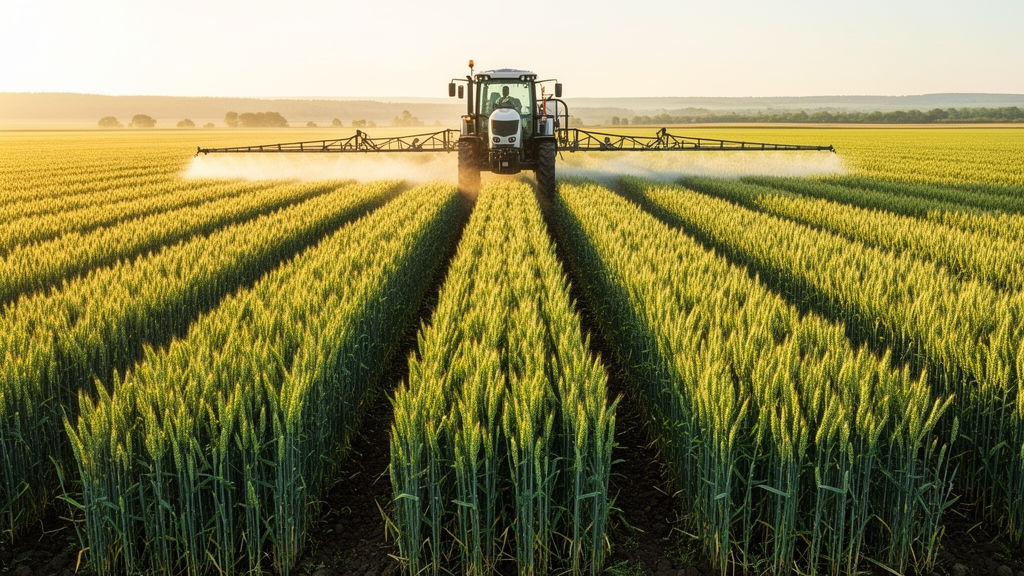
A two-year field study indicates that synchronizing nitrogen supply with crop demand by delaying and reducing fertilizer topdressing sustains grain yield while significantly improving nitrogen use efficiency in wheat. Traditional wheat farming practices frequently rely on excessive nitrogen fertilization, leading to low nitrogen use efficiency and heightened environmental risks. While earlier research recognized that splitting or postponing nitrogen applications could benefit crop production, whether nitrogen inputs could be lowered without penalizing grain yield remained uncertain.
To evaluate how altered nitrogen timing and application rates influence productivity, researchers conducted field experiments across the 2022 and 2023 growing seasons. The field trials assessed seven specific nitrogen fertilizer treatments, comprising a conventional management approach, a basal-only application, an unfertilized control, a postponed split application, and three postponed regimens featuring reduced rates. The conventional regime applied basal nitrogen alongside topdressing at both the three-leaf and seven-leaf growth stages, establishing the standard baseline for comparison.
The experimental postponed treatments delayed topdressing events until the five-leaf and eight-leaf developmental stages to align with plant demand. Among the reduced strategies, one regimen supplied basal nitrogen combined with half-rate nitrogen at the five-leaf stage and full nitrogen at the eight-leaf stage, representing an overall twenty percent reduction in total nitrogen. Two other experimental treatments modified basal levels by applying either half or zero basal nitrogen alongside identical postponed topdressing schedules.
Agronomic performance varied markedly among the fertilization regimes across both years of monitoring. The zero-nitrogen control and the basal-only application significantly decreased grain yield, total tiller production, effective spike counts, and grain quality measurements. Conversely, delaying topdressing to the five-leaf and eight-leaf stages maintained yields regardless of whether nitrogen quantities were applied at full rates or under reduced inputs.
Among all tested approaches, the treatment delivering basal fertilizer, a half dose at the five-leaf stage, and a full dose at the eight-leaf stage attained the highest grain yield, slightly exceeding conventional management in both growing seasons. In 2023, this twenty percent reduced treatment decreased total tiller counts from 1060 × 104 per hectare in the conventional treatment to 780 × 104 per hectare, while maintaining comparable effective spike numbers, raising the effective spike proportion from 40 percent to 51 percent.
Spike morphology and grain formation also showed marked improvements under this postponed-reduced topdressing regime. During the 2022 growing season, the treatment reduced degenerated spikelets per spike from 3.6 under conventional management to 3.1, while total spikelet numbers remained stable at approximately 23 per spike. This structural preservation increased the final grain count from 40.3 to 46.8 grains per spike. Furthermore, grain filling improved substantially, yielding an average thousand-grain weight of 41.4 grams compared to 38.2 grams under conventional topdressing, which drove a significant increase in agronomic nitrogen use efficiency.
Grain processing and nutritional parameters exhibited distinct responses across the fertilization schedules. The postponed full-rate treatment preserved grain quality characteristics without notable divergence from conventional practices. Postponed-reduced treatments maintained flour yield and bulk density but exhibited decreases in dough stability time, formation time, settlement value, grain protein content, wet gluten content, and hardness values.
Overall, the experimental findings demonstrate that precision scheduling combining delayed topdressing with reduced nitrogen application stabilizes wheat grain yield and enhances agronomic efficiency. By curbing unproductive tillers, reducing spikelet degeneration, and supporting grain filling weight, this fertilizer strategy optimizes wheat reproductive development while curtailing unnecessary fertilizer inputs.
Subject of Research: Optimizing nitrogen fertilizer scheduling and application rates in wheat production
Article Title: Synchronizing nitrogen supply with crop demand through postponed and reduced topdressing improves nitrogen use efficiency and maintains yield in wheat
Article References: Ding, M., Liu, J., Bi, L., Li, S., Yin, J., Wang, J., Yang, Z., Tang, X., Li, H., Zhang, C., Guo, C., Liu, K., & Jiang, B. (2026). Synchronizing nitrogen supply with crop demand through postponed and reduced topdressing improves nitrogen use efficiency and maintains yield in wheat. BMC Plant Biology. https://doi.org/10.1186/s12870-026-10367-2
Image Credits: AI Generated
DOI: 10.1186/s12870-026-10367-2
Keywords: wheat productivity, nitrogen use efficiency, nitrogen topdressing, tiller quality, effective spikes, spikelet degeneration, thousand-grain weight, fertilizer management, agronomic efficiency, grain yield, field experiment, crop demand synchronization, grain quality, precision agriculture, wheat cultivation, leaf stage application
News Source: Alan Morgan. (November 13, 2026). Postponed and Reduced Nitrogen Topdressing Boosts Efficiency and Sustains Wheat Yield. Scienmag.