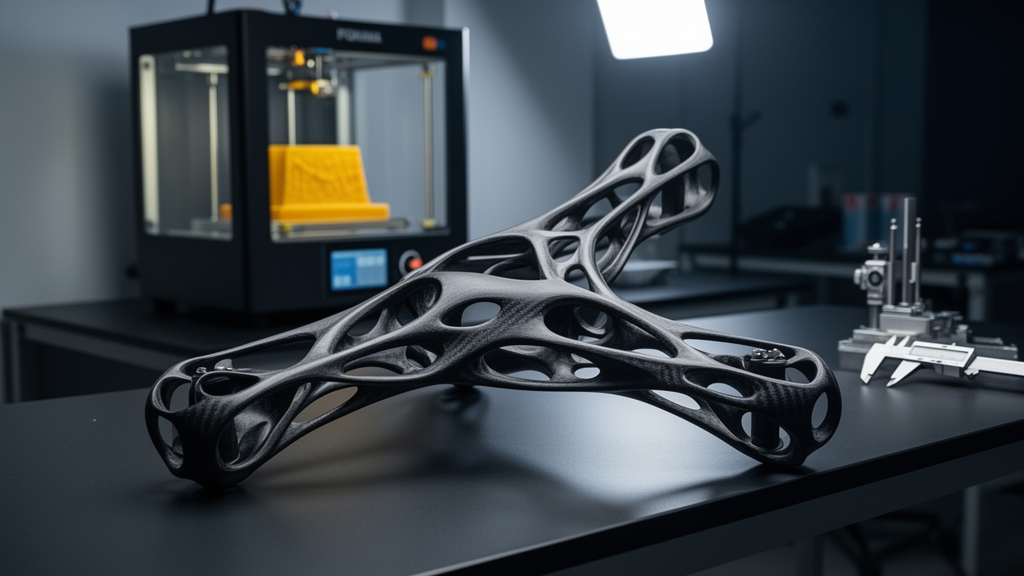
By integrating experimental modal testing, finite element analysis, and machine learning techniques, the study identified geometric configurations that significantly improve the dynamic performance and structural reliability of these lightweight components. The study, published in Discover Mechanical Engineering, demonstrates that the physical geometry of the arm’s cross-section is far more critical to vibration resistance than the internal density of the printed lattice structure.
The investigation focused on the dynamic behavior of quadcopter arms, which are central structural elements that hold the motors and bear continuous propulsion loads. Excessive vibration in these components can increase structural loads and reduce the service life of the drone. The research team aimed to evaluate how variations in thickness, internal infill architecture, and perforation geometry affect the vibration characteristics of additively manufactured arms. To achieve this, they fabricated 27 distinct specimens using fused deposition modeling (FDM) with a gyroid infill structure, a geometry chosen for its ability to distribute load evenly and provide structural stability under dynamic conditions.
The experimental design utilized a Taguchi L27 orthogonal array to systematically vary three parameters: arm thickness, horizontal spacing between perforations, and infill density. Each parameter was tested at three levels: thickness at 8, 10, and 12 millimeters; horizontal spacing at 3, 6.5, and 10 millimeters; and infill density at 20%, 35%, and 50%. This full factorial design allowed the researchers to isolate the individual and interactive effects of these variables on the arm’s vibrational performance. The material used was PLA-CF containing 10% by weight of carbon fibers, fabricated using fused deposition modeling.
To assess the vibration characteristics, the team employed both experimental and numerical methods. Experimentally, each of the 27 specimens was subjected to impact hammer testing using a Dewesoft 8-Channel FFT Analyzer. This setup allowed for the precise measurement of natural frequencies and mode shapes by exciting the arms at varied frequencies and recording the resulting acceleration signals. Numerically, the team used ANSYS Workbench to perform finite element analysis, including static structural, modal, harmonic response, and transient structural analyses. A mesh independence study confirmed that the numerical results were not sensitive to discretization, with a global element size of 1.0 millimeter providing a converged solution.
The analysis of variance (ANOVA) revealed that arm thickness was the dominant factor influencing both the fundamental natural frequency and dynamic stress. Thickness accounted for 84.7% of the variation in fundamental frequency and 84.9% of the variation in dynamic stress. Horizontal perforation spacing was the second most significant factor, contributing 9.2% to frequency variation and 4.1% to stress variation. In contrast, infill density had a statistically insignificant effect on both responses, accounting for only 1.4% of frequency variation and 0.3% of stress variation. This finding suggests that designers can reduce infill density to save mass and print time without materially degrading the vibrational performance of the arm.
To predict the optimal design, the researchers developed a support vector regression (SVR) surrogate model. This machine learning approach was selected for its ability to handle small datasets effectively, avoiding the overfitting issues common in neural networks with limited observations. The SVR model was trained on the experimental data and tuned using exhaustive grid search under leave-one-out cross-validation. The resulting model achieved a high predictive accuracy, with a cross-validated coefficient of determination (R2) of 0.943 for frequency and 0.924 for dynamic stress. This high accuracy indicates that the surrogate model reliably captures the relationship between the design parameters and the vibrational responses.
The surrogate model was coupled with a differential evolution optimizer to identify the best configuration within the tested design space. The optimization was subject to a hard constraint that the predicted fundamental frequency must exceed the motor excitation frequency of 703 Hz to avoid resonance. The optimizer identified an optimal configuration with a thickness of 12.00 millimeters, a horizontal perforation spacing of 10.00 millimeters, and an infill density of 20%. This configuration predicted a fundamental frequency of 923.27 Hz and a dynamic stress of 9.1372 MPa. The optimum lies at the boundary of the design space, driven by the fact that increasing thickness raises stiffness faster than it raises mass, thereby increasing frequency while reducing stress.
A key validation of the study is that the optimal configuration coincides with specimen DA25, which was physically fabricated and tested. The measured fundamental frequency for this specimen was 922.77 Hz, and the computed dynamic stress was 9.1475 MPa. The surrogate predictions deviated from these experimental values by only 0.05% in frequency and 0.11% in stress. This close agreement provides direct physical validation of the optimization framework, confirming that the machine learning model accurately predicts the behavior of real-world components. The optimized design exceeds the motor excitation frequency by 31.3%, providing a substantial margin against resonance during operation.
The structural integrity of the optimized arm was also verified using Rankine’s maximum principal stress criterion. The analysis confirmed a minimum factor of safety of 2.14 across all 27 configurations, with the optimized design achieving a factor of safety of 4.15 against the in-plane tensile strength of PLA-CF. This indicates that the design is not only vibrationally efficient but also structurally robust under the applied dynamic loads.
The study acknowledges several limitations that must be considered when interpreting the results. First, the findings are specific to PLA-CF with 10% carbon fiber reinforcement and may not transfer directly to other material systems. Second, all testing was conducted under ambient laboratory conditions, and the resonance margin identified is an ambient-temperature figure. Since PLA has a glass transition temperature around 60 degrees Celsius, sustained motor operation in hot environments could reduce the elastic modulus and natural frequencies. Third, the study focused on short-duration impact excitation and did not include fatigue or long-term vibration testing, which is critical for assessing the durability of additively manufactured polymer composites under cyclic loading.
Furthermore, the validation was performed on isolated arms under laboratory boundary conditions, rather than under real flight-operating conditions. In service, the arm is coupled to the central frame and motor assembly, experiencing broadband aerodynamic excitation and gyroscopic effects that were not captured in the isolated tests. The surrogate model is also an interpolant valid only within the sampled ranges of the design parameters. The optimal design lies on the boundary of this region, suggesting that further improvements might be possible at thicknesses above 12 millimeters, although this would incur a mass penalty that was not included in the objective function.
Despite these limitations, the study provides a valuable methodology for the design of lightweight UAV structural components. By combining experimental testing, finite element analysis, and machine learning, the researchers demonstrated an efficient and physically verifiable route to optimizing dynamic behavior. The findings highlight the importance of geometric parameters over internal lattice density in determining the vibration characteristics of perforated drone arms.
Subject of Research: Optimization of vibration behavior of carbon fibre reinforced polylactic acid based drone quadcopter arms using ANOVA and support vector regression algorithm
Article Title: Optimization of vibration behavior of carbon fibre reinforced polylactic acid based drone quadcopter arms using ANOVA and support vector regression algorithm
Article References: Chandan, R., Chiranth, D. M., Manukishor, P., Kotturshettar, P., Bharatish, A., & Solaiachari, S. (2026). Optimization of vibration behavior of carbon fibre reinforced polylactic acid based drone quadcopter arms using ANOVA and support vector regression algorithm. Discover Mechanical Engineering, 5(1), Article 181. https://doi.org/10.1007/s44245-026-00374-w
Image Credits: AI Generated
DOI: 10.1007/s44245-026-00374-w
Keywords: Optimization, vibration, behavior, carbon, fibre, reinforced, polylactic, acid, based, drone, quadcopter, arms
News Source: Teresa Odom. (November 13, 2026). 3D-Printed Drone Arms Optimized via Machine Learning. Scienmag.