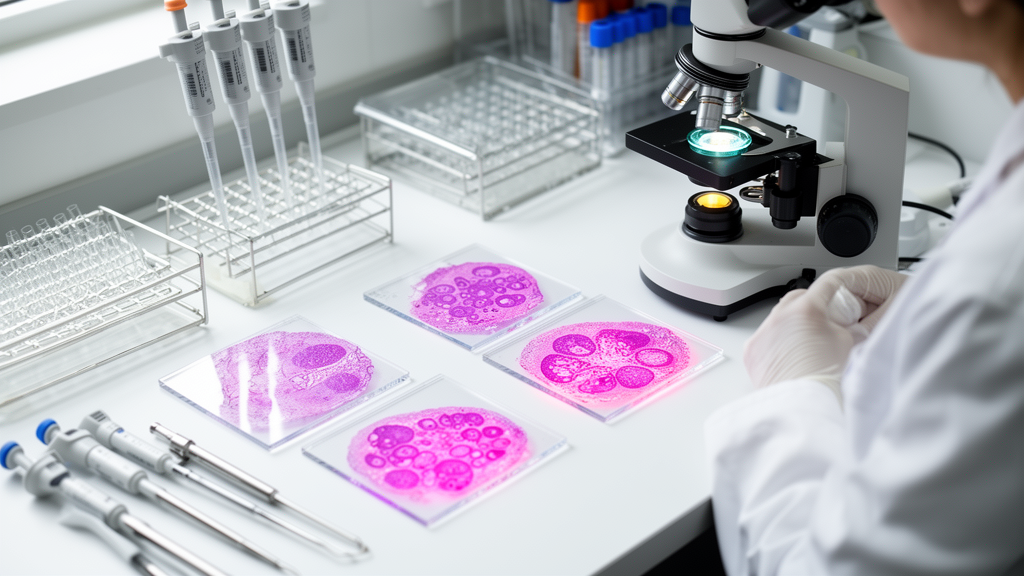
In current pathological workflows, immunohistochemistry serves as the primary screening tool; however, tumors demonstrating an equivocal 2+ staining pattern invariably necessitate secondary reflex testing via in situ hybridization.
To investigate whether automated image analysis could help resolve these ambiguous clinical classifications, an investigative team evaluated the uPath HER2 (4B5) algorithm across two distinct clinical patient series. The researchers examined cases of invasive breast cancer that had been assigned an equivocal HER2 2+ score by human pathologists, subsequently re-scoring the tissue sections using the digital tool while remaining blinded to the underlying in situ hybridization reference standards. The proof-of-concept investigation aimed to determine whether artificial intelligence assistance could reliably separate true gene amplification from non-amplified status within this challenging diagnostic category.
The study protocol evaluated two cohorts structured to assess algorithmic performance under both controlled and real-world conditions. The first group consisted of a retrospective discovery cohort comprising 100 enriched cases balanced evenly between 50 in situ hybridization-amplified and 50 non-amplified specimens. The second group represented a routine-practice validation cohort containing 47 consecutive cases designed to reflect the natural prevalence of HER2 amplification encountered in routine diagnostic pathology. In structuring the analysis according to STARD and CLAIM reporting guidelines, the authors established complete confusion matrices and exact Clopper–Pearson 95% confidence intervals.
For the primary analytical framework, the investigators established an algorithmic score of uPath HER2 3+ as the positive threshold, classifying outputs of 1+ and 2+ as non-positive. Overall quantitative measurements revealed that algorithmic scoring outputs were significantly higher in confirmed in situ hybridization-amplified cases than in non-amplified counterparts, demonstrating a statistically significant divergence with a p-value of less than 0.0001 across the examined series.
Within the retrospective discovery cohort of 100 samples, the automated system re-classified 45 cases as 3+, of which 35 were confirmed to be amplified by in situ hybridization while 10 were non-amplified. This distribution resulted in a sensitivity of 70.0 percent and a specificity of 80.0 percent under the primary analytical threshold. These preliminary metrics indicated that the algorithm concentrated true gene-amplified specimens, although a notable proportion of amplified tumors failed to meet the positive cut-off, and several non-amplified cases were re-scored positively.
When the computational tool was deployed on the consecutive validation cohort representing regular clinical prevalence, its operational profile shifted noticeably. Among the 47 consecutive routine-practice specimens, the uPath platform re-scored only 4 cases, or 8.5 percent of the cohort, as 3+. Confirmatory testing showed that two of these four cases were amplified and two were non-amplified. Consequently, the primary analysis within the validation set yielded an overall sensitivity of 25.0 percent paired with an elevated specificity of 94.9 percent.
The researchers also carried out a secondary exploratory analysis that eliminated equivocal algorithm outputs by completely excluding HER2 2+ calls. When restricted to non-equivocal outcomes with 2+ cases excluded, the secondary exploratory analysis reached 100 percent sensitivity but only 9 percent specificity.
The authors concluded that while an off-the-shelf immunohistochemistry algorithm demonstrably enriches for HER2 gene amplification among equivocal 2+ breast cancer cases, its current diagnostic reliability remains insufficient to replace or eliminate mandatory confirmatory testing via in situ hybridization. These initial proof-of-concept findings highlight the prospective utility of pairing pathologist assessments with purpose-trained artificial intelligence tools, while establishing that extensive prospective and multicenter validation remains mandatory before any implementation into live clinical workflows can be considered.
Subject of Research: Diagnostic performance of an automated immunohistochemistry algorithm in equivocal HER2 breast cancer
Article Title: AI-assisted immunohistochemistry algorithm for enriching HER2-amplified cases among equivocal (2+) breast cancers: a two-cohort proof-of-concept study
Article References: Maniewski, M., Borowczak, J., Durślewicz, J., Andrusewicz, H., Dzierżawski, J., Starzyński, J., Chudzińska, P., Kowalewski, A., & Szylberg, Ł. (2026). AI-assisted immunohistochemistry algorithm for enriching HER2-amplified cases among equivocal (2+) breast cancers: a two-cohort proof-of-concept study. BMC Cancer. https://doi.org/10.1186/s12885-026-17198-2
Image Credits: AI Generated
DOI: 10.1186/s12885-026-17198-2
Keywords: breast cancer, HER2, immunohistochemistry, in situ hybridization, uPath HER2, pathology, equivocal HER2, artificial intelligence, diagnostic performance, sensitivity, specificity, tumor testing, proof-of-concept study, computational pathology, biomarker testing, clinical validation
News Source: Nathaniel Bowman. (November 12, 2026). IHC Algorithm Enriches Equivocal HER2 Breast Cancers but Requires Confirmatory Testing. Scienmag.