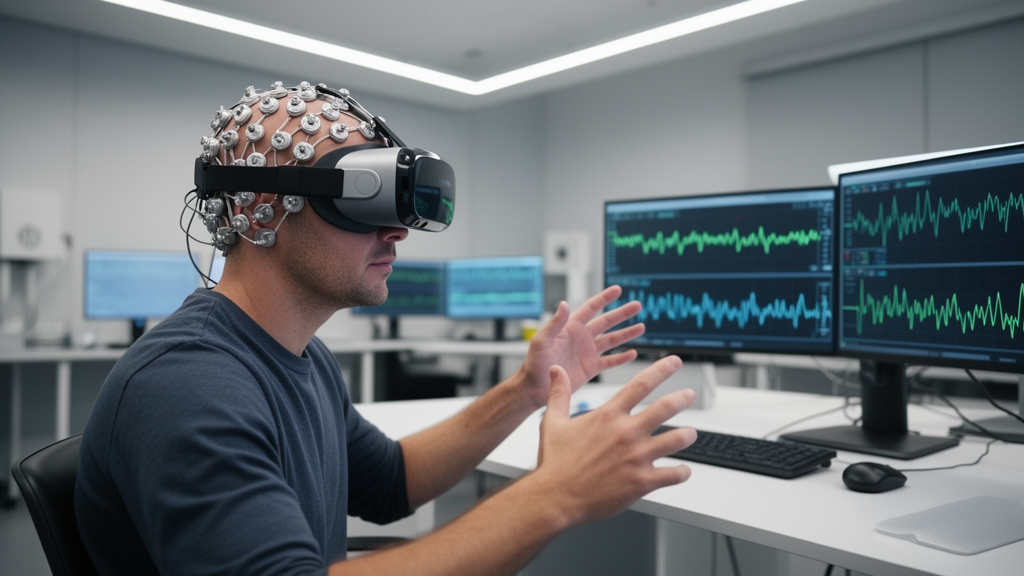
In high-stakes operational environments, teams of human operators frequently make rapid visual judgments under demanding conditions, ranging from screening medical imagery to identifying potential threats across degraded flight corridors. To test whether physiological data can evaluate an operator’s choice before it is formally committed, researchers evaluated electroencephalography signals during a continuous virtual reality target-detection task. The investigation revealed that spatial-covariance brain activity extracted prior to a physical response reliably distinguished correct from incorrect decisions when operators faced high cognitive workload, achieving an average classification accuracy of 61.4 percent. However, this predictive capacity disappeared under low cognitive workload, demonstrating that neural decision-reliability metrics function as state-dependent signals rather than universal performance indicators.
Conventional collaborative brain-computer interfaces and collective decision-making systems typically depend on behavioral outputs that are only accessible after an operator acts, such as recorded response times or subjective self-ratings of confidence. Although these post-hoc markers provide retrospective insight, they cannot intervene during the decision-making process itself. The research team sought to bypass this chronological limitation by extracting neural markers directly within the window preceding each motor response. Their goal was to isolate a pre-emptive signal capable of weighting individual judgments at the exact instant an operator votes, providing collaborative systems with early evidence regarding individual reliability before collective decisions are finalized.
The study evaluated 23 adult participants, comprising 10 females with an average age of 24.8 years, who completed a within-subject repeated-measures experiment in a continuous virtual reality simulation rendered with Unreal Engine 5. Wearing a Varjo Aero head-mounted display, participants observed the visual perspective of an uncrewed aerial vehicle navigating across an open landscape. Operators monitored an ongoing stream of three-dimensional models appearing in their field of view, categorized as either targets or non-targets. A visual targeting reticle locked onto each encountered model for 2,500 milliseconds, prompting participants to register their discrimination response using a physical joystick button before the reticle vanished.
To evaluate the effect of cognitive workload on neural signals, researchers incorporated a within-subject visual degradation manipulation across experimental sessions. High workload sessions altered the simulated atmosphere by reducing ambient lighting levels by 50 percent and lowering the solar angle, reproducing the challenging visibility conditions of a degraded visual environment. In contrast, low workload sessions maintained standard daylight visibility. This visual manipulation successfully degraded human perceptual performance: under high workload, participant accuracy dropped to 77.55 percent compared to 93.84 percent under daylight conditions, while mean response times lengthened from 0.81 seconds in low workload to 1.40 seconds in high workload.
To ensure that the analyzed brain activity was entirely independent of physical movement artifacts, the investigators developed a motor-safe analytical pipeline. Continuous 32-channel electroencephalography data recorded at 500 Hertz were segmented relative to reticle onset. Features were drawn strictly from a temporal window beginning 300 milliseconds after reticle onset—thereby excluding the universal early sensory evoked potential—and concluding 100 milliseconds before each trial’s recorded button press. Any trial yielding a motor-safe window shorter than 150 milliseconds was omitted from analysis. Within this motor-isolated period, spatial covariance matrices were generated using Ledoit-Wolf shrinkage and mapped onto a Euclidean tangent space via Riemannian geometry before classification with regularized logistic regression.
The Riemannian tangent-space classifier demonstrated statistically robust decoding performance under high workload across leave-one-subject-out cross-validation, achieving a 64.8 percent true positive rate for correct choices and a 46.3 percent true negative rate for errors. When accounting for class imbalances, the classifier maintained a balanced accuracy of 55.55 percent and a receiver operating characteristic area under the curve of 0.553, significantly exceeding chance. Furthermore, variations in the duration of the motor-safe window accounted for less than 1 percent of the variance in classification correctness, verifying that the duration of available neural data did not distort classifier reliability across trials.
Under low workload conditions, the decoding system failed to yield meaningful predictions once class imbalances were addressed. Although raw classification accuracy reached 79.4 percent, the true negative rate collapsed to 12.3 percent, demonstrating that the classifier rarely identified an erroneous response. This breakdown stemmed directly from a behavioral ceiling effect: because operators achieved 93.84 percent accuracy under standard daylight conditions, very few error trials occurred. The scarcity of errors prevented the model from establishing a reliable mathematical boundary between correct and incorrect decisions, yielding a balanced accuracy of 45.85 percent and an area under the curve of 0.447, which did not differ significantly from chance.
To uncover the anatomical origin of the predictive signals, the researchers conducted channel ablation tests by systematically eliminating individual electrodes from the covariance matrices and tracking subsequent performance drops. The greatest reductions in decoding accuracy occurred when removing posterior occipito-parietal electrodes, specifically Oz, O2, and P3. In contrast, central and temporal electrode sites contributed only minor improvements to classification. Because the motor-safe window concluded prior to movement execution and the most informative signals stemmed from posterior sensory cortex rather than central motor regions, the decoded activity appears to reflect genuine perceptual evidence accumulation and internal error monitoring rather than premature motor preparation.
The practical utility of this neural signal was assessed through bootstrap-resampled simulations of collaborative teams ranging from 2 to 16 operators. When analyzing evenly split trials under high workload—where conventional majority voting offers no clear guidance—weighting individual votes by pre-emptive neural probabilities boosted collective decision accuracy from 57.2 percent in two-person pairs to 88.2 percent in 16-person groups. Conversely, applying the same neural weighting under low workload caused team accuracy on contested trials to drop toward 10 percent by team size 8, illustrating how relying on an uncalibrated classifier trained on insufficient error samples can severely compromise collective decisions.
The study also contrasted the pre-emptive neural marker against conventional post-hoc indicators. Subjective confidence ratings gathered after each response delivered the highest absolute accuracy during simulated team aggregation, reaching 99.4 percent on contested trials in 16-person teams under high workload. However, post-hoc ratings cannot inform an evolving decision before it concludes. Meanwhile, response-time weighting impaired group accuracy on contested trials because correct answers on evenly split trials were significantly slower than incorrect ones, inverting the general speed-accuracy relationship observed across the broader dataset. The investigators emphasized that while real-time implementation will require prospective stimulus-locked windowing, neural reliability signals provide a unique pre-emptive metric specifically tailored for high-workload operational settings.
To clarify how visual degradation altered cognitive processing, the researchers evaluated participant performance using signal detection theory. The analysis confirmed that the experimental manipulation acted specifically on perceptual sensitivity rather than shifting response strategy. Participants maintained similar decision criteria across conditions, averaging 0.161 under high workload and 0.135 under low workload, reflecting moderate Bayesian evidence for no difference in response bias. In contrast, perceptual sensitivity dropped substantially from a d-prime of 3.58 under daylight conditions to 1.98 in the degraded environment. Independent of workload, detecting targets proved significantly harder than rejecting non-targets, registering an 81 percent hit rate compared to a 90 percent correct rejection rate. This intrinsic perceptual asymmetry directly explained trial difficulty: target trials generated significantly lower vote margins than non-target trials across both experimental sessions, indicating that difficulty was driven by task structure rather than unexplained external noise.
Because unweighted majority voting already achieved between 94 percent and 99 percent accuracy across 16-person teams on the full trial set, researchers evaluated a selective deployment model where neural weighting engaged only when votes tied. The proportion of true-tie trials decreased steadily as simulated team size expanded. Under high workload, true ties comprised 29.3 percent of trials at team size two, declining to 15.3 percent at size four, 6.6 percent at size eight, and 3.4 percent at size 16. In low workload, ties represented 18.5 percent of trials at team size two and 2.5 percent at size eight, with no shared trials remaining at size 16. Under this conservative selective strategy, applying neural weights solely to break ties produced a modest but consistent improvement of 0.7 to 2.1 percentage points in overall team accuracy under high workload. By contrast, applying the uncalibrated low-workload classifier to tied votes caused a net reduction in overall team accuracy of 1.85 percentage points at team size four and 0.95 percentage points at team size eight.
The authors also noted technical boundaries regarding the decoded neural activity and the retrospective nature of the analysis pipeline. While spatial covariance captures relational activity across electrodes, grand-average waveforms revealed substantial amplitude differences between correct and incorrect responses, leaving open whether the model capitalized on complex channel patterns or simpler amplitude variations. Methodologically, enforcing the minimum 150-millisecond motor-safe window caused asymmetrical trial loss, excluding 12.61 percent of correct trials under high workload and 49.53 percent under low workload. Furthermore, the high and low workload labels relied entirely on visual degradation without independent subjective validation via instruments like the NASA Task Load Index or physiological markers. In addition, simulated teams were generated using bootstrap resampling from single-session participant recordings rather than interactive teams cooperating in real time, and the results stem from a single virtual reality discrimination task that requires independent validation in other complex operational settings.
Subject of Research: Pre-emptive EEG decoding of decision correctness under cognitive workload in virtual reality collaborative brain-computer interfaces
Article Title: Decoding decision correctness from EEG under high cognitive workload in virtual reality: implications for collaborative brain-computer interface teams
Article References: Baker, C., Hinton, S., Nijjar, A., Reed, T., & Fairclough, S. (2026). Decoding decision correctness from EEG under high cognitive workload in virtual reality: implications for collaborative brain-computer interface teams. Frontiers in Virtual Reality, 7, Article 1971503. https://doi.org/10.3389/frvir.2026.1971503
Image Credits: AI Generated
DOI: 10.3389/frvir.2026.1971503
Keywords: brain-computer interface, collaborative BCI, electroencephalography, virtual reality, cognitive workload, Riemannian geometry, spatial covariance, decision making, error monitoring, neuroergonomics, target detection, degraded visual environment, signal detection theory, leave-one-subject-out cross-validation, human-machine teaming, perceptual discrimination
News Source: Cassandra Pierce. (November 12, 2026). Brain Waves Predict Decision Accuracy in Virtual Reality Under High Workload. Scienmag.