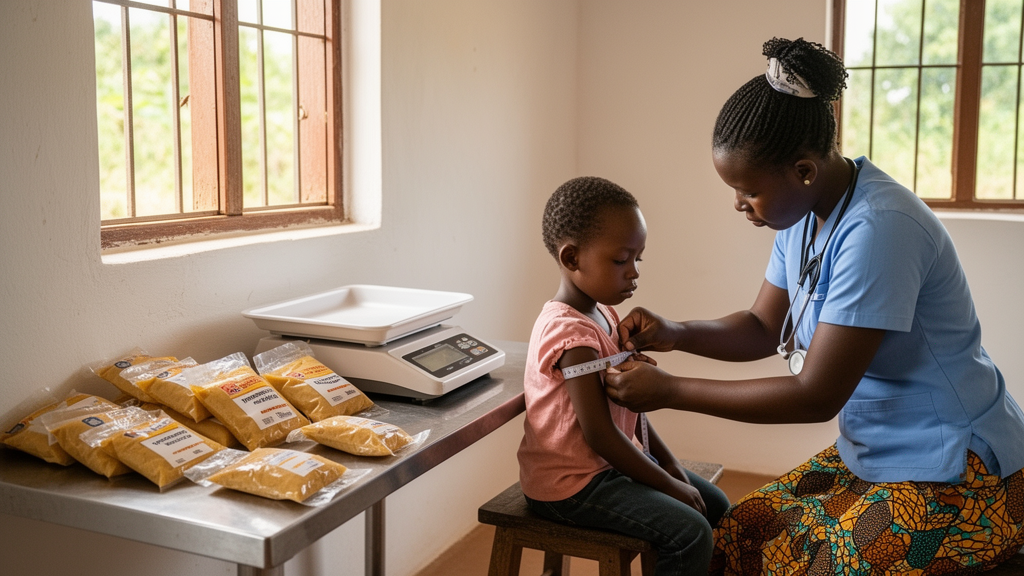
In a secondary prognostic analysis of randomised controlled trial data from Mali, researchers found that distinct and non-overlapping factors determine which severely underweight children experience negative anthropometric deterioration versus positive gains from nutritional supplementation. Under existing clinical guidelines, severely underweight children exhibiting a weight-for-age Z-score below minus three remain ineligible for standard wasting treatment programs unless they present with a mid-upper arm circumference under 125 millimeters or a weight-for-height Z-score below minus three. To clarify health trajectories under these selective criteria, the investigators evaluated the likelihood of both deterioration without supplementation and recovery with nutritional support among children meeting the weight-for-age threshold but maintaining a mid-upper arm circumference of at least 125 millimeters.
The study evaluated a total cohort of 1,378 children to observe clinical outcomes and changes across a 12-week follow-up monitoring window. Researchers established negative outcomes as a sustained decline in weight-for-age Z-score below zero at any evaluation point, hospitalization, death, or the development of a mid-upper arm circumference below 125 millimeters. Conversely, positive outcomes were defined as achieving a sustained weight-for-age Z-score improvement of at least 0.15 alongside no hospitalization, no death, and maintaining a mid-upper arm circumference at or above 125 millimeters throughout the observation period. Generalised linear models were constructed separately for children receiving nutritional supplementation and those left unsupplemented, with significant unadjusted predictors subsequently adjusted for sex, season, age, and physical distance from the local health centre.
Severe clinical events were rare across the studied cohort, with less than two percent of all enrolled children experiencing hospitalisation or death during the study timeframe. Consequently, recorded negative endpoints were overwhelmingly anthropometric in nature rather than fatal or inpatient events. Among the subcohort of 432 children who did not receive nutritional supplementation, 35 percent—accounting for 151 children—experienced negative anthropometric outcomes. In sharp contrast, among the 946 children who received nutritional supplementation, 67 percent—representing 643 children—successfully attained positive anthropometric outcomes over the course of the trial.
The statistical analyses revealed that entirely different characteristics governed deterioration and response to treatment. In unadjusted models evaluating unsupplemented children, younger age under two years, lower baseline body weight, lower height, and currently breastfeeding were each associated with an increased incidence of negative anthropometric outcomes; however, these associations were present only in the unadjusted models. Conversely, among children provided with nutritional support, having a documented illness prior to the initiation of supplementation was significantly associated with positive anthropometric outcomes in both the unadjusted and adjusted statistical analyses.
The complete absence of overlap between the baseline factors predisposing untreated children to decline and those predicting favorable recovery under nutritional support underscores the complex biological dynamics in this patient group. The authors observed that because different characteristics govern risk in the absence of treatment and therapeutic response during supplementation, identifying and targeting the specific severely underweight children most in need of nutritional intervention remains an intricate clinical challenge.
Subject of Research: Prognostic factors and nutritional supplementation outcomes among severely underweight children in Mali
Article Title: Identifying risk and response to nutritional supplementation in severely underweight children missed by standard treatment criteria in Mali: A secondary prognostic analysis of data from a randomised controlled trial
Article References: Potani, I., Khisa, A., Tausanovitch, Z., Heymsfield, G., Ritz, C., Thompson, D., Bandsma, R. H. J., Briend, A., Potani, O., Manda, G., Chisala, M., Bamusi-Nkhoma, E., Bailey, J., & Kangas, S. T. (2026). Identifying risk and response to nutritional supplementation in severely underweight children missed by standard treatment criteria in Mali: A secondary prognostic analysis of data from a randomised controlled trial. PLOS Global Public Health, 6(11), e0007525. https://doi.org/10.1371/journal.pgph.0007525
Image Credits: AI Generated
DOI: 10.1371/journal.pgph.0007525
Keywords: Severe Underweight, Weight-for-Age Z-Score, Mid-Upper Arm Circumference, Nutritional Supplementation, Child Malnutrition, Mali, Prognostic Analysis, Anthropometric Outcomes, Pediatric Nutrition, Randomised Controlled Trial, Wasting Treatment, Global Child Health, Child Growth Failure, Nutritional Intervention, Health Centre Distance, Childhood Morbidity
News Source: Daisy Hatcher. (November 12, 2026). Severely Underweight Children Show Divergent Risks and Responses to Nutritional Support. Scienmag.