Computational structural engineers have introduced an open-source software framework named Program for Structural Design, or P4Struct, designed to unify structural finite element analysis and density-based topology optimization within a single automated pipeline. Developed by Huaiwang Ji, Bin Niu, Rui Yang, and Binze Zou, the system addresses persistent fragmentation across open-source computational design environments, where practitioners frequently rely on separate, non-integrated tools to prepare meshes, calculate structural responses, perform material redistribution algorithms, and reformat final voxelized boundaries into clean computer-aided manufacturing geometries. By integrating these disconnected steps into a hierarchical architecture governed by an interactive graphical interface and a dedicated dual-database architecture, P4Struct allows designers to import raw external finite element meshes, execute complex iterative optimization routines, and directly generate manufacturing-ready stereolithography files without writing supplemental control scripts or post-processing glue code.
Topology optimization has evolved into an essential computational method for synthesizing high-performance structural layouts, particularly as modern additive manufacturing technologies expand the physical realizability of complex, mathematically generated organic forms. Within density-based optimization methodologies, such as the solid isotropic material with penalization approach and the rational approximation of material properties formulation, continuous mathematical relationships are established between element design densities and discrete structural stiffness matrices. Although widely used commercial engineering software platforms provide robust solving capabilities, their closed-source nature and rigid secondary development interfaces often restrict user modifications and algorithmic customizations. Conversely, while numerous specialized open-source research codes have emerged over recent decades, they often lack user-friendly interactive frontends, rely on disparate file storage routines, or omit downstream geometric smoothing operations, leaving interactive workflow integration an underdeveloped area in computational structural engineering.
To overcome these functional bottlenecks, P4Struct was constructed on an object-oriented Python foundation structured across a five-layer technical hierarchy. This modular architecture comprises a user interface layer, a business logic layer, a data access layer, a hardware abstraction layer, and an integration and interface layer. The graphical interface is implemented using PySide6 alongside the Visualization Toolkit, providing real-time model tree navigation, continuous visual feedback, interactive parameter assignment, and dynamic visualization of stress distributions and evolving topologies. The business logic layer serves as the computational engine coordinating preprocessing routines, structural governing equations, mathematical programming solvers, and geometric extraction algorithms. To maximize interoperability across standard industrial workflows, the integration layer facilitates direct model importation via external Abaqus input files and interfaces directly with high-performance external numerical routines, including the Intel Math Kernel Library PARDISO sparse solver and iterative solvers from the open-source SciPy package.
Persistent information management within the software is managed through a hybrid heterogeneous data strategy that separates lightweight relational metadata from massive numerical solution arrays. Standard project configurations, analysis parameters, task definitions, and entity relationships are governed by an embedded SQLite3 relational database, ensuring project traceability and structured organization across multistep design workflows. Concurrently, large-scale numerical datasets generated during iterative analysis—such as global stiffness matrices, element-level displacement vectors, density arrays, and stress tensors—are routed into Hierarchical Data Format Version 5 containers. This distinct dual-storage design preserves full computational reproducibility, eliminates data bloat during interactive sessions, and maintains rapid query execution during large-scale simulations involving multi-element structural models.
The underlying mathematical formulations in P4Struct resolve single-objective minimization problems constrained by structural responses, specifically targeting combinations of compliance, structural volume, and von Mises stress. Design densities are treated as continuous vectors bounded between a minimum value greater than or equal to 0.01 and a maximum limit of 1.0, preventing singularity within element stiffness formulations during intermediate optimization iterations. For stress-constrained formulations, the framework implements a qp-interpolation approach paired with a P-norm aggregation strategy utilizing an aggregation factor of 5.0 to approximate peak global von Mises stresses from discrete element centroidal stress values. The optimization engine solves these nonlinear formulations through sequential explicit approximations, integrating the method of moving asymptotes and its globally convergent variant. To counteract mathematical instability, mesh dependency, and artificial checkerboard patterns, P4Struct applies spatial density filtering techniques alongside threshold truncation and hyperbolic tangent projection methods to establish crisp, distinct structural boundaries.
Numerical fidelity within the framework is underpinned by an integrated structural element library spanning two-dimensional and three-dimensional configurations. The library includes two-dimensional tension-compression trusses, plane stress and plane strain elements, three-dimensional solid elements, and flat shell elements formulated with up to six degrees of freedom per node. During development verification, all implemented element formulations were confirmed to pass standard patch tests and mesh convergence evaluations against exact analytical and numerical baselines. The framework supports two-dimensional and three-dimensional linear elastic evaluations under complex load applications, multi-material distributions, and multiple consecutive analysis steps. Verification against external finite element benchmark simulations and sensitivity validation using finite difference sampling demonstrated accurate structural response calculations, while computational loops were decomposed across multi-process subtasks communicating through predefined data formats to enable parallel execution.
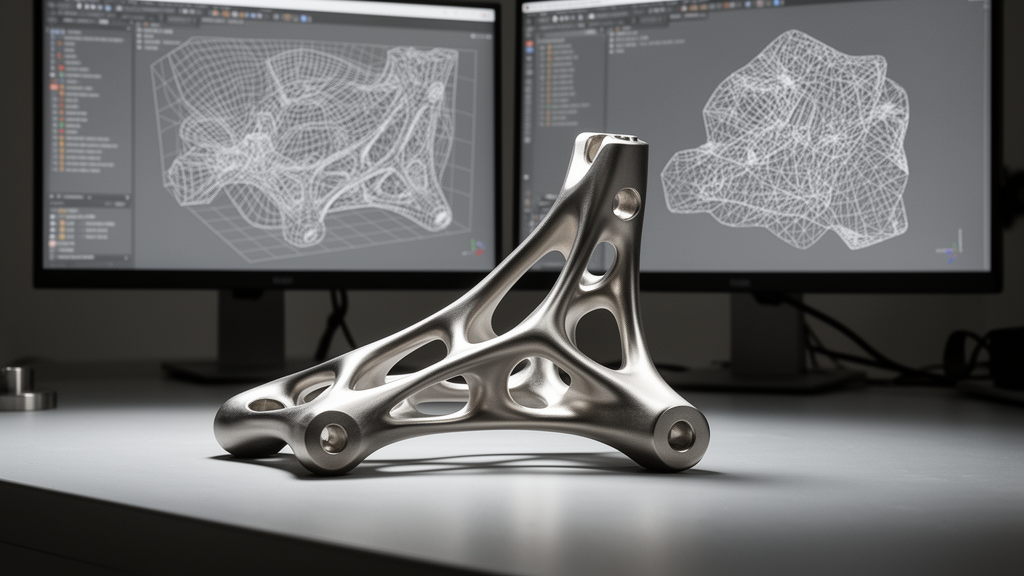
A notable functional feature within P4Struct is its automated geometric post-processing module, which directly resolves the boundary discontinuities inherent to density-based topology optimization. Because standard density distributions yield jagged, voxel-like configurations unsuitable for immediate manufacturing, P4Struct deploys a surface-based smoothing pipeline implemented in the Visualization Toolkit. The smoothing algorithm iteratively adjusts surface mesh vertex coordinates using a windowed sinc low-pass filter combined with Chebyshev polynomial approximations. This numerical smoothing procedure suppresses high-frequency boundary noise while strictly preserving critical structural features and macroscopic geometric profiles, allowing both two-dimensional and three-dimensional optimization outputs to be directly exported as watertight stereolithography files without auxiliary computer-aided design reconstruction software.
The optimization capabilities of the software were demonstrated across several numerical benchmark problems and engineering design cases. In a standard cantilever beam loaded at its center, two optimization scenarios were examined: compliance minimization under a 50 percent volume limit, and volume minimization under a maximum von Mises stress constraint matched to material yield stress. Material parameters were defined using ASTM A36 steel with an elastic modulus of 211 gigapascals, a Poisson’s ratio of 0.29, and a yield stress of 220 megapascals. In the compliance minimization trial, P4Struct reached an optimized compliance value of 114.87, which was 115.42 lower than the reference literature baseline and 3.6 higher than comparative results generated using Abaqus. In the stress-constrained volume minimization trial, P4Struct produced an optimized volume fraction of 0.58, compared to 0.64 in the literature baseline and 0.29 in Abaqus, with observed variance originating from differing optimizer algorithms and divergent stress aggregation treatments.
To evaluate engineering design scenarios, the researchers conducted stiffness optimization on an aircraft wing rib and stress minimization on an externally stiffened cylindrical shell. The wing rib was modeled as a plane stress structure utilizing a symmetric NACA0018 aerodynamic airfoil profile with fixed non-design mounting holes and outer boundary regions subjected to distributed aerodynamic pressure segments. Using the globally convergent method of moving asymptotes with density filtering and projection parameters, structural strain energy decreased by 79.07 percent across a 5,818-element mesh and by 84.60 percent across a refined 12,650-element mesh. Increasing mesh density improved geometric resolution and yielded smoother post-processed boundaries, though it increased average computational time per iteration by 24.60 percent and peak memory consumption by 58.76 percent.
In the three-dimensional stiffened cylinder study, structural coupling was evaluated by modeling an outer skin with four-node flat shell elements and an internal stiffening core with eight-node solid elements sharing common interface nodes. Under fixed base boundary conditions and eight circumferential top loads, the framework optimized internal stiffener density distributions to minimize peak von Mises stress under a 50 percent volume restriction. Across iterative optimization steps, the aggregated stress metric decreased from 6,126,269.23 to 3,176,444.07, representing an approximate 63.39 percent reduction in peak structural stress. The resulting layout formed uniformly distributed circumferential stiffening ribs that seamlessly transitioned into automated multi-dimensional smoothing and stereolithography export.
While P4Struct demonstrates comprehensive workflow integration, its current operational capabilities exhibit notable engineering boundaries. At present, the software is restricted to static linear elastic analyses and single-objective formulations, excluding nonlinear material behaviors, large structural deformations, and dynamic transient loading conditions. Furthermore, although process parallelization and third-party sparse solvers enhance calculation speeds, the prototype framework remains approximately five times slower than mature commercial solvers such as Abaqus on equivalent meshes. Additionally, the development team noted that comprehensive automated software testing suites remain to be implemented as P4Struct transitions beyond its initial research prototype release.
Subject of Research: Integrated open-source software framework for finite element analysis and structural topology optimization
Article Title: P4Struct: An integrated topology optimization software framework with a unified design workflow
Article References: Ji, H., Niu, B., Yang, R., & Zou, B. (2026). P4Struct: An integrated topology optimization software framework with a unified design workflow. SoftwareX, 36, Article 103204. https://doi.org/10.1016/j.softx.2026.103204
Image Credits: AI Generated
DOI: 10.1016/j.softx.2026.103204
Keywords: topology optimization, P4Struct, finite element analysis, structural design, open-source software, computational mechanics, Python, SIMP method, MMA optimizer, additive manufacturing, PARDISO solver, HDF5, SQLite3, PySide6, VTK smoothing, stress optimization, wing rib design
News Source: Denise Maddox. (November 12, 2026). Open-Source P4Struct Framework Integrates Complete Topology Optimization and Mesh Export Workflows. Scienmag.