Routine formalin fixation causes colorectal polyps to shrink measurably, leading to altered post-polypectomy surveillance intervals in nearly a tenth of patients, according to a prospective paired analysis published in BMC Gastroenterology. Clinical guidelines for post-polypectomy surveillance anchor follow-up recommendations to polyp size, alongside histology and lesion counts. In clinical practice, European guidelines rely on a 10-millimeter threshold to differentiate a routine return to screening from a three-year surveillance interval, whereas Japanese guidelines use a 20-millimeter cut-off to distinguish three-year from one-year surveillance intervals. Despite the importance of these numerical thresholds, size remains the only surveillance criterion that depends entirely on a physical measurement, and the only numerical record routinely available to clinicians is the measurement taken by pathologists after fixation.
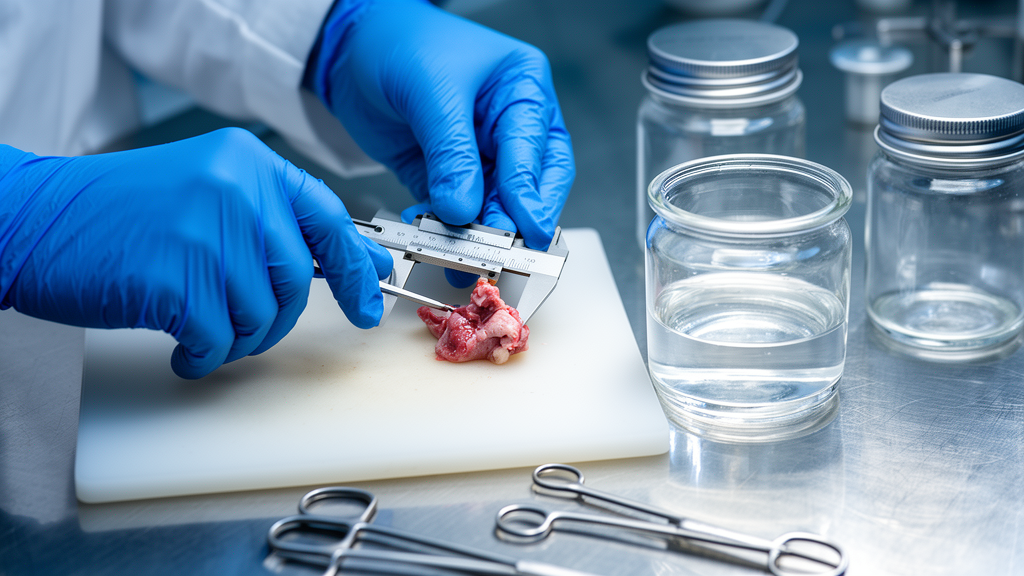
To determine whether chemical preservation meaningfully alters polyp dimensions and affects clinical decisions, researchers evaluated colorectal lesions measuring at least 5 millimeters removed via snare polypectomy during routine colonoscopy. For every intact specimen retrieved during the study, the endoscopist conducted an immediate fresh measurement using a millimetric ruler. Following this baseline assessment, specimens were placed in 10 percent neutral buffered formalin for 8 to 24 hours. A blinded pathologist subsequently re-measured each fixed polyp using an identical millimetric ruler to avoid measurement bias. While comparative statistical analyses were strictly restricted to neoplastic lesions, the investigators also descriptively examined unaided in-vivo visual estimates made before resection.
The study cohort comprised 63 polyps collected from 53 patients, with 55 of the lesions, or 87.3 percent, confirmed to be neoplastic. Among these neoplastic lesions, mean polyp size decreased significantly from a fresh baseline of 10.09 millimeters to a post-fixation mean of 8.98 millimeters. This change represented a statistically significant mean reduction of 1.11 millimeters, with a 95 percent confidence interval ranging from 0.86 to 1.36 millimeters. Overall, 67.3 percent of the neoplastic polyps exhibited shrinkage after immersion in formalin, while none of the polyps enlarged during the fixation process.
Across individual neoplastic lesions, the observed contraction corresponded to a mean shrinkage of 13.7 percent per lesion overall, and an average reduction of 8.3 percent among polyps measuring 10 millimeters or larger. The absolute reduction in specimen size remained comparable regardless of initial lesion size or morphology. Specifically, polyps below 10 millimeters shrank by an absolute mean of 1.13 millimeters, compared to 1.08 millimeters in lesions measuring 10 millimeters or greater. Similarly, sessile polyps contracted by an average of 1.26 millimeters compared to 0.85 millimeters in pedunculated lesions, demonstrating that the higher proportional shrinkage observed in smaller polyps was a mathematical consequence of their lower baseline size rather than a greater absolute tissue loss.
Because surveillance recommendations depend on rigid threshold cut-offs, small reductions in measured size frequently changed patient classifications. Across all 63 polyps evaluated in the study, twelve lesions were located within 1 millimeter of an established clinical threshold, and six of these polyps crossed a guideline boundary following fixation. Among nine polyps that initially measured between 10 and 11 millimeters in fresh tissue, five fell below the 10-millimeter mark after fixation. Similarly, out of three lesions that measured between 20 and 21 millimeters when fresh, one shrank below the 20-millimeter threshold once fixed.
When the investigators applied complete European and Japanese guideline algorithms at the patient level, five of the 53 patients, representing 9.4 percent of the study population, would have been assigned to a different surveillance colonoscopy interval depending solely on whether fresh or fixed measurements were utilized. The authors also noted that unaided in-vivo visual assessments performed by endoscopists agreed far less closely with fresh specimen dimensions than pathology measurements, displaying wider limits of agreement from minus 4.8 to plus 7.5 millimeters, compared to limits of minus 0.7 to plus 3.0 millimeters observed between fresh and post-fixation assessments. Furthermore, in-vivo visual estimates produced discordant classifications at the critical 10-millimeter boundary twice as often as post-fixation measurements, disagreeing in 10 versus 5 out of 56 lesions.
The authors concluded that shrinkage induced by formalin fixation introduces an unstandardised source of variation that directly affects post-polypectomy surveillance intervals. Measuring fresh polypectomy specimens immediately following resection provides an early quantitative record that remains unaffected by chemical fixation. Because fresh measurement requires no specialized equipment, added cost, or extra time, incorporating it into routine practice and clarifying which measurement clinical guidelines intend would standardize post-polypectomy care.
Subject of Research: Impact of formalin fixation on colorectal polyp size and surveillance intervals
Article Title: Impact of formalin fixation on colonic polyp size and post-polypectomy surveillance thresholds: evidence from a prospective paired analysis
Article References: Karataş, S. A., Varlı, G., Aslan, A., Biçer, M., & Akıncıoğlu, P. (2026). Impact of formalin fixation on colonic polyp size and post-polypectomy surveillance thresholds: evidence from a prospective paired analysis. BMC Gastroenterology. https://doi.org/10.1186/s12876-026-05561-3
Image Credits: AI Generated
DOI: 10.1186/s12876-026-05561-3
Keywords: formalin fixation, colonic polyps, colorectal neoplasms, polypectomy, colonoscopy, post-polypectomy surveillance, polyp measurement, tissue shrinkage, clinical guidelines, gastroenterology, pathology, endoscopy, adenoma surveillance, snare polypectomy, histopathology, neoplastic lesions
News Source: Ophelia Keating. (November 12, 2026). Formalin Fixation Shrinks Colonic Polyps and Alters Surveillance Timing. Scienmag.