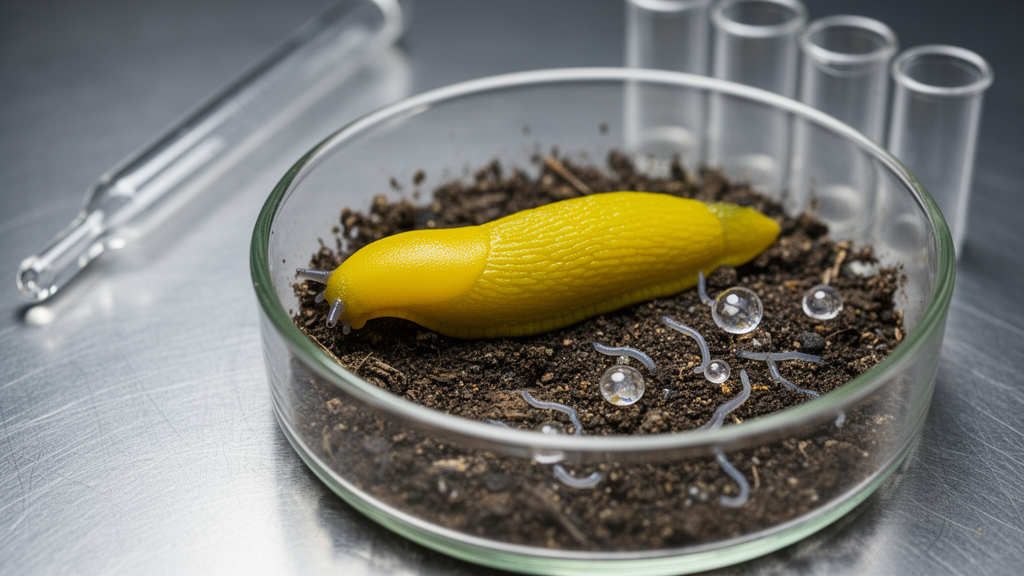
Researchers at Oregon State University have determined that a biological product used to control agricultural pest slugs in multiple countries is harmful to the Pacific banana slug, an iconic species found along the West Coast. The laboratory study, led by Dee Denver and Emily Taylor of the OSU College of Science, demonstrated that the product, marketed as Nemaslug, poses a significant threat to this native species. The team emphasized that further research is required before the product can be approved for use in the United States, where it is currently not permitted due to limited knowledge regarding its effects on non-target and native species.
The Pacific banana slug, which ranges from Alaska to California, is the world’s second-largest terrestrial slug, surpassed only by Europe’s ash-black slug. The species also holds cultural significance, serving as the mascot for athletic teams at the University of California, Santa Cruz.
The Nemaslug product is based on the organism Pellioditis hermaphrodita, a tiny parasitic nematode that enters small openings in the bodies of pest slugs, such as the gray field slug. Once inside, the parasite fatally infects the host, reproduces within the dead slug, and disperses in search of new hosts. A follow-up product, Nemaslug 2.0, utilizes a similar nematode species, P. californica, which was identified as new to science in 2013. These biological tools are currently sold in various international markets, including Kenya, Canada, and parts of Europe, with efforts underway to introduce them to the United States.
The study investigated the effects of both Nemaslug products on a total of 178 juvenile and adult Pacific banana slugs collected at the Oregon coast in the spring of 2024. This experimental work builds on earlier research that documented the lethality of P. hermaphrodita to another native Northwest species, the Pacific sideband snail. The research team, which included biologists and crop and soil scientists from OSU, sought to understand the potential risks these biocontrol agents pose to native gastropods, a group that has historically suffered from poorly designed and executed biocontrol attempts.
The results of the 38-day experiment revealed that the original Nemaslug product, based on P. hermaphrodita, killed every banana slug exposed to it. The follow-up product, Nemaslug 2.0, based on P. californica, was also harmful, though it was not uniformly lethal. However, the mortality rate among juvenile slugs exposed to Nemaslug 2.0 was 80 percent. In contrast, the unexposed control group showed high survival rates, with 84 percent of juveniles and 96 percent of adults living through the duration of the experiment. These findings highlight the vulnerability of the Pacific banana slug to both nematode species used in commercial biocontrol products.
The implications of these findings extend beyond a single species, as terrestrial slugs and snails account for more than one-third of all documented animal species extinctions since the year 1500. The history of biocontrol for agricultural pest snails and slugs is described as somewhat checkered, partly because unintended consequences for non-target species remain understudied and difficult to predict. A previous biocontrol effort involving the introduction of a non-native snail led to the extinction of hundreds of native snail species in Hawai‘i and other Pacific islands, serving as a cautionary example for current efforts.
The research team also highlighted the presence of these nematode species in the wild. In 2018, a paper by some of the same collaborators described the first report of P. hermaphrodita in Oregon. In 2024, another paper reported the first instance of P. californica in Washington state. Denver and co-author Rory McDonnell of the OSU College of Agricultural Sciences found P. californica in Oregon for the first time during a nematode survey conducted between 2018 and 2019.
The study was funded by the U.S. Department of Agriculture and published in the journal PLOS One. Collaborators on the research included Dana Howe from the College of Forestry, Indira Kulkarni Ebner from the College of Science, and Casey Richart from the College of Agricultural Sciences. The authors declared that no competing interests exist. The findings suggest that the use of these nematode-based products in the United States could pose a risk to native biodiversity, particularly in regions where Pacific banana slugs are prevalent. The team’s work contributes to the growing body of evidence that biocontrol agents must be carefully evaluated for their impact on non-target species before widespread adoption.
As efforts to bring Nemaslug products to the U.S. market continue, the study underscores the need for rigorous assessment of their ecological impact.
Subject of Research: Impact of Nemaslug biocontrol nematodes on Pacific banana slug mortality
Article Title: Product for controlling agricultural pests proves harmful to iconic banana slug
Article References: Product for controlling agricultural pests proves harmful to iconic banana slug. Original publication (Bibliographic details unavailable.)
Image Credits: AI Generated
DOI: Not provided
Keywords: Pacific banana slug, Nemaslug, Pellioditis hermaphrodita, P. californica, biocontrol, Oregon State University, terrestrial gastropods, non-target species, biodiversity conservation, laboratory study, Ariolimax, nematode parasites, agricultural pests, PLOS One, native species, slug mortality, Northwest ecology, biocontrol risks, gastropod extinctions, U.S. Department of Agriculture
News Source: Alan Morgan. (November 12, 2026). Slug control nematodes kill Pacific banana slugs in lab study. Scienmag.