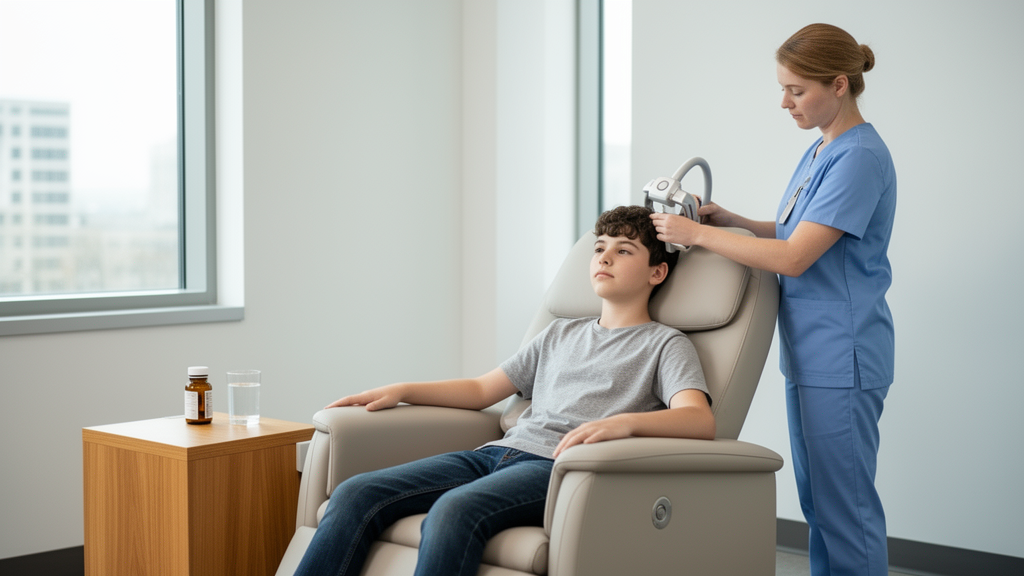
Combining repetitive transcranial magnetic stimulation (rTMS) with the selective serotonin reuptake inhibitor sertraline significantly reduced depressive symptoms and improved clinical response rates in adolescents compared with sertraline monotherapy, according to a systematic review and meta-analysis published in Frontiers in Psychiatry. The researchers evaluated randomized controlled trials to assess the efficacy, neurocognitive impact, and safety of adjunctive repetitive transcranial magnetic stimulation combined with sertraline in adolescents.
The authors searched PubMed (including MEDLINE), Embase, the Cochrane Library, Web of Science, and Chinese scholarly databases including CNKI, Wanfang, and Weipu. Ultimately, the systematic review analyzed 24 randomized controlled trials comprising a total of 2,155 adolescent participants, with all included trials conducted within China and published in Chinese.
The primary clinical outcomes evaluated across the trials were depressive symptom reduction, measured by the 17-item and 24-item Hamilton Depression Rating Scales (HAMD-17 and HAMD-24), along with clinical response rates. Adolescent patients receiving the adjunctive rTMS combination demonstrated significant reductions in depressive symptoms relative to sertraline monotherapy, yielding a standardized mean difference (SMD) of -1.06 on the HAMD-17 and an SMD of -1.39 on the HAMD-24. In addition, the combination therapy improved clinical response rates, demonstrating a pooled risk ratio (RR) of 1.18.
Secondary outcomes examined in the meta-analysis included neurocognitive functioning and adverse events. Cognitive performance was evaluated using the Montreal Cognitive Assessment (MoCA), where a pooled analysis across three studies suggested that adjunctive rTMS may improve MoCA scores, showing an SMD of 0.99 with low certainty of evidence. Regarding safety, patients receiving combination therapy experienced a slightly higher incidence of mild adverse events compared to those on monotherapy, reflected by a pooled risk ratio of 1.21, which the authors characterized as an acceptable safety profile.
Despite the observed clinical benefits, the authors highlighted important methodological caveats, including significant heterogeneity across studies with an I-squared value exceeding 80 percent, evidence of publication bias, and GRADE certainty of evidence ranging from very low to moderate. A meta-regression indicated that treatment duration did not moderate the extent of symptom reduction. However, a sensitivity analysis identified extreme protocols as the primary source of heterogeneity; excluding those outliers yielded a pooled effect size of SMD = -0.74 and reduced the I-squared value to 17 percent. The authors concluded that treatment effects may be overestimated due to low-certainty cognitive data, high heterogeneity, and geographic restriction to China, emphasizing that standardized parameters are critical and that future multinational, sham-controlled trials using updated risk-of-bias frameworks are warranted.
Subject of Research: Adjunctive repetitive transcranial magnetic stimulation with sertraline for adolescent depression
Article Title: Systematic review and meta-analysis on the efficacy and safety of combining repetitive transcranial magnetic stimulation with sertraline for adolescent depression in China
Article References: Sun, H., Zhang, L., Hu, J., Li, J., & Zheng, Z. (2026). Systematic review and meta-analysis on the efficacy and safety of combining repetitive transcranial magnetic stimulation with sertraline for adolescent depression in China. Frontiers in Psychiatry, 17, Article 1893010. https://doi.org/10.3389/fpsyt.2026.1893010
Image Credits: AI Generated
DOI: 10.3389/fpsyt.2026.1893010
Keywords: adolescent depression, repetitive transcranial magnetic stimulation, sertraline, meta-analysis, systematic review, clinical response, Montreal Cognitive Assessment, psychiatry, Systematic, review, efficacy, safety
News Source: Glenn Wilkins. (November 12, 2026). Adding rTMS to Sertraline May Ease Adolescent Depression in Chinese Trials. Scienmag.