A computational fluid dynamics investigation published in Discover Nano demonstrates that dispersing a tri-hybrid mixture of nanoparticles into an electroosmotic flow over an electromagnetically actuated surface enhances convective heat transfer by 75.13 percent. Conducted by researchers Torikul Islam, B. M. Jewel Rana, Md. Sondhi Sheikh, Md. Yousuf Ali, and Mohammad Afikuzzaman, the study evaluated momentum, thermal energy, and chemically reactive mass transport in a shear-thinning non-Newtonian fluid. The mathematical model examined a Williamson fluid carrying spherical carbon nanotubes, cylindrical graphene oxide, and platelet-shaped aluminum oxide nanoparticles across a horizontal Riga surface embedded in a Darcy–Forchheimer porous medium. In addition to rigorous numerical solutions, the research team constructed a Bayesian-regularized artificial neural network that successfully mirrored the high-order flow, thermal, and concentration profiles with exceptional statistical precision.
Microscale thermal and electrochemical devices, including microreactors, catalytic microfluidic platforms, lab-on-a-chip diagnostic tools, and compact electronic cooling modules, depend heavily on the tightly coupled transport of momentum, heat, and reactive chemical species. Traditional mechanical pumping systems frequently encounter physical limitations and excessive pressure drops when miniaturized to microchannel dimensions. Electroosmotic transport circumvents these mechanical challenges by exploiting electrical double layers to mobilize fluid through applied electric fields. To supplement electrokinetic control, researchers often incorporate a Riga plate—a planar electromagnetic actuator composed of an alternating array of electrodes and permanent magnets that produces an exponentially decaying Lorentz force parallel to the surface. Integrating these complementary driving forces provides an external mechanism to actively manipulate fluid speed and boundary-layer thickness without moving mechanical parts.
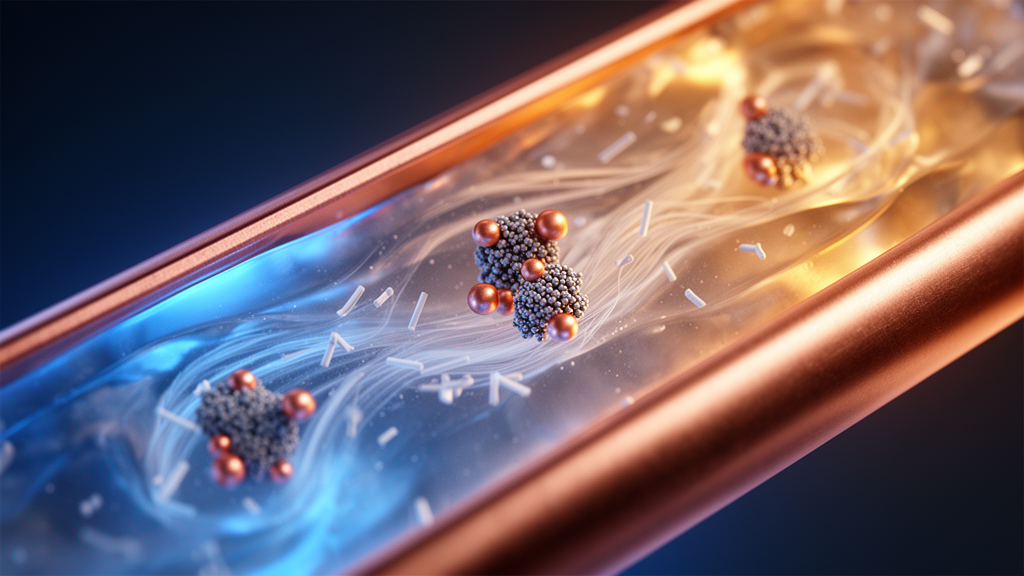
The fluid medium examined in this work was formulated as a ternary nanofluid utilizing a base carrier liquid of 50 percent propylene glycol and 50 percent water by volume. This specific mixture was chosen due to its low corrosivity, anti-freezing properties, environmental safety, and thermal stability. To boost thermal transport characteristics, the authors modeled the sequential suspension of three morphologically distinct nanostructures: spherical carbon nanotubes known for high mechanical durability and thermal conductivity, cylindrical graphene oxide exhibiting high surface area and conductive performance, and platelet-shaped aluminum oxide particles providing corrosion resistance, mechanical hardness, and dielectric stability. Theoretical mixture correlations accounting for dilute loading, homogeneous dispersion, and particle geometry factors were implemented to calculate effective density, viscosity, heat capacity, and thermal conductivity across varying volume fractions up to 3 percent.
Rheological behavior within the computational system followed the Williamson non-Newtonian fluid model, which accurately describes shear-thinning viscoelastic materials where dynamic viscosity decreases under elevated shear rates. The transport took place through a porous substrate governed by Darcy–Forchheimer flow, accounting for linear viscous drag at low speeds alongside quadratic inertial drag at elevated velocities. The governing continuum model combined the continuity equation, momentum equations incorporating the Grinberg Lorentz force and electric double-layer body forces, energy equations featuring nonlinear Rosseland thermal radiation, viscous dissipation, and volumetric heat generation, and species concentration equations incorporating destructive first-order homogeneous chemical reactions and pollutant source parameters.
To solve the complex set of coupled partial differential boundary-layer equations, the researchers applied similarity transformations that converted the spatial field equations into a system of highly nonlinear ordinary differential equations. These equations were recast into seven first-order differential equations and simulated using the MATLAB bvp4c collocation solver. Operating with a three-stage Lobatto IIIA integration scheme providing fourth-order accuracy, the solver adapted computational meshes automatically within a semi-infinite spatial domain truncated at a dimensionless distance of five units from the wall. The numerical method was strictly validated against classical hydrodynamic benchmarks from peer-reviewed literature for special limiting cases, verifying the baseline skin friction and wall heat transfer rates with high fidelity.
The parametric numerical results revealed that fluid velocity within the momentum boundary layer increases significantly with higher values of the modified Hartmann number and the Helmholtz–Smoluchowski electroosmotic velocity parameter. A stronger Hartmann number intensifies the streamwise Lorentz force, which acts as a direct momentum source that accelerates the fluid near the plate surface and thickens the hydrodynamic boundary layer. Similarly, elevating the Helmholtz–Smoluchowski velocity strengthens the electrostatic body force acting across the electrical double layer, facilitating momentum penetration. In contrast, increasing the Williamson parameter, the porous resistance parameter, the Forchheimer inertial number, or the magnet-electrode width parameter suppressed the velocity distribution, as enhanced viscoelastic tension and porous matrix obstruction generate stronger resistive drag against the moving fluid.
Thermal analysis revealed distinct mechanisms controlling the temperature distribution and boundary-layer thickness. The presence of volumetric internal heat generation contributed internal energy to the fluid core, significantly elevating local temperatures and broadening the thermal boundary layer. Conversely, increasing the nonlinear thermal radiation parameter and the surface-to-ambient temperature ratio accelerated energy dissipation away from the wall, causing a pronounced decrease in the dimensionless temperature profile and thinning the thermal boundary layer. When evaluating engineering transfer metrics, the local Nusselt number decreased under higher thermal radiation and temperature ratio parameters due to weakened temperature gradients near the wall, but increased notably when volumetric heat generation intensified.
Mass transport and contaminant dispersion analyses showed that chemical reaction kinetics and molecular diffusion strongly govern the species concentration field. Raising the destructive chemical reaction parameter accelerated the consumption rate of the diffusing reactant species, causing concentration levels to fall sharply and producing steeper concentration gradients adjacent to the wall. Higher Schmidt numbers, representing lower mass diffusivity relative to momentum diffusivity, similarly contracted the concentration boundary layer. Conversely, positive increases in the external pollutant source strength and the local discharge parameter supplied additional solute into the stream, counteracting chemical consumption, elevating local species concentrations, and expanding the concentration boundary layer.
A critical engineering comparison conducted in the study highlighted the quantitative superiority of ternary nanofluids over conventional single-particle nanofluids and two-particle hybrid suspensions. When the total solid nanoparticle volume fraction was raised to 3 percent, the ternary nanofluid achieved a 215.56 percent increase in the skin-friction coefficient, a 75.13 percent increase in the local Nusselt number, and a 10.77 percent increase in the local Sherwood number relative to the pure base fluid. Under identical 3 percent loading conditions, a hybrid nanofluid delivered gains of 91.62 percent in skin friction, 22.14 percent in heat transfer, and 7.23 percent in mass transfer, while a single-component nanofluid generated increases of only 5.74 percent, 0.37 percent, and 0.33 percent, demonstrating the powerful physical synergy among multi-component nanoparticles.
To circumvent the heavy computational expense required for iterative numerical differential equation evaluations, the authors trained an artificial neural network using Bayesian regularization. Configured with a single hidden layer of ten neurons utilizing hyperbolic tangent sigmoid activation functions, the neural network processed fourteen governing dimensionless input parameters to simultaneously predict fluid velocity, temperature, species concentration, surface skin friction, the Nusselt number, and the Sherwood number. The surrogate framework achieved a correlation coefficient of 0.99999 and exhibited mean squared errors spanning 10⁻⁷ to 10⁻¹⁰ across training, validation, and test subsets. Relative prediction errors remained strictly below 0.08 percent for skin friction, 0.3 percent for the Nusselt number, and 0.65 percent for the Sherwood number, confirming that data-driven surrogate modeling can reliably forecast complex non-Newtonian transport phenomena.
Despite the high computational precision achieved, the authors documented several model assumptions and operational boundaries that define the scope of the study. The mathematical formulation was restricted to steady, two-dimensional laminar flow across an idealized flat boundary, leaving three-dimensional turbulent and transient dynamics for future evaluation. Furthermore, thermophysical properties were assumed constant with respect to temperature and local concentration variations, and empirical models presumed ideal nanoparticle dispersion without accounting for physical aggregation or particle settling over time. Finally, the authors noted that the neural network was trained entirely on synthetic data from numerical solvers rather than empirical measurements, highlighting the future need for experimental validation in physical microchannels and the exploration of physics-informed neural network architectures.
Subject of Research: Computational modeling of electroosmotic ternary nanofluid transport and thermal performance across an electromagnetic Riga surface
Article Title: Thermodynamic analysis of electroosmotic transport in a williamson ternary nanofluid over a riga surface with coupled heat and reactive mass transfer
Article References: Islam, T., Jewel Rana, B. M., Sheikh, M. S., Ali, M. Y., & Afikuzzaman, M. (2026). Thermodynamic analysis of electroosmotic transport in a williamson ternary nanofluid over a riga surface with coupled heat and reactive mass transfer. Discover Nano, 21(1), Article 633. https://doi.org/10.1186/s11671-026-05026-2
Image Credits: AI Generated
DOI: 10.1186/s11671-026-05026-2
Keywords: ternary nanofluid, electroosmotic transport, Riga surface, Williamson fluid, Darcy-Forchheimer medium, heat transfer, mass transfer, Nusselt number, Sherwood number, skin friction, artificial neural network, Bayesian regularization, computational fluid dynamics, microfluidics, thermal radiation, chemical reaction kinetics
News Source: Audrey Campbell. (November 12, 2026). Ternary Nanofluid Boosts Microscale Heat Transfer by Seventy-Five Percent in Computational Study. Scienmag.