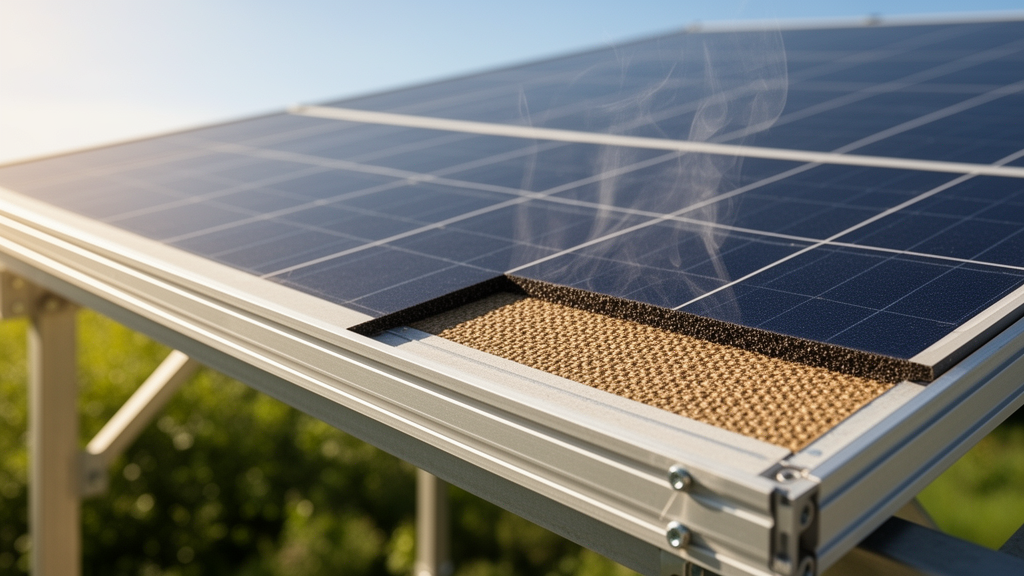
A laboratory study evaluating passive thermal management has demonstrated that combining an organic phase change material with an embedded copper mesh and hybrid conductive additives significantly mitigates heat accumulation in solar cells. In controlled experiments conducted under simulated solar irradiance, an engineered cooling system incorporating a Vaseline-glycerin mixture, an interconnected copper tube-wire network, expanded graphite, and alumina nanoparticles achieved a 9.4-degree Celsius reduction in photovoltaic panel surface temperature. This thermal suppression, representing a 19.97 percent decrease compared to an uncooled baseline panel, prevented overheating and yielded a 2.073-watt improvement in maximum electrical power output. The resulting 36.34 percent relative boost in peak power highlights the viability of combining multi-component phase change materials with structured heat-spreading matrices to counteract thermal losses without auxiliary energy.
The performance of semiconductor photovoltaic panels degrades progressively as operational temperatures escalate under continuous sunlight. Excessive heating diminishes open-circuit voltage, reduces net power conversion efficiency, and accelerates long-term degradation of photovoltaic encapsulation materials, ultimately compromising module operational lifespans. Passive cooling approaches using phase change materials have attracted extensive scientific attention because they absorb surplus thermal energy as latent heat during phase transitions. By buffering extreme temperature fluctuations, phase change materials maintain photovoltaic cells closer to optimal operating thresholds. However, conventional organic phase change media such as petroleum jelly exhibit low thermal conductivity, which impedes heat absorption and creates localized hot spots.
To resolve these thermal bottlenecks, researchers have increasingly examined shape-stabilized phase change composites incorporating high-conductivity carbonaceous fillers and dispersed metal oxide nanoparticles. Expanded graphite features a porous layered structure with a high specific surface area, establishing continuous heat conduction pathways across an organic matrix. Concurrently, metallic or ceramic nanoparticles, such as aluminum oxide, accelerate melting and freezing kinetics while reducing composite thermal response times. Despite these individual advancements, prior investigations frequently evaluated thermal conductivity enhancers, extended finned geometries, and carbon additives in isolation. Systematic experimental data evaluating the simultaneous integration of optimized base phase change formulations, metallic conduction grids, expanded graphite networks, and dispersed alumina nanoparticles within a unified cooling architecture remained scarce, prompting the authors to construct a controlled laboratory investigation.
The experimental apparatus was constructed inside a dedicated laboratory chamber measuring 80 by 50 by 50 centimeters. The enclosure featured a wooden roof and interior walls lined with reflective aluminum sheets to maximize radiation intensity and ensure spatial irradiance uniformity. Illumination was provided by five 400-watt greenhouse metal halide lamps mounted above the module, operated using dedicated ballasts and starters to prevent power fluctuations. To simulate ambient airflow and maintain steady ventilation, two axial fans were positioned on opposite sidewalls. Testing utilized a commercial Welion polycrystalline silicon photovoltaic module comprising 108 solar cells with dimensions of 24 by 36 centimeters. Specified ratings included a maximum power of 10 watts, open-circuit voltage of 21.6 volts, short-circuit current of 0.62 amperes, maximum voltage of 18 volts, and maximum current of 0.56 amperes.
Thermal and electrical parameters were tracked through calibrated laboratory instrumentation to ensure experimental repeatability. Six type-K thermocouples were affixed to the front surface of the photovoltaic module at equidistant locations using high-temperature silicone adhesive. These sensors fed into a 12-channel Lutron digital data acquisition system to calculate spatial average surface temperatures. Electrical performance was recorded using a variable resistive load, allowing operators to derive current-voltage and power-voltage curves and identify the peak operating point. Repeatability was evaluated by conducting three independent runs for every operational configuration under ambient room temperatures between 23 and 26 degrees Celsius. Measurement uncertainties were quantified based on manufacturer specifications, encompassing plus or minus 0.37 degrees Celsius for temperature acquisition, plus or minus 0.016 volts for panel voltage, and plus or minus 0.08 amperes for current.
Initial testing established baseline thermal dynamics and determined the optimal mixing ratio for the base matrix. Under illumination, the uncooled reference module reached a steady-state surface temperature of approximately 50 degrees Celsius after 60 minutes, delivering 5.244 watts. Introducing 2 kilograms of pure Vaseline in a rear container reduced panel temperature to 49.6 degrees Celsius and raised maximum power to 5.343 watts. The authors then blended glycerin—50, 100, 150, 200, and 250 grams—into the Vaseline. Panel surface temperature reductions relative to baseline measured 1.3, 2.3, 3.2, 3.3, and 1.7 degrees Celsius across these mixtures. The optimal composition containing 200 grams of glycerin achieved a 3.3-degree Celsius temperature decrease, raised voltage by 0.2 volts, and boosted peak power to 5.647 watts, a 12.3 percent improvement. Adding 250 grams of glycerin diminished performance because liquid-phase predominance reduced heat storage efficiency.
Following base material optimization, researchers introduced an internal metallic structure to accelerate heat transfer between the module and cooling medium. Short copper tubes, measuring 1.5 centimeters in diameter and 2.5 centimeters in height, were interconnected with copper wires in a square grid and submerged within the container. This network promoted lateral heat spreading throughout the composite layer, mitigating localized thermal gradients. When integrated with the base phase change material, the copper grid lowered panel surface temperature from 46.7 to 44.8 degrees Celsius, achieving an additional 1.9-degree Celsius reduction. Compared to the uncooled panel, total temperature reduction reached 2.5 degrees Celsius, a 4.8 percent cooling effect. Electrically, maximum power increased from 5.891 to 5.917 watts, representing a 0.44 percent gain over the material-only setup and a 12.74 percent enhancement over the uncooled baseline.
Material characterization via differential scanning calorimetry and thermal conductivity analysis revealed significant thermodynamic shifts across formulations. The baseline matrix possessed a thermal conductivity of 0.190 watts per meter-Kelvin, a solid density of 870 kilograms per cubic meter, and a latent heat of fusion of 45.49 joules per gram across a melting range of 46 to 49 degrees Celsius. Adding 0.05 weight percent expanded graphite raised thermal conductivity to 0.300 watts per meter-Kelvin and latent heat to 116.50 joules per gram. Incorporating alumina nanoparticles altered these parameters substantially. A composite containing 0.075 weight percent expanded graphite and 0.05 weight percent alumina nanoparticles achieved the highest latent heat of fusion at 200.00 joules per gram alongside a thermal conductivity of 0.367 watts per meter-Kelvin. Conversely, increasing nanoparticle loading to 0.125 weight percent produced the maximum thermal conductivity of 0.377 watts per meter-Kelvin but reduced latent heat to 133.80 joules per gram, demonstrating a trade-off between conduction and storage capacity.
When conductive additives were evaluated within the solar simulator, physical behavior revealed practical complexities. Introducing 1 gram of expanded graphite alone into the matrix failed to enhance cooling; instead, surface temperature increased by approximately 1.5 degrees Celsius, causing a drop in electrical generation. The authors noted that this negative effect likely arose from particle agglomeration, non-uniform dispersion, or increased thermal contact resistance at the panel interface. However, combining expanded graphite with dispersed alumina nanoparticles reversed this outcome entirely. Testing successive nanoparticle additions between 0.5 and 2.5 grams revealed that an optimal loading of 0.1 weight percent alumina nanoparticles combined with 0.075 weight percent expanded graphite delivered superior cooling. Relative to the base phase change setup, this hybrid formulation reduced panel temperature by 2.4 degrees Celsius and increased maximum power output by 1.4 watts, corresponding to a 23.6 percent electrical gain.
A cumulative comparison of progressive system modifications illustrated how each consecutive thermal intervention contributed to overall electrical performance gains. Relative to the uncooled reference panel, blending 200 grams of glycerin into the base Vaseline raised relative power output by approximately 12.3 percent. Installing the interconnected copper tube-wire grid increased the relative power gain to approximately 15.5 percent, demonstrating the benefit of establishing conductive pathways through the melt layer. Incorporating 0.075 weight percent expanded graphite produced an incremental gain to approximately 16 percent relative improvement. Finally, the simultaneous addition of 0.1 weight percent alumina nanoparticles alongside expanded graphite elevated total relative power improvement to approximately 36 percent. The authors explicitly emphasized that these reported figures represent relative percentage improvements in electrical power generation compared against the identical uncooled baseline condition, rather than absolute increases in semiconductor conversion efficiency.
The experimental observations demonstrate consistency with broader published literature on photovoltaic thermal regulation, while reflecting variations arising from experimental boundaries. Previous investigations examining phase change materials in solar applications, such as studies by Waqas and colleagues, documented average operating temperature reductions between 2.4 and 2.8 degrees Celsius alongside electrical efficiency improvements of up to 2.0 percent. Other published works utilizing form-stabilized graphite composites or nanofillers have reported temperature reductions ranging from moderate drops to over 30 degrees Celsius depending on module geometry, incident radiation intensity, wind speeds, and heat sink thickness. Beyond panel cooling, the evaluated composite formulations exhibit thermodynamic characteristics relevant to low- and moderate-temperature latent heat thermal energy storage systems. The combination of high latent heat storage density and enhanced thermal transport properties could potentially benefit shell-and-tube or finned storage units, similar to geometries explored by researchers like Nekahi and Vaferi.
Notwithstanding the performance enhancements documented during testing, the authors identified essential boundary conditions governing their findings. Experiments were conducted entirely within a controlled laboratory environment using simulated metal halide lighting, fixed ambient temperatures, and artificial ventilation, which do not replicate outdoor meteorological complexities such as transient cloud cover, variable irradiance, shifting winds, and dust accumulation. Furthermore, two-hour testing windows did not evaluate composite behavior across complete diurnal cycles or extended charging and discharging periods. The authors concluded that future research must subject these multicomponent formulations to rigorous long-term thermal cycling to evaluate physical stability over repeated melting and solidification cycles.
Subject of Research: Passive thermal management of photovoltaic panels using composite phase change materials
Article Title: Using shape-stabilized phase change material and thermal conductive nanoparticles/expanded graphite to improve electrical efficiency of photovoltaic panels
Article References: Goudarzi, A., Rahimi, M., & Azimi, N. (2026). Using shape-stabilized phase change material and thermal conductive nanoparticles/expanded graphite to improve electrical efficiency of photovoltaic panels. Results in Engineering, 32, Article 113986. https://doi.org/10.1016/j.rineng.2026.113986
Image Credits: AI Generated
DOI: 10.1016/j.rineng.2026.113986
Keywords: photovoltaic thermal management, phase change materials, shape-stabilized phase change materials, Vaseline-glycerin blend, expanded graphite, alumina nanoparticles, copper tube-wire network, passive cooling, solar simulator, polycrystalline silicon, electrical power output, latent heat of fusion, thermal conductivity, differential scanning calorimetry, operating temperature reduction, current-voltage characteristics, solar cell efficiency, latent heat storage
News Source: Denise Maddox. (November 12, 2026). Integrated Phase Change Composite Lowers Solar Panel Temperature and Increases Power Output. Scienmag.