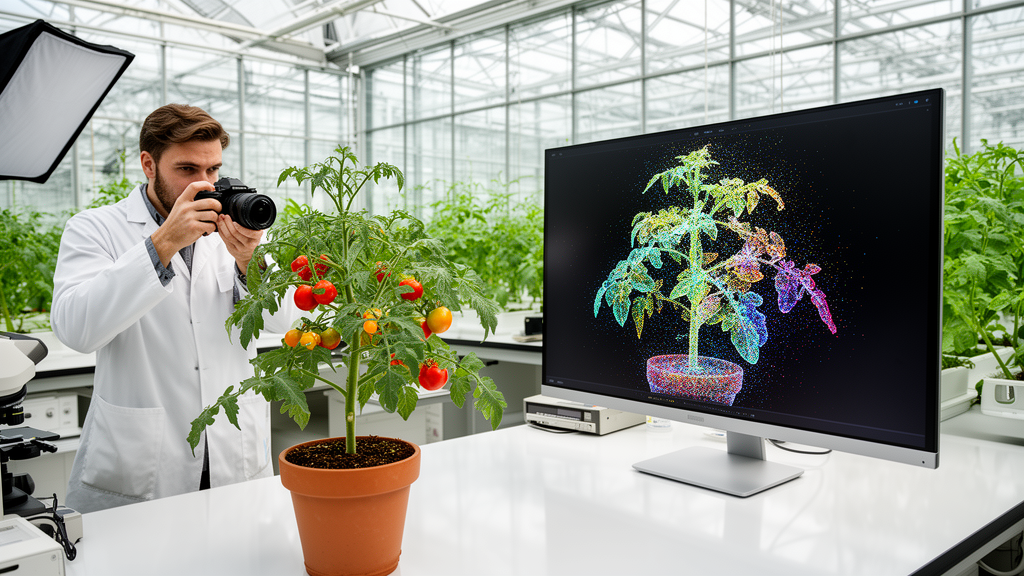
Researchers at the University of Tartu have demonstrated that everyday consumer-grade cameras can generate detailed, explorable three-dimensional models of plants, providing botanical gardens and museums with an accessible, affordable method to document and preserve dynamic living collections. In a peer-reviewed study published in the open-access Biodiversity Data Journal, authors Toivo Aukusti Ylinampa and Urmas Kõljalg established a workflow that captures complex botanical structures without requiring specialized or expensive scanning hardware.
Plants present enduring documentation challenges because they are inherently three-dimensional and constantly changing over time, characteristics that make them difficult to capture faithfully in conventional two-dimensional photographs or traditional pressed herbarium specimens. To address these physical complexities, the research team combined two distinct computational techniques: photogrammetry, which reconstructs measurable three-dimensional geometry from sets of overlapping photographs, and 3D Gaussian Splatting, an emerging method capable of producing photorealistic models in real time while effectively rendering thin, tangled foliage.
The experimental setup relied primarily on accessible hardware, centering on a compact Olympus TG-6 camera that was supplemented by a macro-lens camera, a standard smartphone, and an aerial drone. Using this consumer-grade imaging array, the investigators successfully digitized diverse botanical subjects across a broad range of biological scales, extending from an individual orchid flower to a full-sized tree.
Two primary datasets highlighted the versatility of the combined workflow. In the first dataset, the authors documented the temporal development of a fern by capturing approximately 8,500 photographs across twelve separate days within a fifteen-day observation window. Instead of maintaining permanently fixed camera rigs, the team aligned the daily image sets using stable, unchanging features in the surrounding background environment, ensuring that each day’s model shared a unified scale and spatial orientation to enable direct comparisons of structural growth over time.
Reflecting on the photogrammetric process, lead author Toivo Ylinampa noted that extensive scanning revealed unexpected practical efficiencies in image alignment. “After running thousands of photogrammetric scans I realised that not all the images have to be directly related,” Ylinampa stated, explaining that “while two pieces of fern won’t share many comparable feature points, the surrounding area has lots of them — for free!”
In the second major demonstration, the researchers tackled an entire indoor facility by collecting approximately 20,000 photographs inside the University of Tartu Botanical Garden’s tropical greenhouse. The extensive image collection was processed across fourteen separate overlapping spatial sections and subsequently assembled into an interactive virtual walkthrough, illustrating how large-scale botanical enclosures can be translated into navigable digital formats.
Despite these successes, the investigators documented several operational limitations, observing that even gentle ambient wind noticeably reduced model quality, while the manual assembly of the greenhouse segments makes the walkthrough better suited to visual exploration than to exact physical measurement. Nevertheless, a close-up macro test demonstrated reliable spatial accuracy, with a 13-millimeter measurement taken directly from the digital model closely matching a 13.2-millimeter physical caliper reading. Because the methodology relies on consumer cameras and widely accessible software, the authors noted it provides practical guidance for generating scalable 3D datasets for plant documentation, living collections, digital exhibitions, and quantitative analyses, with automated section stitching and independent quantitative validation planned as future steps.
To support widespread adoption across the botanical research community, the investigators released their complete collection of interactive 3D models and demonstration videos online through links hosted in the study, which was published by Pensoft Publishers. In demonstration video materials credited to Toivo Aukusti Ylinampa, the lead author documents the underlying practical capture routine by taking multiple photographs around a botanical subject that are subsequently converted into an explorable digital twin.
Subject of Research: Digitizing plant growth and greenhouse environments using consumer cameras and 3D Gaussian Splatting
Article Title: Digital twins for plants: how ordinary cameras are helping preserve living collections
Article References: Digital twins for plants: how ordinary cameras are helping preserve living collections. Original publication (Bibliographic details unavailable.)
Image Credits: AI Generated
DOI: Not provided
Keywords: photogrammetry, 3D Gaussian Splatting, digital twins, plant documentation, University of Tartu, botanical gardens, living collections, Olympus TG-6, Biodiversity Data Journal, fern growth capture, greenhouse walkthrough, consumer-grade cameras, Toivo Aukusti Ylinampa, Urmas Kõljalg, macro photography, 4D plant growth, drone imaging, virtual walkthrough
News Source: Mallory Mcbride. (November 12, 2026). Consumer Cameras and Gaussian Splatting Create Explorable Plant Digital Twins. Scienmag.