Credit: Michiel Verhofstad/NIOO-KNAW
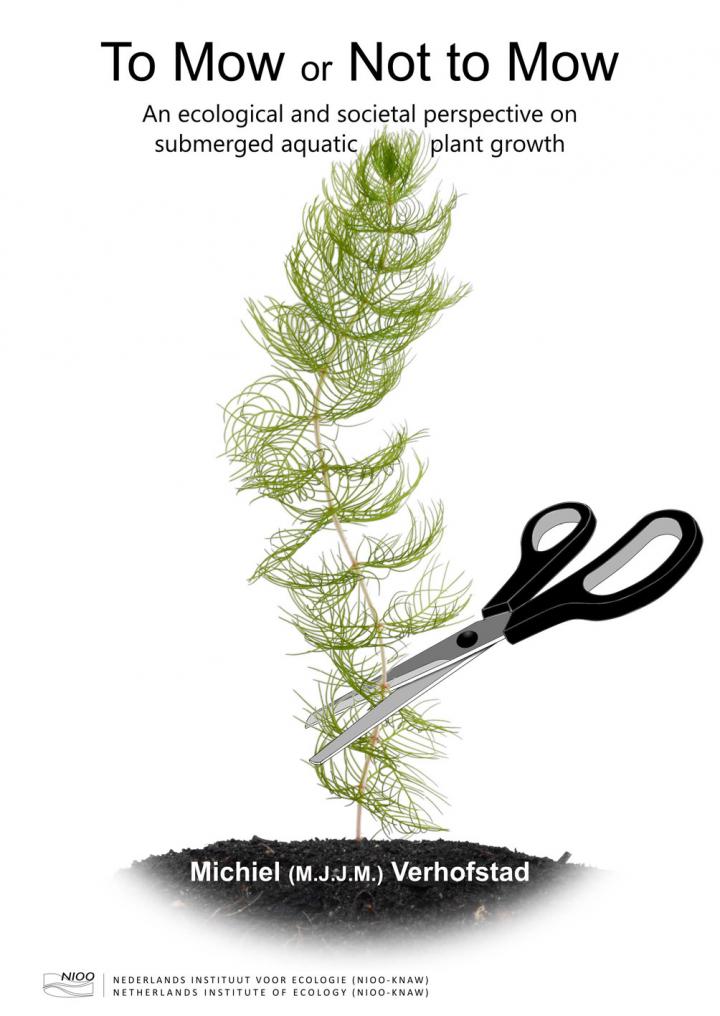
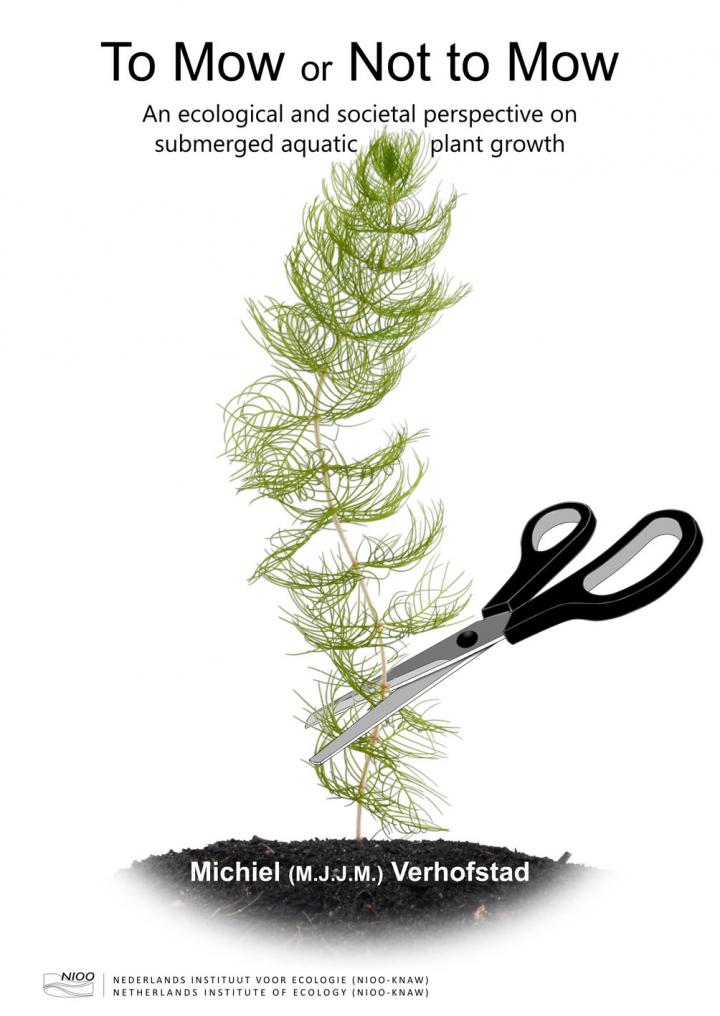
Massive growth of submerged aquatic plants can be a nuisance, especially in summer. It's up to water managers to limit the inconvenience for swimmers, boats and fishermen in a way that is both responsible and cost-effective. NIOO researcher Michiel Verhofstad defended his PhD thesis this week on the 'root' causes of the problem, and how best to tackle it.
Mowing as a way of trimming not just grass but aquatic plants is getting to be more and more common. In some situations, submerged aquatic plants can become rampant. That's not just true for invasive species such as western waterweed in the Netherlands, but also for indigenous ones, including Eurasian watermilfoil and perfoliate pondweed.
"If the stems become too long in shallow water, and the plants begin to crowd the surface, that can be a major nuisance", says ecologist Michiel Verhofstad of the Netherlands Institute of Ecology (NIOO-KNAW). "Of course it all depends on what you're planning to do on that spot."
Nuisance growth of aquatic plants has become a problem in more and more areas – from Europe and North-America to Africa and Australia – but until now, very little scientific research had been done into the issue.
Root of the problem
"My advice to water managers would be to avoid drastically removing submerged aquatic plants, as they do have an important function in shallow lakes and ditches", says Verhofstad. "They're needed for various ecosystem services from which we as humans benefit."
The most effective way to halt nuisance growth in the longer term, he discovered, is to tackle the problem at the 'root': nuisance growth is caused mostly by an abundance of light and nutrients such as phosphates.
"So the best thing would be simply to reduce nutrient levels. Unfortunately this may not always be possible, or at least not in the short term. The procedure may be too expensive or too intrusive, or nutrients may be coming in from outside." In such cases, top-down management methods such as mechanical cutting can alleviate the problem.
Disadvantages of mowing
But the effects of mowing are usually short-lived. And if it's done too frequently or too drastically, the result may be an ecosystem collapse, clearing the way for excessive growth of – possibly toxic – algae. Unfortunately, it's not always immediately clear if mowing has indeed been too drastic, as the adverse effects may not occur until after several years.
It's also important not to mow everywhere at once, argues Verhofstad. Phased mowing leaves more room for diversity in the landscape, which is good for habitat formation. And as an additional bonus, the costs for water managers aren't as high.
Many of Verhofstad's findings have in the meantime been included in a report for water managers published by Stowa, the Dutch foundation for applied water research.
Harvesting biomass
Another recommendation in Verhofstad's thesis is that plants or parts of plants that have been cut should be removed. This prevents nutrients from being released back into the water, and another advantage is that any harvested vegetation can subsequently be used as fertiliser.
"There are plenty of ways in which the harvested biomass can be used sustainably", say Verhofstad and his supervisor, NIOO-researcher Liesbeth Bakker. "But most have become forgotten or fallen into disuse in today's western society."
Aquatic plants can be used for food production, cattle fodder, building materials, fuel and medication. "But the preferred option is to use them as fertiliser, as it closes the nutrient cycle. The harvested biomass needs very little processing, so it can be used right away and in the vicinity. And using it as fertiliser can easily be combined with other applications, such as the production of biofuel."
The researchers emphasise that the nuisance caused by massive growth of submerged aquatic plants should not eclipse their beneficial qualities. Without them, our water would not be as clean or as limpid, and for many animals they're a valuable source of food and shelter: 'ecosystem services' from which, ultimately, we all benefit.
###
With more than 300 staff members and students, the Netherlands Institute of Ecology (NIOO-KNAW) is one of the largest research institutes of the Royal Netherlands Academy of Arts and Sciences (KNAW). The institute specialises in water and land ecology. As of 2011, the institute is located in an innovative and sustainable research building in Wageningen, the Netherlands. NIOO has an impressive research history that stretches back 60 years and spans the entire country, and beyond.
Media Contact
Froukje Rienks
[email protected]
31-610-487-481
@niooknaw
http://www.nioo.knaw.nl
Original Source
https://nioo.knaw.nl/en/press/rampant-aquatic-plant-growth-mow-or-not-mow