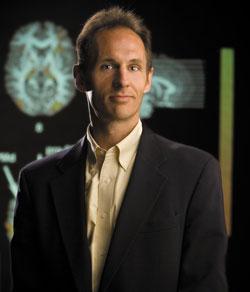
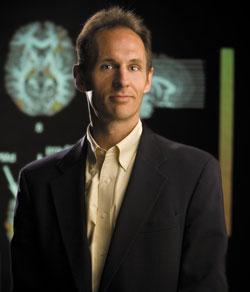
Credit: MU School of Medicine
When a person loses a hand, nerves that control sensation and movement are severed. This trauma deprives sensory and movement areas of the brain of stimulation, causing them to reorganize their functions. Whether these reorganizational changes can be reversed in the adult brain is of broad relevance to neurorehabilitation. Scott Frey, a professor at the University of Missouri, reports in a new study that higher-level regions of the brain may compensate for persistent reorganizational changes in brain areas responsible for hand sensation and movement. These and other findings from Frey's decade-long study of hand transplant recipients have led to a new $1.7 million grant from the Department of Defense to determine whether recovery from nerve injury can be improved through non-invasive brain stimulation.
"Currently, there are approximately 75 former amputees worldwide who have received hand transplants," said Frey, the Miller Family Chair in Cognitive Neuroscience in the Departments of Psychological Sciences, Physical Medicine and Rehabilitation and Neurology. "While conceptually similar to heart, lung and kidney transplants, hand transplants present unique challenges. For successful recovery, the brain that has reorganized following hand loss must relearn how to feel with, and control voluntary movements of, the new hand. How this is possible has been a central question in my work for the past decade."
In this recent paper Frey and his team studied a trauma victim who had lost his left, non-dominant hand through a crush injury at the age of 23. He underwent the transplant procedure over a decade later and essentially had to "re-learn" sensory perception and basic motions, such as reaching and grasping.
In the study, the hand transplant patient completed a series of ordinary reaching and grasping tasks at different intervals following the hand transplant procedure. Regions of the brain were monitored by functional magnetic resonance imaging (fMRI) to observe how sensorimotor areas in both sides of the brain reacted to the tasks. The researchers found that at 26 and 41 months post-surgery, the patient showed marked improvements in hand function that were accompanied by some surprising adaptations in the brain.
"While areas involved in basic sensory and motor functions exhibited persistent amputation-related changes, higher-level regions that typically control reaching and grasping actually took over their old functions again," Frey said. "The results from the study suggest that even in the middle-aged brain, when stimulation is provided, areas of the rain that are "upstream" may compensate for persistent reorganizational changes in "down-stream regions." This fresh perspective, if correct, may have broad implications for how approach the challenge of neurorehabilitation in a variety of conditions."
Frey and his team's work on amputees may inform rehabilitation of amputees and stroke patients.
###
The study, "Grasping with a new hand: Improved performance and normalized grasp-selective brain responses despite persistent functional changes in primary motor cortex and low-level sensory and motor impairments," was accepted by NeuroImage. Funding for the study was provided by the Department of Defense (W81XWH-13-1-0496) and the National Institutes of Health (NS083377). The content is solely the responsibility of the authors and does not necessarily represent the official views of the funding agencies.
Frey holds joint appointments as an adjunct professor in the Departments of Neurology, Psychiatry and Physical Medicine and Rehabilitation in the MU School of Medicine, and as a professor of psychological sciences in the MU College of Arts and Science.
Media Contact
Jeff Sossamon
[email protected]
573-882-3346
@mizzounews
http://www.missouri.edu
Original Source
http://munews.missouri.edu/news-releases/2018/0123-brain-reorganization-supports-recovery-of-function-in-hand-transplant-recipient-mu-researcher-finds/