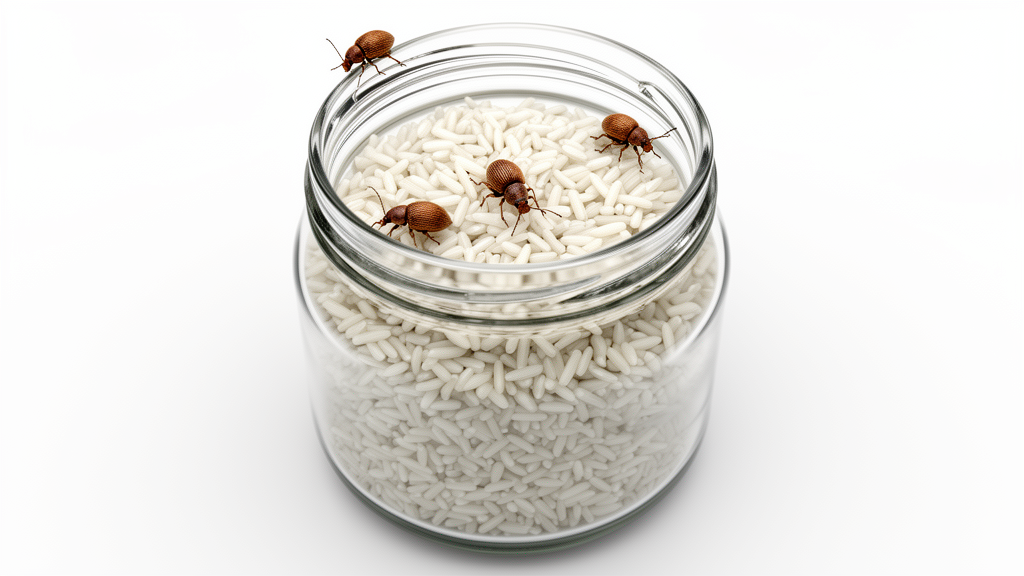
A comprehensive systematic review of forty-three experimental studies has determined that insect infestations during rice storage cause quantitative losses characterized by marked variability rather than a uniform, pest-specific metric. The investigation, conducted by researchers Shravani Ladkat-Gadge, Surabhi Singh Yadav, Shariza Abdul Razak, and Kavitha Menon, synthesized experimental literature examining physical depletion across various processing forms of rice. The research demonstrated that storage insect pests cause measurable grain weight losses ranging from negligible baseline levels up to 61.50 percent, while the proportion of insect-damaged grains spans from 0.00 percent to complete destruction at 100.00 percent. In addition, the review identified frass accumulation reaching up to 5.88 percent and standardized kernel mass reductions reaching up to 40.00 percent. The authors concluded that the extent of stored grain deterioration cannot be captured by a singular fixed percentage, as physical losses are determined by complex biological interactions between specific insect species, initial pest densities, grain processing structures, exposure intervals, environmental conditions, and analytical assessment methods.
Global rice production represents a cornerstone of worldwide caloric intake and agricultural commerce, ranking as the third most harvested crop globally by volume. Annual production of unmilled rice reached 820 million tonnes in 2024, with global milled rice production projected to reach between 551.5 and 555.6 million tonnes during the 2025 to 2026 season. India stands as the world’s largest producer, accounting for 28 percent of global production in 2024, where substantial warehouse surpluses remain vulnerable to postharvest pest colonization. Broad national surveys, such as the 2022 NABCONS investigation in India, reported an overall postharvest paddy loss of 4.8 percent, comprising 4.16 percent during farm-level operations and 0.61 percent at the market stage. However, broader national aggregate assessments fail to isolate the specific proportion of physical loss directly attributable to stored-product insect infestations. Both primary pests, which attack intact kernels through specialized feeding mechanisms, and secondary pests, which exploit broken kernels, dust, and pre-existing grain fissures, compromise the physical volume, nutritional integrity, and economic viability of harvested reserves, impeding international targets outlined in Sustainable Development Goals 2, 3, and 12.
To rigorously evaluate the experimental evidence surrounding insect-induced postharvest deterioration, the investigators executed a systematic literature search adhering to the Preferred Reporting Items for Systematic Reviews and Meta-Analysis guidelines. The search protocol interrogated three electronic indexing databases—PubMed, Scopus, and Web of Science—spanning publications from January 1928 through June 2026. The search architecture utilized combinations of Medical Subject Headings and Boolean operators incorporating terms for rice grains, storage conditions, damage indicators, and specific pest taxa. The initial query yielded 13,374 candidate records. Following the automated and manual removal of 4,681 duplicate citations, title and abstract screening was conducted on 8,693 unique articles. Full-text eligibility evaluations were then performed on 52 candidate articles using a structured Population, Intervention, Comparator, Outcome, Study design, and Timeframe framework. Studies were required to employ controlled experimental designs assessing quantitative loss endpoints—specifically weight loss, damaged grain percentages, frass generation, hundred-kernel weight, or thousand-kernel weight—in stored rice forms subjected to insect infestation. Field trials, observational studies, secondary reviews, and non-English manuscripts were excluded, yielding a final corpus of 43 eligible experimental studies appraised with the Joanna Briggs Institute critical appraisal checklist for quasi-experimental designs.
The forty-three included investigations represented experimental work conducted across fourteen nations, with a pronounced geographical concentration in Asia accounting for 76 percent of the literature. India was the most heavily represented country with thirteen studies, followed by Pakistan with six, the United States and Indonesia with four each, and Bangladesh, Ethiopia, Greece, Japan, Mozambique, and Nigeria contributing two studies apiece. Malaysia, Portugal, Brazil, and Thailand each contributed one study. Across these trials, researchers examined diverse processing forms of rice: paddy, also referred to as rough or husked rice, appeared in 28 studies; milled or polished white rice appeared in 18 studies; brown or de-husked rice appeared in 12 studies; while hand-pounded rice with an approximate seven percent milling degree and parboiled rice were evaluated in single investigations. Eleven studies assessed multiple processing stages simultaneously. The biological interventions evaluated nine insect species, dominated by the rice weevil Sitophilus oryzae across 20 studies, the lesser grain borer Rhyzopertha dominica across 15 studies, the Angoumois grain moth Sitotroga cerealella across 12 studies, and the maize weevil Sitophilus zeamais across six studies.
Direct grain weight loss served as the most frequently evaluated quantitative parameter, reported across 33 distinct experimental studies encompassing 20 assessments on paddy, 17 on milled rice, nine on brown rice, and one each on hand-pounded and parboiled grains. Across these thirty-three investigations, recorded weight losses ranged from 0.00 percent to 61.50 percent, observed across storage durations between 14 and 365 days. The primary beetle Sitophilus oryzae was the most extensively tested pest, documented in 17 weight loss studies across multiple grain forms. Extreme weight losses were documented under specific experimental configurations; for instance, Shahjahan in 1974 reported weight losses between 52.70 percent and 61.50 percent in paddy infested with Sitotroga cerealella until complete larval development under ambient temperatures. Similarly, Das and colleagues in 2024 recorded weight losses ranging from 12.41 percent to 60.16 percent in dehusked rice exposed to Sitophilus oryzae for 180 days, contrasting with 2.90 percent to 8.81 percent loss in intact husked paddy under identical conditions. Gravimetric methods and count-and-weigh techniques constituted the two primary estimation methodologies employed to assess these mass deficits.
Physical kernel damage, measured as the proportion of bored, tunneled, or visibly perforated grains, was evaluated in twenty-four experimental studies covering brown rice, milled rice, paddy, hand-pounded rice, and parboiled rice. The reported proportion of damaged grains spanned the entire theoretical spectrum from 0.00 percent to 100.00 percent over experimental timelines spanning 14 to 365 days. Sitophilus oryzae was again the dominant organism evaluated, featuring in ten studies and displaying kernel damage across the entire 0 to 100 percent range depending on the substrate. The absolute maximum damage of 100.00 percent was recorded by Athanassiou and colleagues in 2017 when milled rice was challenged with sixty adult Sitophilus oryzae per 100 grams for 62 days at 30 degrees Celsius and 65 percent relative humidity. In the same experimental setting, the related taxa Sitophilus granarius and Sitophilus zeamais generated 71.00 percent and 66.00 percent kernel damage, respectively. Most studies quantified damage through physical sorting and manual enumeration, demonstrating that while insect feeding compromises physical grain integrity, damaged kernel counts represent an index of physical injury rather than a direct equivalent of total mass disappearance.
Accumulation of frass—a composite mixture comprising insect excrement, larval exuviae, undigested endosperm powder, insect fragments, and fine grain debris—was quantified across seven studies using physical sieving separation. Frass values ranged from 0.00 percent to 5.88 percent of total sample mass across storage durations ranging from 42 to 240 days. Six primary pests were documented generating frass, including Rhyzopertha dominica in five studies, Sitophilus oryzae in three, and Sitophilus granarius, Sitophilus zeamais, Sitotroga cerealella, and Trogoderma granarium in single evaluations. Within-study comparative trials illustrated that grain processing profoundly modulates frass deposition. Hampton and co-workers in 2019 demonstrated that under identical Rhyzopertha dominica challenge densities and environmental conditions of 27 degrees Celsius and 60 percent relative humidity over 50 days, brown rice yielded 5.11 percent frass, whereas rough rice produced only 0.44 percent frass, representing an 11.6-fold disparity. Earlier work by Pingale and colleagues in 1957 showed that raw husked rice subjected to Sitophilus oryzae infestation for 240 days generated 6.82 percent frass, compared to 1.48 percent in parboiled milled rice under equivalent exposure parameters.
Standardized kernel mass depletion parameters, specifically hundred-kernel weight and thousand-kernel weight, represent direct measures of unit-level grain substance loss but remain remarkably underutilized in modern literature. Only two older experimental studies, both conducted in Japan, measured these metrics. Sittisuang and Imura in 1987 evaluated hundred-kernel weight reductions in brown rice across four insect species over a 98-day storage timeline with an identical starting density of 14 insects per 100 grams. Their findings revealed species-dependent depletion rates: Ephestia cautella larvae caused a 10.00 percent reduction, Tribolium castaneum caused a 14.00 percent reduction, Sitophilus oryzae caused a 19.00 percent reduction, and Rhyzopertha dominica produced the greatest degradation with a 40.00 percent drop in hundred-kernel weight. For thousand-kernel weight, Takeshita and Imura in 1990 recorded reductions ranging from 7.50 percent to 12.40 percent in brown rice and 6.70 percent to 14.30 percent in paddy following 91 days of exposure to Sitotroga cerealella adults. Both investigations applied count-and-weigh techniques, demonstrating that kernel-level mass measurements provide valuable insights into grain degradation that gross bulk weight loss may obscure.
A critical outcome of the systematic review is the refutation of simplistic, hierarchical vulnerability rankings based solely on processing stages or initial pest numbers. While paddy frequently exhibited lower weight loss and damage than processed forms due to the mechanical barrier presented by the outer hull, the hull did not provide universal protection. For example, Nadeem and colleagues in 2011 demonstrated that under Rhyzopertha dominica challenge for 90 days, paddy suffered greater weight loss ranging from 4.60 percent to 12.50 percent than milled rice at 2.40 percent to 2.70 percent, whereas under Tribolium castaneum and Trogoderma granarium, brown rice proved more susceptible. Similarly, initial infestation density failed to correlate linearly with subsequent quantitative loss. In trials by Hassan and co-workers in 2023, introducing 375 insects per 100 grams yielded insect-damaged grain proportions below 1.10 percent after 30 days, whereas Athanassiou and colleagues in 2017 observed up to 100 percent damage using only 60 adults per 100 grams over 62 days. These divergent outcomes indicate that progeny establishment, reproductive success, and kernel exploitation capacity outweigh raw inoculation counts.
The systematic synthesis also identified critical methodological boundaries and evidence gaps within the existing global literature. Only two investigations, conducted in Mozambique by Guenha et al. in 2014 and Covele et al. in 2020, evaluated naturally occurring insect infestations in stored paddy over extended storage periods of 180 and 365 days, recording weight losses of 0.27 to 5.56 percent and grain damage between 3.24 and 6.98 percent. The overwhelming reliance on artificial confinement in laboratory jars isolates biological damage potential under optimized temperatures and relative humidity levels, but fails to capture the fluctuating climatic stresses, pest migration dynamics, and logistical realities of farm-level granaries or commercial warehouses. Furthermore, methodological heterogeneity in loss estimation, frequent omission of standard deviations or standard errors, absence of formal meta-analytic pooling, and heavy geographical clustering in South and Southeast Asia constrain the direct translation of experimental findings into universal postharvest food loss policies.
To advance global postharvest preservation and support the attainment of international food security mandates, the review authors emphasized the imperative for standardized experimental protocols and field-validated assessments. Harmonized metrics are essential to bridge the divide between laboratory susceptibility testing and real-world loss modeling, enabling empirical data to populate global knowledge platforms such as the African Postharvest Losses Information System and the Food Loss and Waste databases maintained by the Food and Agriculture Organization. By establishing a multidimensional evaluation framework that integrates bulk weight depletion, kernel damage prevalence, frass contamination, and standardized kernel mass indices, researchers and agricultural policymakers can accurately characterize pest-grain interactions. Developing targeted, context-specific management strategies based on these empirical interactions will be vital to mitigating postharvest physical losses, safeguarding economic returns for producers, and securing stable rice supply chains globally.
Subject of Research: Quantitative loss parameters in stored rice grain forms caused by insect pest infestation
Article Title: Quantifying insect-induced losses in stored rice: a systematic review of grain damage, weight loss, and postharvest implications
Article References: Ladkat-Gadge, S., Yadav, S. S., Razak, S. A., & Menon, K. (2026). Quantifying insect-induced losses in stored rice: a systematic review of grain damage, weight loss, and postharvest implications. Frontiers in Sustainable Food Systems, 10, Article 2001641. https://doi.org/10.3389/fsufs.2026.2001641
Image Credits: AI Generated
DOI: 10.3389/fsufs.2026.2001641
Keywords: stored rice, postharvest loss, insect pests, grain storage, weight loss, grain damage, frass accumulation, food security, Quantifying, insect-induced, losses, stored
News Source: Alan Morgan. (November 12, 2026). Systematic Review Quantifies Insect Damage and Weight Loss in Stored Rice. Scienmag.