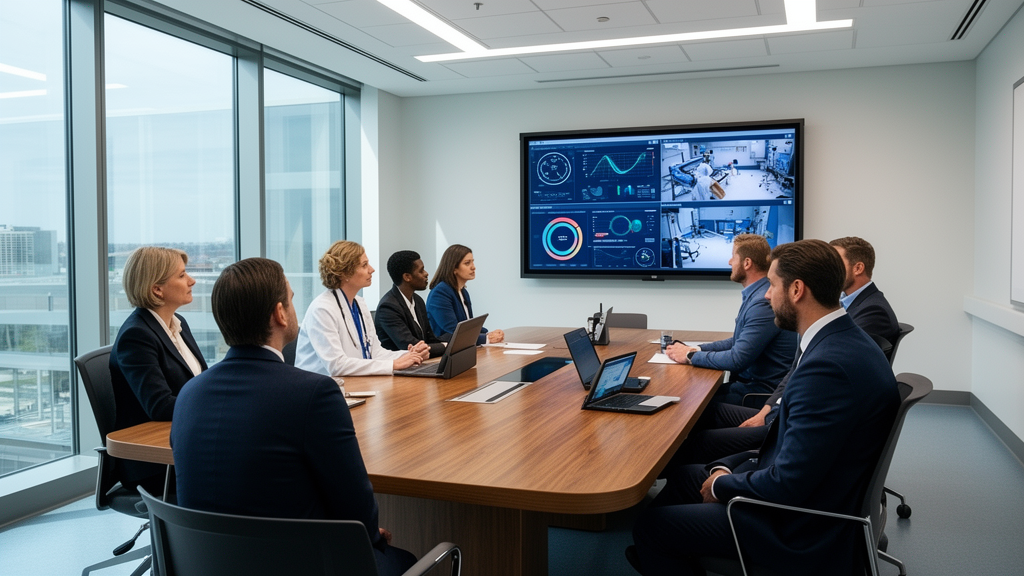
Debriefing represents an established, foundational learning mechanism across healthcare simulation, providing a structured environment where clinicians reflect on procedural decisions, technical actions, and interprofessional dynamics. In an analysis published in Advances in Simulation, researchers Lucy Stocks, Marc Place, Victoria Brazil, Ranjev Kainth, Belinda Lowe, Ibraaheem Khan, and Prashant Kumar examine how emerging artificial intelligence architectures can address longstanding operational constraints in traditional debriefing. While facilitated reflective dialogue remains central to translating simulated lessons into clinical practice, running high-quality sessions remains resource-intensive, highly dependent on individual facilitator expertise, and constrained by the growing volume of multimodal telemetry generated during contemporary simulation activities. Rather than viewing artificial intelligence as an ad-hoc technological intervention, the authors establish a conceptual framework classifying four distinct functional architectures currently entering educational environments: metric-based artificial intelligence tutors, large language model-assisted debriefing tools, conversational chatbot debriefers, and hybrid integrated systems. The synthesis explores how each structural approach interfaces with learners, faculty, and performance datasets, presenting practical governance guidance alongside critical inquiries into whether automated systems should function as supportive adjuncts or potential substitutes for human educators.
The conceptual framework directly responds to implementation challenges previously identified across simulation literature. The authors note that the integration of artificial intelligence within healthcare education has frequently unfolded through opportunistic demonstrations of technical feasibility rather than systematic, conceptually grounded integration. To counter this fragmented adoption, the paper situates emerging tools within a structured model of thinking proposed by Cheng and McGregor, which prioritises educational alignment, evaluation, and responsible implementation. Modern clinical simulation scenarios routinely generate diverse data streams, encompassing video recordings, physical telemetry, physiological logs, and verbal communication transcripts. However, human facilitators often struggle to synthesise these disparate inputs in real time while maintaining conversational flow and psychological safety. Artificial intelligence systems introduce computational mechanisms capable of processing these high-volume streams, structuring reflective discussion points, and standardising evaluative criteria, though the authors emphasize that empirical research examining these methodologies remains in an early, exploratory phase that demands careful pedagogical scrutiny.
The first category identified in the framework consists of metric-based artificial intelligence tutors, which rely on simulator telemetry and quantifiable performance metrics to deliver automated, individualized feedback following technical tasks. Deployed primarily within procedural and surgical training, these platforms evaluate trainee motor performance through concrete indicators such as instrument movement, time efficiency, path length, error rates, and algorithmic adherence. Unlike generative dialogue models, metric tutors function predominantly via rule-based algorithms, machine learning classifiers, or established performance benchmarking models that evaluate competency against standardized criteria. In documenting practical applications, the authors highlight the Virtual Operative Assistant developed by Mirchi and colleagues, which uses machine learning to assess virtual reality instrument kinematics and delivers staged guidance progressing from basic safety protocols to advanced handling techniques. A cited randomized controlled trial comparing this system against remote expert instruction demonstrated that learners guided by automated tutoring achieved improved technical performance and skill transfer, while exhibiting cognitive load and emotional response measures comparable to those working with human instructors.
Despite strong empirical support in technical domains, metric-based systems present clear pedagogical boundaries and governance considerations. The authors illustrate their practical application through a clinical vignette featuring an obstetrics and gynaecology trainee practicing laparoscopic salpingectomy on a virtual reality simulator, wherein real-time motion analysis and generative post-session summary reports enable longitudinal tracking across a ten-session curriculum. This automated oversight allows clinical supervisors to monitor progression against predefined competency thresholds and intervene when trainees require supplemental human guidance. However, the authors stress that metric tutors remain strictly constrained to simulation exercises that can be operationalized into quantifiable parameters. They are ill-suited for debriefing complex interpersonal relationships, non-technical team communication, or behavioural sensitivity. Furthermore, deploying algorithmic scoring introduces critical governance obligations regarding metric validation, scoring transparency, and curricular alignment, requiring educators to ensure that performance benchmarks reflect validated clinical standards rather than opaque computational abstractions.
The second modality described is large language model-assisted debriefing, where generative systems analyze textual transcripts, chat logs, or multimodal feeds to support, rather than replace, human-led discussions. In this collaborative configuration, the human facilitator retains ultimate interpretative authority, deciding which algorithmically generated insights to adopt, adapt, or dismiss. Cited investigations demonstrate that general-purpose systems such as ChatGPT-4.0 can process simulation transcripts to produce thematic event summaries, proposed discussion agendas, and targeted open-ended questions mapped to intended learning outcomes. Researchers Hong and colleagues observed that while facilitators valued artificial intelligence summaries for targeting curriculum objectives, navigating the software generated moderate operational cognitive load. Tscholl and colleagues established that constraining model outputs through explicit educational frameworks, such as the Team-FIRST structure, substantially enhanced usability and thematic alignment. More advanced platforms extend beyond plain text: Echeveria and colleagues introduced TeamVision, an analytics dashboard processing multimodal scenario feeds, while Benfatah and colleagues integrated OpenPose motion capture and Deepgram speech analytics to inform debriefing discussions.
The central contribution of large language model assistance lies in the redistribution of analytic labour during complex scenario debriefings. The authors illustrate this through a vignette involving an operating theatre team undergoing crisis resource management training during an anaesthetic emergency, where an automated system parses the scenario dialogue, maps team behaviours against intended learning outcomes, and generates structured discussion prompts for the human instructor. This analytic scaffolding relieves the facilitator from real-time data collation, allowing them to focus on contextual interpretation, relational nuance, and emotional containment. The review also identifies applications within simulation faculty development, noting that transcript analytics can support meta-debriefing sessions—the practice of debriefing the debrief—by providing structured records of instructor questioning techniques. Nevertheless, limitations remain prominent: automated text models frequently miss non-verbal communication, tacit cues, and contextual subtleties, while background environmental noise can compromise transcript fidelity. Furthermore, handling sensitive clinical recordings introduces cybersecurity vulnerabilities and risks of generative hallucination or systemic bias, necessitating rigorous faculty oversight.
Learner-facing conversational chatbot debriefers constitute the third mode, defined by artificial intelligence agents that interact directly and autonomously with trainees to prompt reflective dialogue without continuous human intervention. Combining generative language models with structured scripts, prompt libraries, or pedagogical rubrics, these systems simulate conversational debriefing to facilitate scalable, asynchronous deliberate practice. Current applications range from virtual patient encounters that improve communication history-taking, such as the Authentic Teaching and Learning Application Simulation developed by Barker and colleagues, to dedicated reflective agents like those developed by Relativ.ai.Inc that guide students through structured post-scenario inquiries. A clinical vignette demonstrates this approach through a social work student practicing end-of-life family communication with a distressed virtual relative, followed by immediate chatbot-led Socratic questioning aligned to curriculum rubrics. The primary advantages include increased educational access, flexible self-directed scheduling, and reduced learner performance anxiety within low-stakes, psychologically safe reflective environments.
However, unmediated conversational chatbots introduce substantial pedagogical and ethical risks. Empirical studies cited by the authors reveal that automated conversational agents frequently display tendencies toward uncritical, overly flattering, or sycophantic responses, potentially blunting the rigorous self-examination required to correct serious clinical errors. Furthermore, because these underlying language models train on broad and heterogeneous datasets, unmoderated chatbots are vulnerable to generating fabricated statements, reinforcing societal biases, or applying inappropriate clinical generalisations. The systems also lack the capacity to interpret learner emotional distress, subtle gestural communication, or the complex interprofessional tensions common in team-based simulation. Consequently, the authors caution that while conversational chatbots provide scalable practice for individual communication development, deploying unmonitored reflective tools without institutional validation or faculty safety nets risks embedding substandard habits and superficial reflection into clinical training pathways.
The fourth and most complex architecture encompasses hybrid and integrated artificial intelligence systems, which unite multiple computational layers into unified debriefing platforms. Rather than relying on a single technology, hybrid architectures synthesize deterministic rule-based algorithms, machine learning classifiers, multimodal analytics, retrieval-augmented generation pipelines, and natural language models. Cited operational examples include LogiDebrief, an auditable platform combining logical reasoning models with language generation to analyze emergency 911 dispatch calls, and systems developed by Salvetti and colleagues that deploy embodied conversational agents equipped with layered natural language processing and non-verbal behavioural tracking. Similarly, the MedSimAI platform decouples communication interaction from evaluation by pairing virtual patient simulations with validated assessment rubrics and longitudinal tracking portfolios. The authors note that hybrid architectures offer distinct advantages for translational simulation—using simulation activities to diagnose clinical work systems and latent hospital safety hazards rather than solely training individual practitioners.
The potential of integrated systems within translational simulation is demonstrated through a vignette depicting an in-situ multidisciplinary ward scenario focused on medication administration. In this setting, the hybrid platform captures multi-channel audio, physical workflow movements, and electronic health record interactions, successfully isolating a latent prescribing vulnerability within the hospital interface and delivering auditable data directly into hospital governance and quality improvement pipelines. Yet, the authors emphasize that hybrid systems demand considerable technical infrastructure, financial investment, and ongoing engineering maintenance. Across all four modes, the authors outline pragmatic recommendations for simulation leaders, urging institutions to foster faculty artificial intelligence literacy, enforce strict cybersecurity and informed consent protocols for sensitive learner data, conduct iterative small-scale pilot studies, and preserve human interpretative authority. The paper concludes by addressing the broader philosophical dilemma confronting healthcare educators: while automated tools promise efficiency and scalability, preserving the relational craft, ethical responsibility, and human satisfaction intrinsic to debriefing dialogue remains paramount.
Subject of Research: Artificial intelligence integration architectures and governance in healthcare simulation debriefing
Article Title: AI integration in healthcare simulation debriefing: support or substitute?
Article References: Stocks, L., Place, M., Brazil, V., Kainth, R., Lowe, B., Khan, I., & Kumar, P. (2026). AI integration in healthcare simulation debriefing: support or substitute?. Advances in Simulation, 11(1), Article 56. https://doi.org/10.1186/s41077-026-00448-5
Image Credits: AI Generated
DOI: 10.1186/s41077-026-00448-5
Keywords: Healthcare Simulation, Simulation Debriefing, Artificial Intelligence, Large Language Models, Medical Education, Translational Simulation, Educational Technology, Clinical Training, integration, healthcare, simulation, debriefing
News Source: Blake Davidson. (November 12, 2026). Researchers Examine Artificial Intelligence Frameworks to Augment Healthcare Simulation Debriefing. Scienmag.