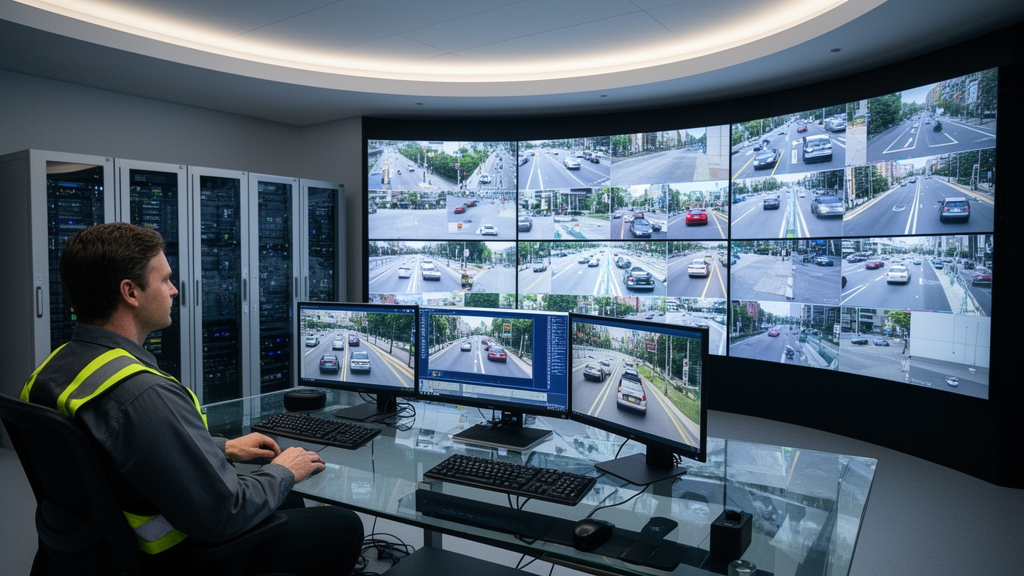
Transportation researchers have introduced TrafficAtlas, an open-source and cloud-native software platform engineered to transform how large collections of traffic video datasets are indexed, curated, and evaluated for artificial intelligence training. Modern autonomous driving systems, computer vision models, and multimodal foundation architectures depend heavily on balanced operational data, yet existing open traffic repositories remain fragmented across disconnected web archives, disparate hosting environments, and mutually incompatible metadata schemas. Leading collections such as BDD100K, the Waymo Open Dataset, nuScenes, KITTI, and Cityscapes have independently advanced perception tasks, but they lack a shared semantic analysis layer that allows engineers to inspect collective coverage. TrafficAtlas addresses this systemic limitation by pairing an administrator-gated community contribution workflow with an automated cloud processing pipeline that extracts semantic representations from video footage and maps scenario coverage across multi-dimensional embedding space.
The motivation behind the platform stems from persistent challenges faced by state departments of transportation, metropolitan planning organizations, and academic laboratories developing real-time incident detection, automated scene narration, and work-zone safety models. While urban roadway footage recorded under daylight conditions is abundant across public archives, critical edge cases—such as collision events on rural two-lane highways during adverse meteorological conditions—remain sparse and difficult to locate. Practitioners frequently spend weeks sifting through independent data dumps without confirming whether necessary operational scenarios are present. Furthermore, public-sector transportation agencies collecting high volumes of traffic monitoring video often lack governance-aware platforms that combine access control, audit logging, and provenance tracking. TrafficAtlas was designed to resolve these data-sharing frictions by establishing a unified repository where operational footage can be contributed under controlled visibility settings while exposing scenario diversity and dataset overlap as directly observable mathematical properties.
Architecturally, TrafficAtlas is deployed on Amazon Web Services using a modular, service-oriented structure distributed across four integrated tiers: a user-facing application layer, an identity and storage layer, an orchestrated dataset processing pipeline, and an analytics layer for scenario representation. The frontend client is built as a single-page application using React and is hosted through AWS Amplify to provide an interactive portal for dataset discovery, metadata inspection, upload submissions, and administrative oversight. The frontend communicates with a backend service implemented in Node.js with Express running on an Amazon Elastic Compute Cloud instance, which exposes RESTful endpoints for dataset operations, pipeline status tracking, and download access requests. User authentication, credential management, and role-based permissions are enforced through Amazon Cognito, distinguishing administrative personnel who review and validate submissions from registered contributors and consumers who upload or download data assets.
Data storage and governance mechanisms within TrafficAtlas utilize Amazon Simple Storage Service organized under dataset-specific key prefixes to partition raw video files, extracted frame sequences, vector embeddings, generated semantic tags, and administrative records. To avoid the operational overhead of managing external database infrastructure, structured metadata describing dataset provenance, user messages, and request histories are stored directly as structured JSON records within dedicated storage prefixes. Data access operates under a tiered model where public collections can be downloaded via an automated self-service request form, while restricted datasets require formal approval from dataset owners or platform administrators. All access requests, approvals, rejections, and transfer events are logged against verified user identities to guarantee traceability, providing public-sector agencies with an auditable environment suitable for sharing operational footage while retaining institutional oversight over downstream distribution.
The computational core of TrafficAtlas operates as an asynchronous processing state machine orchestrated by AWS Step Functions, which coordinates distributed compute tasks across AWS Batch, serverless control functions in AWS Lambda, and managed model inference endpoints in Amazon Bedrock. In the initial version 1.0.0 release of the software, the automated pipeline executes on an approved representative video sample capped at 1 gigabyte rather than the full-scale archival dataset. This bounded design preserves cloud processing budgets during initial deployment while generating representative tags, vector representations, and visual sparsity projections that reflect the submitted material. The Step Functions coordinator incorporates native state transitions, automated retry semantics, and parallel execution branches to oversee three sequential analysis stages, ensuring that transient processing faults during container execution or model inference are handled without corrupting repository metadata.
Stage 1 of the processing pipeline handles video ingestion, adaptive frame extraction, and multimodal embedding generation. To accommodate variable dataset sizes without maintaining idle server instances, containerized worker tasks packaged as Docker images are executed on demand through AWS Batch utilizing Amazon Elastic Container Service with serverless AWS Fargate compute environments. The extraction workers implement a duration-aware adaptive sampling algorithm that dynamically calculates frame sampling intervals based on total recording duration while enforcing a configurable maximum frame ceiling per video file. This adaptive mechanism bounds overall computing expenditure while maintaining temporal granularity across extended recordings, maximizing the probability of capturing transient or rare driving incidents. Extracted image frames are converted into 512-dimensional vector embeddings using the Vision Transformer ViT-B/32 architecture of the contrastive vision-language model CLIP, projecting scene visual features into a standardized semantic feature space.
Stage 2 of the pipeline generates structured semantic descriptions for every ingested sample using a sequence of three AWS Lambda functions coordinated by the state machine. The first Lambda function aggregates extracted representative frames into a structured batch manifest compatible with Amazon Bedrock. The second Lambda function dispatches this batch job to Amazon Bedrock, invoking the multimodal foundation model Claude Haiku to perform zero-shot scene analysis across extracted frames. The model generates per-frame structured descriptions adhering to a standardized 11-field schema that records atmospheric conditions, lighting characteristics, roadway classifications, traffic density levels, and road-user configurations. These fields were established through iterative prompt refinement to provide stable, uniform descriptors across heterogeneous traffic footage from disparate camera sensors. A third Lambda function retrieves the completed inference records, aggregates frame-level attributes into dataset-level metadata summaries, and persists all structured outputs alongside the Stage 1 vector embeddings in Amazon S3 for cross-repository search indexing.
Stage 3 processes the high-dimensional frame representations to construct the mathematical foundations of the platform scenario sparsity dashboard. Because L2-normalized CLIP vectors reside on the surface of a unit hypersphere, applying conventional linear dimensionality reduction and standard Euclidean clustering directly to raw vector coordinates distorts angular relationships. To resolve this geometric constraint, an AWS Lambda function computes the spherical mean direction of the embedding set and projects each 512-dimensional vector into the Euclidean tangent space established at that mean point, linearizing local spherical geometry. Principal component analysis is then performed within this tangent space to reduce embedding dimensionality to 50 principal components, capped mathematically at the minimum of 50, the frame count, and 512. This step isolates dominant scene-level variance while eliminating high-frequency feature noise before density-based grouping takes place.
Clustering within the reduced 50-dimensional tangent space is executed using the Density-Based Spatial Clustering of Applications with Noise algorithm employing Euclidean distance metrics. To eliminate reliance on rigid, manually tuned hyperparameter configurations across collections of divergent scale, TrafficAtlas determines clustering parameters adaptively for each individual dataset. The minimum cluster size parameter is calculated as the minimum of 5 and the maximum of 2 and the floor of total frames divided by 20. The neighborhood distance threshold is estimated dynamically from the 70th percentile of the k-nearest-neighbor distance distribution computed across the reduced frame vectors, where k equals the calculated minimum points value. This formulation clusters recurring driving scenarios into semantically coherent groupings while isolating unique, low-frequency frames as noise candidates rather than forcibly absorbing them into prominent clusters, directly identifying underrepresented visual conditions.
For interactive user exploration within the web dashboard, the tangent-space principal component analysis is mapped to three dimensions, and the resulting coordinates are renormalized onto a unit sphere to render a rotatable 3D scenario visualization. Users can alternate between an isolated per-dataset view, which illustrates the internal environmental diversity of a specific contribution, and a comprehensive repository-wide view that superimposes embeddings from all ingested collections onto a shared spherical space. In this visual landscape, dense concentrations of points denote heavily represented operational circumstances, such as daytime highway cruising, while isolated points highlight rare operating conditions, including night driving, adverse weather events, or complex pedestrian interactions. In the initial software release, users inspect sparse regions visually by reviewing linked dataset tags, while planned future releases intend to introduce direct per-point frame previews and quantitative numerical sparsity metrics derived from tangent-space k-nearest-neighbor distances.
Operational governance and ethical data management are integrated into the contribution workflow to mitigate privacy risks associated with public traffic surveillance footage. Because roadway video frequently captures identifiable personal data such as vehicle license plates and pedestrians faces, the platform requires contributors to confirm that submitted materials conform to relevant jurisdictional and institutional privacy standards. Video frames transmitted to Claude Haiku through Amazon Bedrock are processed under privacy terms ensuring that customer inputs and model outputs are not retained by the cloud provider, are not utilized for foundation model training, and are not disclosed to external model developers. The platform developers have scheduled automated face and license-plate obfuscation mechanisms for representative preview frames in a subsequent software release to further reinforce pre-ingestion privacy compliance.
TrafficAtlas demonstrates how embedding-based representation learning and multimodal artificial intelligence can be embedded directly within data infrastructure to support emerging transportation engineering applications. Beyond serving as a conventional archival repository, the platform provides an analytical substrate for explainable incident reconstruction, benchmark generation, and vision-language model pretraining. It also establishes a closed-loop curation mechanism for generative video synthesis models, allowing researchers to mathematically identify underrepresented operational domains, generate synthetic driving sequences targeting those specific gaps, and re-ingest the synthesized data with structured provenance tags. While reliance on managed cloud infrastructure introduces operational costs and platform dependencies, the open-source release provides a reproducible architecture for transforming fragmented traffic archives into an interconnected, semantically searchable data commons.
Subject of Research: Cloud-native platform for semantic curation and sparsity analysis of traffic video datasets
Article Title: TrafficAtlas: An AI-powered cloud native platform for semantic curation and sparsity analysis of traffic video datasets
Article References: Dumka, A., Jain, R., Prajapati, S., & Sharma, A. (2026). TrafficAtlas: An AI-powered cloud native platform for semantic curation and sparsity analysis of traffic video datasets. SoftwareX, 36, Article 103207. https://doi.org/10.1016/j.softx.2026.103207
Image Credits: AI Generated
DOI: 10.1016/j.softx.2026.103207
Keywords: TrafficAtlas, traffic video datasets, semantic curation, sparsity analysis, contrastive vision-language models, CLIP embeddings, Claude Haiku, Amazon Bedrock, DBSCAN clustering, AWS Step Functions, AWS Batch, adaptive frame sampling, tangent space projection, transportation artificial intelligence, autonomous driving benchmarks, synthetic video generation, open-source traffic repository
News Source: Denise Maddox. (November 12, 2026). Cloud Platform Maps Semantic Sparsity Across Fragmented Traffic Video Repositories. Scienmag.