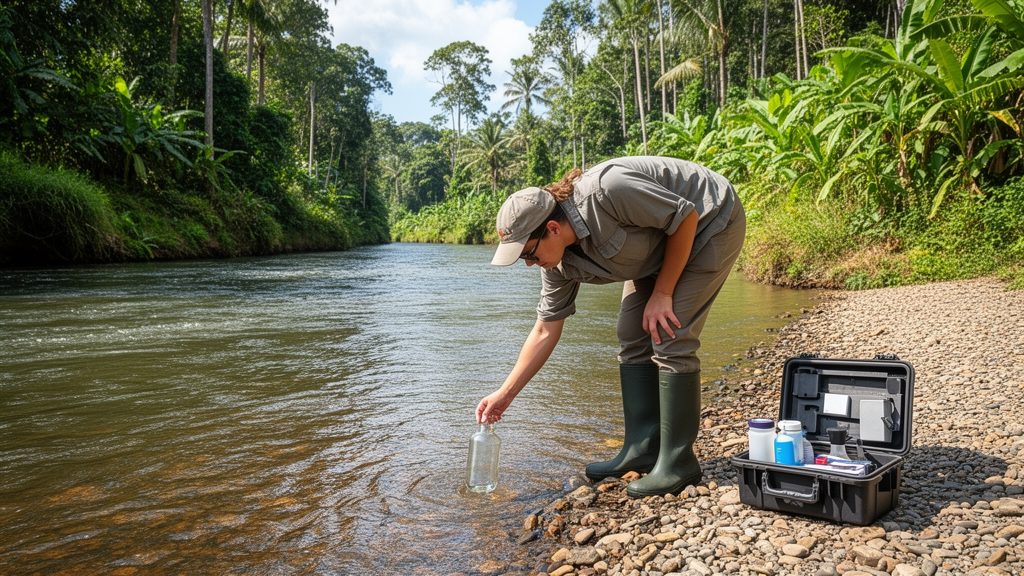
Routine environmental surveillance programs that rely on infrequent field visits risk missing substantial contamination events, according to an exact conditional analysis of historical monitoring along the Buranhém River in Bahia, Brazil. Researchers Vinicius Saraiva Santos and Fabrício Berton Zanchi examined a curated record of 106 Class 2 freshwater monitoring campaigns collected between 2015 and 2024 across five river stations, evaluating how hypothetical reductions in annual sampling effort altered the conditional probability of capturing recorded water-quality violations. The investigation demonstrated that when annual monitoring effort was reduced to a single campaign per year, the mean conditional probability of detecting an observed threshold exceedance dropped to 58.3 percent across twenty positive evaluation site-years under fixed common support. This sampling reduction produced a corresponding conditional false-negative probability of 41.7 percent, underscoring that a solitary annual visit regularly fails to encounter pollution events that are demonstrably present within the river’s recorded historical baseline.
The study addressed a fundamental challenge in surface water management: environmental compliance and ambient conditions are routinely inferred from sparse field campaigns, yet single snapshot measurements capture only the specific physical and chemical conditions present at the precise moment of sample collection. Under Brazilian environmental governance, National Environment Council Resolution 357/2005 establishes strict numeric criteria for freshwater classifications, while National Water and Sanitation Agency Resolution 903/2013 governs minimum operational visit schedules across national networks. However, neither regulatory benchmark provides municipal authorities or river basin managers with an explicit probabilistic estimate of how likely a chosen operational schedule is to detect a water-quality breach at a given monitoring station. When threshold breaches are transient, episodic, or concentrated during specific seasons, sparse sampling schedules run a structural risk of reporting negative findings simply because no monitoring crew visited during an exceedance window, confusing unobserved events with clean water.
Geographically, the Buranhém River basin encompasses approximately 2,504 square kilometers, originating in the Serra dos Aimorés within Minas Gerais and draining eastward to discharge into the Atlantic Ocean at Porto Seguro, Bahia. The monitored river course traverses a pronounced land-use gradient, transitioning from pasture and smallholder agriculture in the upper basin through intermediate agricultural zones dominated by cocoa and eucalyptus plantations, before entering urbanized coastal reaches exposed to dense municipal runoff and tourism pressures. Demographic data from the 2022 Brazilian Census highlighted significant infrastructural disparities across the basin municipalities, showing that the proportion of residents connected to formal sewage systems, stormwater networks, or connected septic infrastructure stood at only 28.9 percent in Eunápolis, 52.5 percent in Guaratinga, and 57.9 percent in Porto Seguro. Unconnected rudimentary pits and untreated septic setups remain widespread, establishing diverse upstream and downstream pathways for organic, nutrient, and microbiological pollution.
To establish a clean analytical reference dataset, the authors audited public environmental records maintained within the State Environmental and Water Resources Information System by Bahia’s Instituto do Meio Ambiente e Recursos Hídricos. The investigative reach extended from upstream context stations FBS-BRH-250 and FBS-BRH-300 in Eunápolis down to stations FBS-BRH-450, FBS-BRH-500, and FBS-BRH-950 in Porto Seguro, terminating in the estuarine zone. The rigorous data audit resolved historical anomalies in the raw state archive, including the recovery of fourteen campaign collection dates previously cataloged under placeholder January 1 timestamps. Furthermore, duplicated records for three 2021 campaigns were corrected against official annual reporting annexes to restore authentic July measurements without data imputation. Crucially, the researchers screened for environmental water classification, excluding two campaigns from station FBS-BRH-950 that exhibited salinities of 10.7 and 0.6 parts per thousand (‰), as official records categorized them as Class 1 brackish water rather than freshwater Class 2 domains.
The finalized ten-year dataset encompassed 35 calendar-year site-years and evaluated seven primary Class 2 freshwater water-quality parameters: dissolved oxygen, biochemical oxygen demand, total phosphorus assessed against a lotic threshold of 0.10 milligrams per liter, pH, turbidity, total dissolved solids, and thermotolerant coliforms. Across 742 expected parameter evaluations, 741 classifiable results were retrieved, with a single missing coliform result bypassed without creating ambiguity because biochemical oxygen demand breached its limit in the same campaign. Out of 106 verified freshwater campaigns, 46 contained at least one parameter threshold exceedance, representing an overall campaign exceedance rate of 43.4 percent. Thermotolerant coliforms constituted the dominant environmental signal, exceeding the campaign indicator threshold of 1,000 most probable number per 100 milliliters in 34 of 105 valid samples, while pH transgressions occurred in 9 campaigns, dissolved oxygen fell below 5 milligrams per liter in 3 campaigns, and phosphorus, turbidity, and biochemical oxygen demand each recorded 2 exceedances.
Methodologically, the researchers modeled subsampling using exact finite-population hypergeometric calculations rather than relying on unconstrained binomial approximations, because monitoring campaigns within any given year constitute finite sets drawn without replacement. Rather than assuming a random uniform draw across all annual visits, the primary analytical framework enforced a stratified temporal allocation that balanced sampling effort between an October-to-March operational stratum and an April-to-September stratum, thereby mimicking professional monitoring practices. To prevent changing site-year eligibility from confounding the frequency comparisons, the team established a fixed common support criterion, restricting primary comparisons to positive site-years that contained at least three classifiable campaigns. Computational verifications confirmed the exact probability formulation: independent Python scripts utilizing explicit combinatorial enumeration reproduced all 199 estimated annual scenarios to numerical precision with an absolute difference capped at 1.11 times ten to the negative sixteenth power, while extensive Monte Carlo simulations verified the calculations.
When hypothetical monitoring efforts were increased under fixed common support, detection success expanded substantially across the twenty positive site-years. The mean conditional detection probability for composite threshold exceedances rose from 58.3 percent under a single-campaign schedule to 87.9 percent under a two-campaign schedule, reaching 95.8 percent when three campaigns were conducted. This progression corresponded to a steep reduction in conditional false-negative probabilities, tumbling from 41.7 percent at one campaign to 12.1 percent at two, and falling to 4.2 percent at three. The greatest marginal efficiency gain occurred when shifting from one to two annual visits, which provided a 29.6 percentage point surge in detection reliability, whereas adding a third annual visit yielded a further 7.9 percentage point improvement. Annual simple random sampling without temporal stratification yielded detection probabilities of 53.9 percent, 79.5 percent, and 94.3 percent, indicating that temporal allocation affected the magnitude of the estimates but not the observed increase with sampling frequency.
The study also examined individual contaminant dynamics under the fixed common-support design, demonstrating that even recurrent contaminants remain vulnerable to high false-negative rates under sparse sampling. For thermotolerant coliforms across fifteen eligible positive site-years, conditional detection probabilities averaged 61.7 percent for one campaign, 90.0 percent for two campaigns, and 96.1 percent for three campaigns, reflecting a substantial 38.3 percent false-negative probability under single-visit monitoring despite the pathogen indicator being the river’s most widespread contaminant. For less frequent chemical parameters, smaller sample sizes permitted descriptive tracking: pH detection across seven site-years averaged 25.0 percent with one campaign, 50.0 percent with two, and 78.6 percent with three, while dissolved oxygen across two site-years rose from 25.0 percent to 87.5 percent. Station-level evaluations mirrored this variability, with single-campaign composite detection probabilities ranging between 48.6 percent at station FBS-BRH-300 and 64.6 percent at upstream station FBS-BRH-250.
The authors emphasized that several structural attributes of the historical archive dictate careful interpretation of the mathematical results. A major constraint stems from finite-population support: twelve of the twenty common-support site-years contained exactly three classifiable campaigns, meaning that a hypothetical three-campaign design automatically exhausted the entire historical reference set, guaranteeing a detection probability of one hundred percent by computational construction. When the analysis was restricted to the eight robust site-years containing four or more campaigns, the mean conditional detection probability for three campaigns adjusted downward to 89.6 percent. Furthermore, sensitivity analyses evaluating alternative seasonal partitions—such as an October-to-September hydrological year or alternative six-month contiguous divisions—produced subtle shifts in baseline probabilities without altering the fundamental trend that detection capacity scales nonlinearly with sampling frequency.
Ultimately, Santos and Zanchi underscored that their findings describe the mathematical subsampling behavior of an observed historical record and cannot be used to infer unobserved contamination events occurring between visits or establish universal regulatory rules. Because the analysis was conditional on historical data, a negative result from a reduced schedule simply measures the failure to capture an exceedance that was documented in the archive, rather than confirming that the waterbody was genuinely compliant throughout the entire year. Moreover, assessing thermotolerant coliforms against an operational campaign threshold does not constitute a full legal classification under Brazilian rules, which require six distributed samples and an eighty percent compliance rate. The authors concluded that while discrete grab sampling remains vulnerable to false negatives, the open-source analytical framework provides a rigorous, transparent methodology for environmental agencies to stress-test planned surveillance budgets before deploying sparse monitoring schedules into vulnerable river basins.
Subject of Research: Water quality monitoring frequency and false-negative detection probabilities in river systems
Article Title: Annual sampling frequency and false-negative probability in water-quality threshold-exceedance detection: an exact conditional analysis of the Buranhém River, Bahia, Brazil
Article References: Santos, V. S., & Zanchi, F. B. (2026). Annual sampling frequency and false-negative probability in water-quality threshold-exceedance detection: an exact conditional analysis of the Buranhém River, Bahia, Brazil. Earth Science Informatics, 19(12), Article 240. https://doi.org/10.1007/s12145-026-02298-1
Image Credits: AI Generated
DOI: 10.1007/s12145-026-02298-1
Keywords: Buranhém River, water quality monitoring, sampling frequency, false-negative probability, threshold exceedance, finite population analysis, CONAMA Resolution 357, INEMA, thermotolerant coliforms, dissolved oxygen, biochemical oxygen demand, environmental surveillance, hypergeometric distribution, Bahia hydrology, Class 2 freshwater, monitoring design
News Source: Violet Maxwell. (November 12, 2026). Single Annual Sampling Carried 41.7 Percent False-Negative Probability in Buranhém River Analysis. Scienmag.