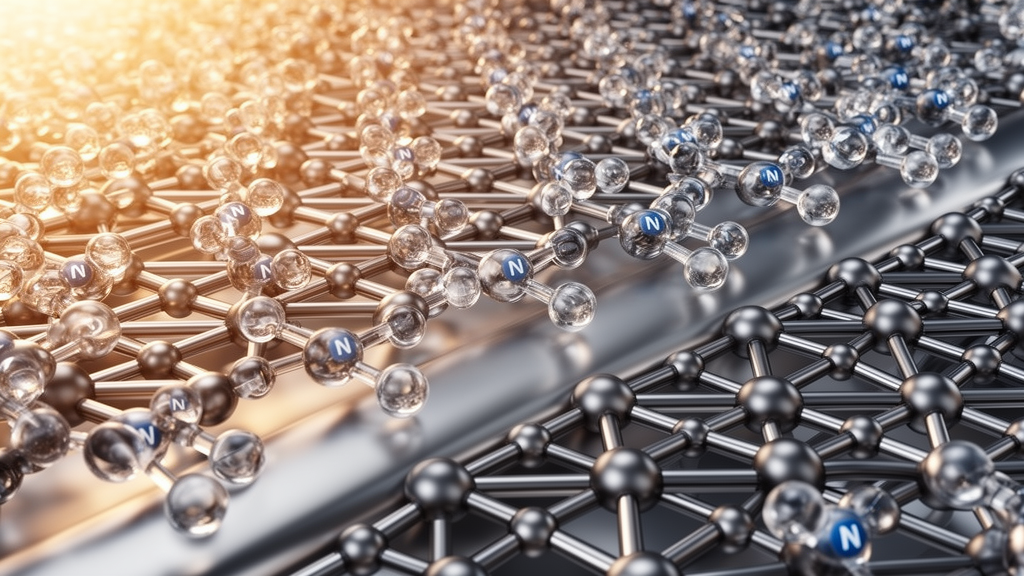
Published in Discover Molecules in December 2025, the study utilizes density functional theory (DFT) calculations, Monte Carlo simulations, and ecotoxicity predictions to evaluate a new class of compounds known as aldo-benzimidazoles. These molecules, specifically benzimidazolyl-pentane-1,2,3,4,5-pentaol derivatives, are designed to address the limitations of traditional organic inhibitors, which often suffer from poor solubility in aqueous media due to their inherent hydrophobicity.
The primary motivation for this research stems from the persistent challenge of corrosion in the construction and oil and gas industries. Mild steel, despite its favorable mechanical properties and low cost, is highly susceptible to corrosive attacks in acidic environments. While organic inhibitors are preferred over toxic inorganic alternatives, their effectiveness is often hindered by their inability to disperse uniformly in water. This poor solubility prevents the formation of a stable protective film on the metal surface. The study proposes that introducing hydrophilic groups, such as hydroxyl groups, can enhance aqueous solubility and improve the performance of these organic mitigators.
The team focused on benzimidazole derivatives because they have a established history of inhibiting mild steel corrosion and possess additional antimicrobial properties. By attaching aldose molecules to the benzimidazole ring, the researchers created a series of nine distinct compounds. These include variants with various substituents such as methyl, dimethyl, chloro, dichloro, bromo, methoxy, nitro, and benzophenone groups. The computational approach allowed the team to screen these compounds for their potential as green inhibitors without the immediate need for extensive experimental synthesis, thereby aligning the focus of future experimental studies on the most promising candidates.
To assess the electronic properties of these molecules, the researchers performed DFT calculations using the M06/def2TZVP level of theory. The simulations were conducted in simulated aqueous acid media, specifically hydrochloric acid and sulfuric acid, using the integral equation formalism polarizable continuum model. The results indicated that the optimized molecular structures were true ground state configurations, characterized by the absence of negative frequencies. A key structural feature observed was that the aldose aliphatic chain was approximately 35 degrees out of the plane of the benzimidazole ring. This slight twist may facilitate interactions between the polyhydroxy chain and the steel surface, potentially enhancing corrosion inhibition compared to native benzimidazole.
The study also derived quantum chemical parameters from frontier molecular orbital energies, including energy gap, global hardness, and global electronegativity. Compounds with electron-donating groups, such as methoxy and methyl, exhibited higher HOMO and LUMO energies than those with electron-withdrawing groups. However, the researchers noted that corrosion inhibition efficiency is not solely dependent on electron-donating tendency. Instead, it correlates with a combination of quantum chemical parameters, which the team addressed by developing a quantitative structure-activity relationship (QSAR) model.
The QSAR model was developed using data from six previously studied benzimidazole derivatives with known corrosion inhibition efficiencies. Linear regression analysis yielded a model with an R-squared value of 0.9966, indicating a strong theoretical fit for predicting inhibition efficiencies. When applied to the new aldo-benzimidazoles, the model predicted that g-bzm-methoxy and g-bzm-nitro would have the highest corrosion inhibition efficiencies. This suggests that both strong electron-donating and electron-withdrawing substituents can increase inhibition efficiency, depending on the overall electronic effect on the active site.
Monte Carlo simulations were used to investigate the adsorption tendencies of these inhibitor molecules on a cleaved Fe(1 1 0) surface, which is considered the most energetically favored iron crystal surface for simulating steel. The simulations were performed both in the absence and presence of corrosive ions, specifically hydronium and chloride ions. The results showed that the inhibitor molecules adsorbed in a near-flat orientation, promoting maximum interaction with the metallic surface. Interatomic distances between the inhibitors and iron atoms ranged from 3.196 to 4.921 angstroms, suggesting non-covalent interactions between the nitrogen atom of the benzimidazole ring and the iron surface.
A critical aspect of the study was the prediction of ecotoxicity using the Toxicity Estimation Software Tool (TEST), an online freeware affiliated with the U.S. Environmental Protection Agency. The team evaluated the toxicity of the compounds against four ecological species: fathead minnow, Daphnia magna, Tetrahymena pyriformis, and oral rat. The results indicated that all modelled aldobenzimidazoles were practically non-toxic to fathead minnow, with the exception of g-bzm-benz, g-bzm-diCl, and g-bzm-dimethyl, which were classified as slightly toxic. All compounds exhibited higher LC50 values than native benzimidazole, except for g-bzm-benz and g-bzm-diCl.
For Daphnia magna, the toxicity varied from slightly toxic to practically non-toxic, with only g-bzm-dimethyl and g-bzm-methoxy considered practically non-toxic. The compounds generally showed lower toxicity to Daphnia magna and T. pyriformis than native benzimidazole, supporting their eco-friendly attributes. The oral rat LD50 values fell within the range of slightly toxic substances. These predicted toxicity indices suggest that the compounds are safe for the environment, although the authors emphasize that further experimental studies are recommended to confirm these theoretical inferences.
The study concludes that the systematic application of computational chemistry offers a viable pathway for designing green corrosion inhibitors. The aldo-benzimidazoles demonstrated promising corrosion inhibition potentials and high solubility compared to existing compounds. The QSAR analysis provided a clear trend in inhibition efficiency, with g-bzm-methoxy ranking highest. The combination of high predicted inhibition efficiency and low predicted toxicity makes these derivatives strong candidates for further experimental analysis.
Despite the promising computational results, the study highlights the importance of complementary experimental validation. The theoretical predictions, while robust, are based on models and simulations that may not fully capture the complexities of real-world corrosion environments. The computational studies were carried out as a preliminary effort toward the experimental design of new industrial-grade corrosion formulations.
The research underscores the potential of computational methods in accelerating the development of sustainable materials. By identifying the most promising compounds early in the design process, researchers can save time and resources in the experimental phase. The focus on green chemistry and environmental safety aligns with current industrial demands for non-toxic and environmentally compatible corrosion inhibitors.
The computational screening process was designed to filter out less promising molecular candidates before any physical synthesis begins. By varying the precursors in the theoretical reaction scheme, the researchers identified that numerous compounds could be formed, but the current study specifically utilized glucose as the carbonyl compound to generate the aldobenzimidazole structures. This targeted approach allows the computational results to guide future experimental efforts, ensuring that laboratory resources are directed toward molecules with the highest predicted performance. The nine distinct compounds evaluated include the parent g-bmz structure along with variants modified by methyl, dimethyl, chloro, dichloro, bromo, methoxy, nitro, and benzophenone substituents. Each molecule was assigned a specific acronym to track its unique electronic and structural properties throughout the analysis.
The choice of the Fe(1 1 0) surface for the Monte Carlo simulations was based on its specific physical characteristics that make it a representative model for mild steel. This crystal plane is considered the most energetically favored surface for iron, offering a stable configuration with a large inter-planar distance. Compared to other iron surfaces such as Fe(1 1 1) or Fe(1 0 0), the Fe(1 1 0) plane exhibits a lower van der Waals surface energy and a larger total facet area. These attributes make it the preferred surface for simulating steel interactions in theoretical studies. The simulations employed the COMPASSII forcefield with ultrafine calculation quality to ensure accurate modeling of the molecular interactions.
The adsorption behavior of the inhibitors was examined under conditions that mimic the presence of corrosive agents. Specifically, the simulations included 25 hydronium ions and 25 chloride ions to represent the acidic environment. The adsorption energy was calculated by accounting for the energy of the iron surface, the inhibitor molecule, and the corrosive ions, minus the energy of the resulting complex. The results indicated that the inhibitor molecules adopted a near-flat orientation on the surface, which maximizes the contact area between the organic molecules and the metal. This orientation is critical for the formation of a protective layer that can effectively block corrosive ions from attacking the steel.
The ecotoxicity predictions were benchmarked against established safety thresholds to provide context for the predicted toxicity levels. An LC50 value greater than 100 mg/L is generally considered practically non-toxic, a standard used to classify the compounds in the study. The predicted toxicity indices for the aldobenzimidazoles were compared directly with those of native benzimidazole, which served as a reference point. For most of the new derivatives, the LC50 values against Tetrahymena pyriformis were in the hundreds, significantly higher than those of the native compound. This suggests that the introduction of the hydrophilic aldose chain may contribute to a reduced toxic profile for certain aquatic organisms, although the specific impact varies by species and substituent type.
The study acknowledges that the theoretical predictions, while robust, do not replace the need for empirical validation. The authors note that corrosion and adsorption are complex processes that may not be fully captured by computational models alone. Factors such as deformation energy, which can significantly influence inhibition trends, were not the primary focus of the direct correlation with inhibition efficiency in this specific analysis. Therefore, the study recommends complementary experimental studies to confirm the accuracy of the theoretical inferences. This step is essential to verify that the predicted high inhibition efficiencies and low toxicity levels translate into practical performance in real-world industrial applications.
Subject of Research: Computational design of eco-friendly benzimidazole corrosion inhibitors
Article Title: Theoretical design of green corrosion inhibitors using novel benzimidazolyl-pentane-1,2,3,4,5-pentaol derivatives as a case study: DFT calculations, Monte Carlo simulations and ecotoxicity prediction
Article References: Olasunkanmi, L. O., Famutimi, O. G., Raimi, I. O., Omoboye, O. O., Waziri, I., Olomola, T. O., Taleatu, B. A., & Adekunle, A. S. (2025). Theoretical design of green corrosion inhibitors using novel benzimidazolyl-pentane-1,2,3,4,5-pentaol derivatives as a case study: DFT calculations, Monte Carlo simulations and ecotoxicity prediction. Discover Molecules, 2(1), Article 29. https://doi.org/10.1007/s44345-025-00041-9
Image Credits: AI Generated
DOI: 10.1007/s44345-025-00041-9
Keywords: corrosion inhibition, benzimidazole, DFT calculations, Monte Carlo simulations, ecotoxicity, mild steel, green chemistry, QSAR model, computational chemistry, Theoretical, design, green
News Source: Bethany Barker. (November 12, 2026). Computational Study Predicts Eco-Friendly Benzimidazole Corrosion Inhibitors. Scienmag.