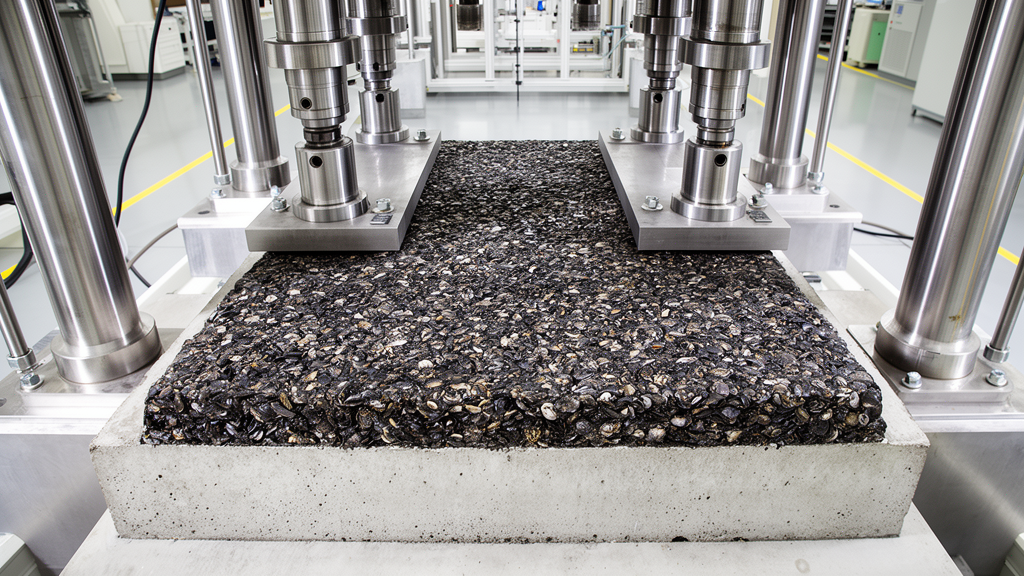
Structural lightweight concrete incorporating treated coconut shell aggregate and ground granulated blast furnace slag can successfully meet standard structural specifications for precast light-duty manhole cover panels, according to an experimental investigation published in Discover Concrete and Cement. Researchers A. Sujatha and Deepa Balakrishnan demonstrated that reinforced slab panels cast with surface-modified coconut shell coarse aggregate and a ten percent slag replacement for Ordinary Portland Cement achieved a twenty-eight-day compressive strength of 41.55 megapascals and sustained ultimate failure loads nearly four times higher than the design service threshold. In standardized physical load evaluations, the bio-aggregate concrete slabs sustained cyclic proof loading without forming observable surface cracks and displayed minimal residual deformation. The experimental outcome confirms that agricultural by-products, when conditioned with thermal and cementitious surface treatments, can substitute entirely for conventional crushed stone in targeted precast infrastructure elements without compromising essential mechanical strength or serviceability criteria.
The study addresses critical environmental hurdles facing modern civil construction, where conventional concrete production accounts for nearly seventy percent of all materials consumed across global industrial building sectors. In response, environmental engineering research has increasingly focused on developing sustainable concrete incorporating industrial by-products and renewable agricultural wastes to mitigate landfill burdens and diminish raw mineral extraction. Coconut shells represent a particularly abundant agro-industrial waste stream, with India alone responsible for approximately 22.45 percent of worldwide coconut output. Although raw coconut processing leaves behind massive quantities of discarded shells that exhibit inherent structural toughness, abrasion resistance, and low bulk density, their practical engineering adoption has remained largely confined to low-grade non-structural applications due to concerns regarding moisture absorption, organic degradation, and bonding limitations within standard cement binders.
Untreated bio-based aggregates present specific physical vulnerabilities when embedded directly into alkaline concrete matrices. Naturally occurring agricultural shells contain high proportions of cellulose, hemicellulose, and lignin, organic polymer fractions that degrade over time through moisture sensitivity, alkaline hydrolysis, and cell wall mineralization. These inherent biochemical processes frequently weaken the interfacial transition zone between the aggregate particle and the surrounding hardened paste, leading to elevated porosity, microcrack development, and reduced composite durability. To overcome these deficiencies without introducing hazardous chemical reagents that could leach into surrounding soils during weathering, the researchers adopted a physical surface modification process combining controlled heating with grout encapsulation. Raw coconut shells obtained from local oil processing mills were first sun-dried over a six-month duration to lower raw moisture levels and eliminate volatile organic residue before being reduced in a specialized mini crusher to a graded aggregate sizing between 2.36 millimeters and 9.5 millimeters in conformance with standard lightweight aggregate specifications.
The crushed aggregate particles subsequently received thermal conditioning at sixty-five degrees Celsius for thirty minutes both prior to and immediately following the application of an engineered cementitious grout coating. Formulated with a water-to-cement ratio of 1.25, the fluid slurry penetrated into surface fissures and established a uniform protective envelope across each shell particle, after which the aggregate was brought to a saturated surface dry condition through a twenty-four-hour water immersion. To further optimize the binding matrix and lower clinker consumption, the researchers blended Ordinary Portland Cement possessing a fifty-six megapascal compressive rating with ground granulated blast furnace slag at an optimum ten percent cement replacement ratio. Energy dispersive X-ray spectroscopic analyses revealed that incorporating ten percent blast furnace slag enriched the silicon distribution and balanced calcium-to-silicon proportions within the hydrating paste. This chemical composition promoted secondary pozzolanic reactions that consumed calcium hydroxide to generate additional calcium silicate hydrate gel, densifying the composite microstructure, refining capillary pores, and substantially strengthening mechanical interlock across the aggregate interfacial zone.
The bio-aggregate concrete mixture achieved a fresh slump value of 106 millimeters, reflecting superior flowability compared to the 65-millimeter slump recorded for the conventional stone concrete. In the hardened state, the oven-dry density of the treated coconut shell concrete averaged 1930 kilograms per cubic meter, representing an 18.6 percent reduction compared to the 2386 kilograms per cubic meter measured for the conventional control. This dry unit weight places the bio-aggregate mix squarely within recognized technical definitions for structural lightweight concrete, which require an oven-dry density below 2000 kilograms per cubic meter alongside a compressive strength exceeding 20 megapascals. At twenty-eight days of water curing, standard test cubes of the treated coconut shell concrete registered an average compressive strength of 41.55 megapascals, outperforming the 40.89 megapascals attained by conventional concrete and easily surpassing the thirty megapascal minimum required by relevant precast standards.
To evaluate performance under practical engineering conditions, the investigators manufactured full-scale light-duty precast manhole cover slab panels designated as grade LD-2.5 according to the Indian standard specification IS 12592:2002. A total of six square panels measuring 600 millimeters in length, 600 millimeters in width, and 100 millimeters in thickness were cast, comprising three replicate specimens prepared from the treated coconut shell aggregate mix and three identical reference panels fabricated with conventional stone concrete. All slabs were reinforced using high-strength Fe 415 deformed steel bars measuring ten millimeters in diameter, arranged in an orthogonal two-way grid spaced at 110-millimeter centers in both directions with a specified clear protective cover of twenty millimeters. Standard municipal guidelines define these light-duty panels as suitable for installation within residential zones, institutional environments subject to pedestrian movement and infrequent light vehicular crossings, and utility inspection chambers requiring durable modular access covers.
Following a standard twenty-eight-day water curing period, each slab panel underwent rigorous structural evaluation using a universal testing machine with a loading capacity of one thousand kilonewtons. Slabs were positioned horizontally upon a rigid support frame featuring a standardized clear central opening measuring 450 millimeters by 450 millimeters, while vertical load was delivered through a circular bearing block measuring three hundred millimeters in diameter positioned at the geometric center. Central vertical displacements were monitored continuously using precision dial gauges to record residual deformations following cyclic unloading, after which the full twenty-five kilonewton service proof load was sustained for thirty seconds to assess crack initiation before advancing steadily to ultimate structural failure.
Although the bio-aggregate slabs exhibited a fractional increase in residual deformation attributable to the lower elastic modulus and inherent physical flexibility of cellular shell particles, this 0.01-millimeter variation fell within the boundary of instrument precision. Crucially, the measured permanent set remained well below the six-millimeter maximum limit permitted under IS 12592:2002, verifying that the treated bio-composite retains robust elastic recovery and resists irreversible structural deformation under repeated traffic loadings.
The conventional concrete slabs achieved an average ultimate load capacity of 101.5 kilonewtons with a corresponding vertical settlement of 0.11 millimeters at peak resistance. Slabs cast with the treated coconut shell aggregate concrete achieved an average ultimate load capacity of 98.5 kilonewtons alongside a peak settlement of 0.13 millimeters, reflecting a marginal capacity difference of only 2.95 percent despite utilizing lightweight agricultural waste aggregate as the sole coarse component. Both slab varieties exhibited identical structural failure mechanics governed entirely by concentrated punching shear rather than primary flexural yielding. Visual inspection of fracture surfaces revealed distinctive star-like or cross-shaped cracking patterns that originated directly beneath the perimeter of the circular loading block and propagated radially outward across the slab faces without forming classical longitudinal flexural cracks within the bottom tensile zone.
The structural metrics documented for the treated coconut shell panels also demonstrated notable performance advantages over earlier published findings involving untreated coconut shell aggregate concretes. Prior research evaluating comparable light-duty manhole panels cast with untreated crushed coconut shells and river sand recorded a permanent set of 0.11 millimeters, notably higher than the 0.09 millimeters recorded for the grout-coated material in the current investigation. Furthermore, while the earlier untreated aggregate slabs developed an ultimate settlement of 0.16 millimeters at a failure load of 103 kilonewtons, the treated aggregate slabs restricted ultimate settlement to 0.13 millimeters. This improved deformation resistance underscores the vital contribution of grout coating and supplementary blast furnace slag, which refine the interfacial transition zone, limit aggregate slippage, and enhance the composite shear stiffness of the cast concrete under intense mechanical stress.
While the experimental outcomes validate the technical viability of treated coconut shell coarse aggregate for precast light-duty infrastructure, the researchers emphasized clear methodological boundaries and outlined directions for ongoing investigation. The experimental scope examined exclusively light-duty LD-2.5 square slabs tested under laboratory configurations, leaving the mechanical behavior of medium, heavy, and extra-heavy duty precast grades unverified under dynamic traffic conditions. Furthermore, the investigation did not incorporate a detailed economic cost analysis or a comprehensive life cycle assessment, leaving unresolved whether the thermal curing steps and higher baseline cement contents common to lightweight concrete formulations fully preserve environmental savings against conventional production. Future research will need to analyze statistical deformation distributions across larger specimen populations, optimize grout coating thicknesses, and examine alternative supplementary cementitious additions to reduce overall binder intensity while maintaining compliant structural performance in sustainable bio-composite precast elements.
Subject of Research: Structural performance of precast reinforced manhole cover slabs made with grout-coated coconut shell aggregate and blast furnace slag
Article Title: Performance of reinforced manhole cover slabs with treated coconut shell coarse aggregate and GGBFS
Article References: Sujatha, A., & Balakrishnan, D. (2026). Performance of reinforced manhole cover slabs with treated coconut shell coarse aggregate and GGBFS. Discover Concrete and Cement, 2(1), Article 50. https://doi.org/10.1007/s44416-026-00088-y
Image Credits: AI Generated
DOI: 10.1007/s44416-026-00088-y
Keywords: coconut shell aggregate, sustainable concrete, lightweight concrete, manhole cover slabs, precast concrete, ground granulated blast furnace slag, supplementary cementitious materials, interfacial transition zone, compressive strength, punching shear, permanent set, structural performance, agricultural waste valorization, surface treatment, cement grout coating, IS 12592, manufactured sand, bio-based materials
News Source: Denise Maddox. (November 12, 2026). Treated Coconut Shell Concrete Slabs Withstand Heavy Loads in Structural Testing. Scienmag.