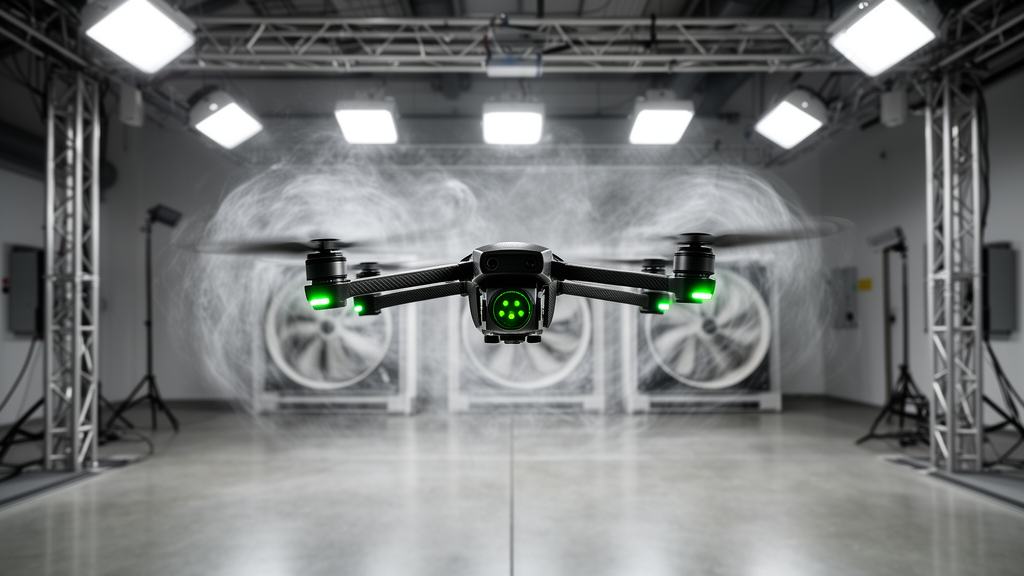
In an investigation published in Discover Robotics, researchers Abdul Rahman Abdul Majid and Abdelhadi Aouaichia demonstrated that replacing the traditional proportional-derivative feedback block in an active disturbance rejection framework with an adaptive neuro-fuzzy inference system significantly improves the attitude stabilization of quadrotor unmanned aerial vehicles under simulated flight conditions. The authors designed and tested an Intelligent Active Disturbance Rejection Control architecture, termed IADRC, which unites the real-time disturbance estimation of a linear extended state observer with the nonlinear learning capabilities of a five-layer neuro-fuzzy network. The evaluation established that the intelligent controller attenuated unwanted oscillations and reduced tracking errors when subjected to nonlinear aerodynamic coupling, aerodynamic ground effect, ceiling effect, and externally injected sinusoidal disturbances, all while reducing manual parameter tuning to a single controller design value.
Quadrotor drones, characterized by their symmetric four-rotor mechanical structure, have become central to numerous civilian missions including agricultural monitoring, infrastructure inspection, disaster management, environmental observation, water quality assessment, aerial cinematography, and delivery services, alongside critical military operations such as reconnaissance, combat surveillance, and search and rescue. Operating these four-rotor aircraft requires overcoming challenging dynamic constraints, as quadrotors represent highly nonlinear, strongly coupled, and under-actuated physical systems. The overall flight control problem is mathematically separated into two interconnected loops: an outer loop that governs translational positions along the Cartesian axes and an inner loop dedicated to attitude stabilization. Because the linear translational forces generated by rotor thrust depend entirely on the aircraft’s orientation angles in three-dimensional space, the inner attitude loop—responsible for regulating the roll, pitch, and yaw angles—is the fundamental prerequisite for ensuring total flight stability, trajectory accuracy, and operational maneuverability.
Conventional flight architectures often rely on model-based control strategies, including first- and second-order sliding mode control, backstepping schemes, adaptive augmented torque controllers, and linear quadratic regulators. However, these classical approaches depend heavily on precise mathematical representations of the aircraft’s physical parameters, mass distribution, and aerodynamic drag coefficients. In practical flight operations, unmodeled dynamics, parameter variations, gyroscopic interactions, and external wind gusts introduce uncertainties that degrade model accuracy and impair model-dependent control laws. Active Disturbance Rejection Control, originally formulated by Han as an alternative to standard proportional-integral-derivative controllers, addresses these limitations through an error-driven mechanism that abstracts internal uncertainties and external forces into a single consolidated quantity known as the total disturbance. By transforming the physical plant into an extended canonical integrator chain, an Extended State Observer continuously estimates both the internal system states and the total disturbance in real time, enabling the controller to cancel disturbances dynamically.
Although nonlinear active disturbance rejection control provides robust disturbance mitigation, its practical implementation is frequently hindered by the labor-intensive tuning of multiple interdependent mathematical parameters, specifically those governing the nonlinear fal-function such as linearity coefficients and linear interval widths. To alleviate this complexity, Gao established Linear Active Disturbance Rejection Control, which streamlines the framework by parameterizing the controller and observer gains according to bandwidth concepts, reducing the tuning burden to just three parameters for single-input single-output systems. Nevertheless, this linear simplification often compromises control authority when operating in severely nonlinear, cross-coupled operating regimes. Previous attempts to integrate artificial intelligence techniques—such as particle swarm optimization, back-propagation neural networks, radial basis function networks, and conventional fuzzy logic—succeeded in enhancing robustness, but they routinely introduced supplementary optimization loops or complex algorithmic structures that increased parameter counts and initialization demands rather than simplifying system architecture.
To overcome the trade-off between algorithmic simplicity and nonlinear performance, the authors formulated their intelligent framework by retaining the linear Extended State Observer while replacing the conventional state error feedback controller with a first-order Sugeno Adaptive Neuro-Fuzzy Inference System. By directly combining the tracking differentiator and state feedback components into a unified neuro-fuzzy functional block, the architecture eliminates conventional signal pre-processing blocks and delivers smooth control outputs without requiring gain retuning. The mathematical model developed for the quadrotor system establishes translational and rotational dynamics using the Lagrange approach within Earth-fixed and body-fixed reference frames connected through orthogonal rotation and kinematic transformation matrices. The rotational subsystem decouples the vehicle’s angular accelerations for roll, pitch, and yaw, expressing each orientation channel as a second-order differential equation influenced by rotor torques, structural moments of inertia, airframe drag factors, motor distances, and unmodeled external disturbance torques.
The Adaptive Neuro-Fuzzy Inference System operates as an adaptive black-box controller structured across five functional processing layers that process error and the rate of error variation for each attitude angle. In the initial fuzzification layer, continuous input error signals are mapped into fuzzy sets through bell-shaped Gaussian membership functions. The second layer computes the firing strength of each rule by calculating the product of incoming membership values, which are subsequently normalized across all active nodes in the third layer. The fourth layer applies a first-order Sugeno model where normalized firing strengths multiply linear consequent functions containing tuned constants. The fifth defuzzification layer aggregates these weighted outputs through summation to generate the final nonlinear feedback control signals for the roll, pitch, and yaw channels. To streamline model training, historical input-output data from an established proportional-derivative attitude baseline were utilized, allowing the neural learning algorithm to capture control behaviors without requiring prolonged computational data gathering.
Theoretical stability for the closed-loop attitude subsystem was established through a formal Lyapunov analysis applied to second-order extended state-space dynamics. Representing the rolling channel as an illustrative case, the total disturbance—comprising unmodeled aerodynamic drag, gyroscopic moments, channel coupling, and external disturbances—was defined as an extended system state. The linear observer dynamics were structured in matrix form, proving that the state estimation error dynamics are exponentially stable provided the total disturbance derivative remains bounded and the observer gain matrix satisfies the Hurwitz condition. Under characteristic polynomial pole placement, the observer gains are parameterized using an observer bandwidth parameter. By defining positive-definite quadratic Lyapunov candidate functions for each orientation channel, the authors demonstrated that when the linear observer operates as a high-gain observer with bounded gains and the neuro-fuzzy output remains bounded, the time derivatives of the Lyapunov functions remain strictly negative, ensuring asymptotic convergence of tracking errors to zero.
The performance of the proposed intelligent architecture was evaluated through comparative numerical simulations against conventional linear active disturbance rejection control during an indoor flight profile encompassing critical takeoff and landing phases. The simulated flight path subjected the quadrotor model to severe aerodynamic ground effects near zero seconds and landing disturbances at thirty seconds, combined with ceiling effects and sudden trajectory transitions. To ensure an equitable and unbiased comparison, both the linear and intelligent control systems utilized identical linear Extended State Observer configurations, resulting in identical real-time total disturbance estimations across the roll, pitch, and yaw channels. System tracking trajectories, error deviations, and control outputs were recorded and systematically quantified using standard Mean Squared Error and Integral of Absolute Error performance metrics across each rotational axis.
Quantitative analysis of the simulation trajectories demonstrated that while both control strategies maintained baseline stability, the intelligent neuro-fuzzy controller achieved markedly superior precision and disturbance attenuation. To assess resilience under severe operating anomalies, such as motor partial shutdown or propeller degradation, continuous sinusoidal disturbance profiles were injected into the attitude dynamics. In this perturbed operational state, the intelligent controller sustained robust trajectory tracking across all three orientation angles, achieving substantially smaller error magnitudes and lower cumulative error values than the linear alternative without requiring gain scheduling, manual parameter adjustments, or real-time model linearization.
Despite these simulated operational advantages, the authors highlighted a significant engineering constraint regarding the practical deployment of neuro-fuzzy disturbance rejection algorithms on embedded physical platforms. The five-layer Adaptive Neuro-Fuzzy Inference System imposes substantial computational processing demands, requiring high-performance onboard processing units to execute inference rules within tight control loop intervals. Consequently, while the controller has been validated in a high-performance computer simulation environment, experimental verification on physical quadrotor hardware remains a necessary objective for future research to establish real-world viability under strict onboard computing constraints.
Subject of Research: Intelligent active disturbance rejection control for quadrotor attitude stabilization
Article Title: Intelligent active disturbance rejection controller based on adaptive neuro fuzzy inference system for the quadrotor system
Article References: Majid, A. R. A., & Aouaichia, A. (2025). Intelligent active disturbance rejection controller based on adaptive neuro fuzzy inference system for the quadrotor system. Discover Robotics, 1(1), Article 8. https://doi.org/10.1007/s44430-025-00009-x
Image Credits: AI Generated
DOI: 10.1007/s44430-025-00009-x
Keywords: quadrotor systems, active disturbance rejection control, adaptive neuro-fuzzy inference system, extended state observer, attitude stabilization, unmanned aerial vehicles, state error feedback controller, linear ADRC, Lyapunov stability analysis, MATLAB Simulink simulation, nonlinear flight dynamics, Sugeno fuzzy model, observer bandwidth, ground effect disturbances, drone control architecture, trajectory tracking, takeoff and landing maneuvers
News Source: Denise Maddox. (November 12, 2026). Adaptive Neuro-Fuzzy Disturbance Rejection Controller Improves Simulated Quadrotor Attitude Stabilization. Scienmag.