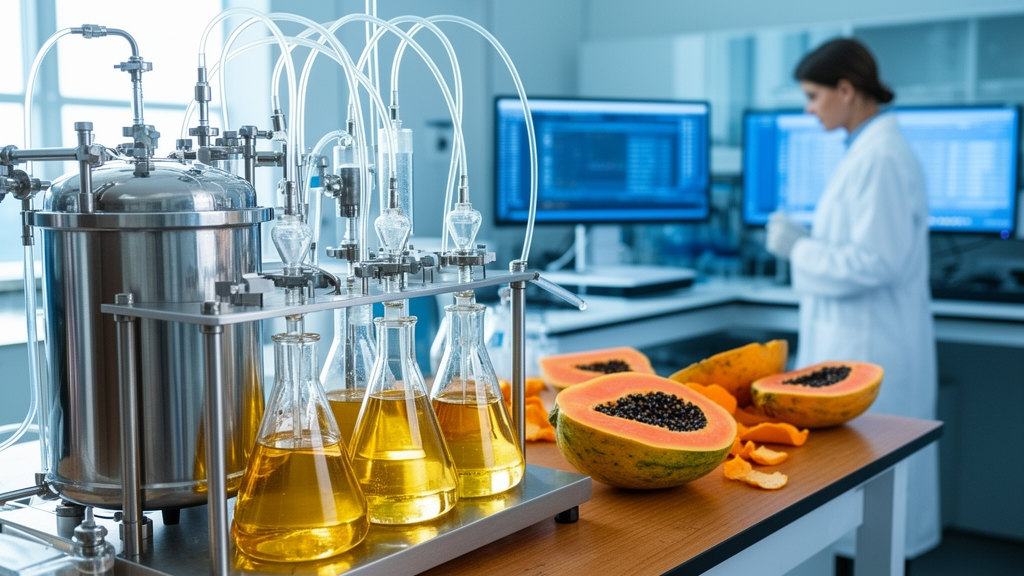
The study, published in Discover Energy, combines experimental transesterification with advanced intelligent modeling to optimize production efficiency and fuel quality. By utilizing biomass residues as both the feedstock source and the catalyst precursor, the team demonstrated a dual valorization approach that addresses sustainability challenges in renewable fuel production. The central finding indicates that hybrid intelligent optimization can achieve a biodiesel yield approaching 98% while ensuring the resulting fuel meets international quality standards.
The research addresses the need for sustainable biodiesel systems that reduce dependence on edible feedstocks and minimize environmental impact. Papaya seed oil represents an underutilized non-edible resource with a favorable fatty acid composition, while papaya peels, a byproduct of processing, can be transformed into functional catalyst materials. The study aimed to develop a unified experimental and computational framework that evaluates catalyst performance, compares predictive modeling approaches, and identifies optimal process conditions. This integrated strategy seeks to overcome limitations of previous studies that often focused solely on catalyst development or single-method process optimization.
The catalyst was synthesized from papaya peels through a process involving washing, drying, grinding, and calcination in a muffle furnace. Temperatures ranging from 400 to 1000 degrees Celsius were evaluated, with 400 degrees Celsius selected as the optimum based on textural and basic properties. Subsequent chemical activation using potassium hydroxide enhanced surface basicity and catalytic activity. Characterization via X-ray diffraction revealed that the treatment transformed the amorphous precursor into calcium-rich crystalline phases, specifically increasing the fraction of hydroxyapatite from 49.5 wt% to 72.0 wt%.
Textural analysis using the Brunauer–Emmett–Teller method showed a substantial increase in the catalyst’s physical properties following activation. The surface area rose from 1.2 square meters per gram to 150.5 square meters per gram, while the pore volume increased from 0.005 cubic centimeters per gram to 0.25 cubic centimeters per gram. These enhancements indicate improved porosity and surface basicity, which are critical for facilitating the transesterification reaction. Scanning electron microscopy confirmed the removal of organic matter and the formation of a consolidated, porous structure that exposes more active catalytic sites.
The experimental design employed a Central Composite Design comprising 32 runs to systematically evaluate five process variables: methanol-to-oil ratio, catalyst loading, reaction temperature, reaction time, and agitation speed. The methanol-to-oil molar ratio was varied between 6:1 and 14:1, based on preliminary experiments and literature indicating that excess methanol shifts the equilibrium toward ester formation. The extracted papaya seed oil was characterized using gas chromatography–mass spectrometry, which identified palmitic acid as the dominant fatty acid, accounting for approximately 30.05% of the total peak area. Oleic acid and 9-eicosenoic acid contributed 17.09% and 7.38% respectively, confirming the oil’s suitability for biodiesel production due to its C16–C20 fatty acid profile.
Three modeling approaches were applied to the experimental data: Response Surface Methodology, Artificial Neural Networks, and Adaptive Neuro-Fuzzy Inference Systems. The quadratic RSM model demonstrated good predictive capability for biodiesel yield with an R-squared value of 0.9451, but showed moderate performance for kinematic viscosity. In contrast, the ANN and ANFIS models provided superior accuracy in capturing complex nonlinear relationships among the process variables. Analysis of variance confirmed that the methanol-to-oil ratio and reaction temperature were the most statistically significant factors influencing the response variables, with significant quadratic effects indicating nonlinear system behavior.
Hybrid optimization integrated three metaheuristic algorithms: Genetic Algorithm, Grey Wolf Optimizer, and Grasshopper Optimization Algorithm. Each algorithm was paired with the RSM, ANN, and ANFIS models to identify optimal operating conditions. The ANFIS-based models consistently converged to stable optimal solutions, demonstrating robustness and reduced sensitivity to the specific optimizer selected. Under these optimized conditions, the predicted biodiesel yield reached 98%, with a kinematic viscosity of 5.23 square millimeters per second and a cetane index of 68. These values satisfy the specifications of ASTM D6751 and EN 14,214 standards for biodiesel quality.
Gas chromatography–mass spectrometry analysis of the produced biodiesel confirmed the formation of fatty acid methyl esters, validating the successful transesterification of triglycerides. The chromatographic profile revealed the presence of major long-chain esters, predominantly within the C16–C18 range, including methyl palmitate, methyl stearate, methyl oleate, and methyl linoleate. The dominance of these compounds indicates high conversion efficiency and minimal residual triglycerides. The specific gravity of the biodiesel was measured at 0.8729, falling within the acceptable range for both ASTM and EN standards, while the flash point of 155 degrees Celsius significantly exceeded the minimum safety requirements.
The study highlights the importance of multi-response optimization in balancing production yield with fuel quality. While the RSM-based hybrid model predicted the highest yield at approximately 98.17%, the corresponding kinematic viscosity fell below the acceptable limits, indicating extrapolation beyond the reliable design space. The ANN-based hybrids achieved high conversion but also produced substandard viscosity values. The ANFIS-based hybrids provided the most robust outcome by simultaneously satisfying yield targets and fuel quality constraints. This suggests that intelligent modeling approaches are essential for navigating the trade-offs between maximizing production and ensuring regulatory compliance.
Limitations of the study include the relatively small dataset of 32 experimental runs used for model development. The authors note that the reported performance of the ANN and ANFIS models should be interpreted as interpolation within the experimental design space rather than independent predictive validation. Furthermore, experimental confirmation runs were not conducted at the predicted optimum conditions, meaning the optimization results remain model-based predictions. Catalyst reusability was not experimentally evaluated, although the enhanced crystallinity and textural properties suggest potential structural robustness for long-term application.
The findings contribute to the advancement of the circular bioeconomy by demonstrating the simultaneous valorization of papaya waste as both feedstock and catalyst. The integration of waste-derived catalysts with hybrid intelligent optimization offers a sustainable framework for biodiesel production that reduces environmental burden and production costs. The study provides a comprehensive methodology for evaluating non-edible feedstocks and biomass-derived catalysts, offering insights that can be applied to other agricultural waste streams. The robust statistical validation and intelligent modeling approach establish a foundation for future research into scalable and efficient renewable fuel systems.
Future work should focus on validation experiments at the optimized operating conditions to verify the predictive accuracy of the framework. Additional research is needed to assess catalyst reusability, process scale-up, and the generation of larger datasets to enhance model reliability. The study underscores the potential of combining traditional chemical engineering with modern machine learning techniques to solve complex optimization problems in energy production. By leveraging waste materials and advanced computational tools, the research points toward a more sustainable and efficient approach to renewable energy generation.
The transesterification process utilized in this study involves the chemical reaction of triglycerides with methanol to produce fatty acid methyl esters and glycerol. In the base-catalyzed system employed here, the reaction proceeds through the nucleophilic attack of methoxide ions on the carbonyl carbon of triglycerides. This mechanism results in the sequential formation of diglycerides and monoglycerides before ultimately yielding glycerol. The efficiency of this conversion is strongly influenced by the nature and availability of active catalytic sites. Heterogeneous catalysts, such as the calcium-rich material developed in this research, offer distinct advantages over conventional homogeneous catalysts, including ease of separation, reusability, and reduced wastewater generation. These properties are critical for minimizing the environmental burden and operational costs associated with large-scale biodiesel production.
Gas chromatography–mass spectrometry analysis of the extracted papaya seed oil identified cholesterol as a naturally occurring non-triglyceride component, accounting for 11.13% of the total peak area. The presence of minor unsaturated compounds detected at lower concentrations may contribute to improved cold-flow behavior in the final fuel. The predominance of C16–C20 fatty acids is advantageous for biodiesel production because these compounds are associated with favorable cetane numbers, oxidative stability, and combustion characteristics. The specific gravity of the optimized biodiesel sample was measured at 0.8729, which falls within the acceptable range of 0.86 to 0.90 for both ASTM D6751 and EN 14,214 standards. This density indicates suitable fuel atomization characteristics, ensuring efficient fuel injection during engine operation.
The statistical analysis revealed that catalyst concentration and reaction time were not statistically significant factors for biodiesel yield, with p-values greater than 0.05. This suggests that sufficient catalyst activity and reaction duration had already been achieved within the investigated experimental range. Beyond optimal levels, increasing catalyst loading or reaction time does not significantly improve biodiesel yield due to equilibrium limitations and possible side reactions. In contrast, the interaction between reaction temperature and agitation speed was found to be statistically significant for biodiesel yield. This synergistic influence highlights the importance of balancing reaction kinetics with mixing intensity to enhance mass transfer between immiscible reactants. The significance of quadratic terms across all responses further confirms the nonlinear behavior of the transesterification process, justifying the use of second-order polynomial models for accurate prediction.
Reproducibility of the experimental procedure was assessed using six replicated center-point runs within the Central Composite Design. These replicated runs yielded identical kinematic viscosity values of 7.693 square millimeters per second and highly consistent specific gravity values of 0.8698. The very low standard deviations observed in these runs confirm the stability and reliability of the experimental procedure. Replicated center points are widely used in experimental design to estimate pure experimental error and assess model adequacy. The consistency of these results provides confidence in the experimental data used for subsequent modeling and optimization analyses, ensuring that the observed trends are not artifacts of experimental variability.
The kinematic viscosity of the optimized biodiesel sample was measured at 6.997 square millimeters per second, which is slightly above the ASTM D6751 upper limit of 6.0 square millimeters per second. This deviation may be attributed to the presence of higher molecular weight fatty acid esters, as supported by the gas chromatography–mass spectrometry analysis. The kinematic viscosity of biodiesel is strongly influenced by fatty acid chain length and molecular structure, with longer-chain esters contributing to increased viscosity. While the cetane index of 55.45 exceeds the minimum requirements of both ASTM and EN standards, indicating excellent ignition quality, the viscosity deviation suggests that additional purification or process optimization may be necessary to fully meet all regulatory specifications for practical application.
Subject of Research: Hybrid intelligent optimization of biodiesel production from papaya seed oil using waste papaya peel–derived catalyst
Article Title: Hybrid intelligent optimization of biodiesel production from papaya seed oil using waste papaya peel–derived catalyst
Article References: Nnali-Uroh, E., Esonye, C., Onukwuli, D. O., Menkiti, M. C., John, S. U., & Yunusa, Y. (2026). Hybrid intelligent optimization of biodiesel production from papaya seed oil using waste papaya peel–derived catalyst. Discover Energy, 6(1), Article 86. https://doi.org/10.1007/s43937-026-00175-y
Image Credits: AI Generated
DOI: 10.1007/s43937-026-00175-y
Keywords: Hybrid, intelligent, optimization, biodiesel, production, papaya, seed, waste, peel, derived, catalyst, scientific research
News Source: Denise Maddox. (November 12, 2026). Papaya Waste Powers High-Yield Biodiesel via AI Optimization. Scienmag.