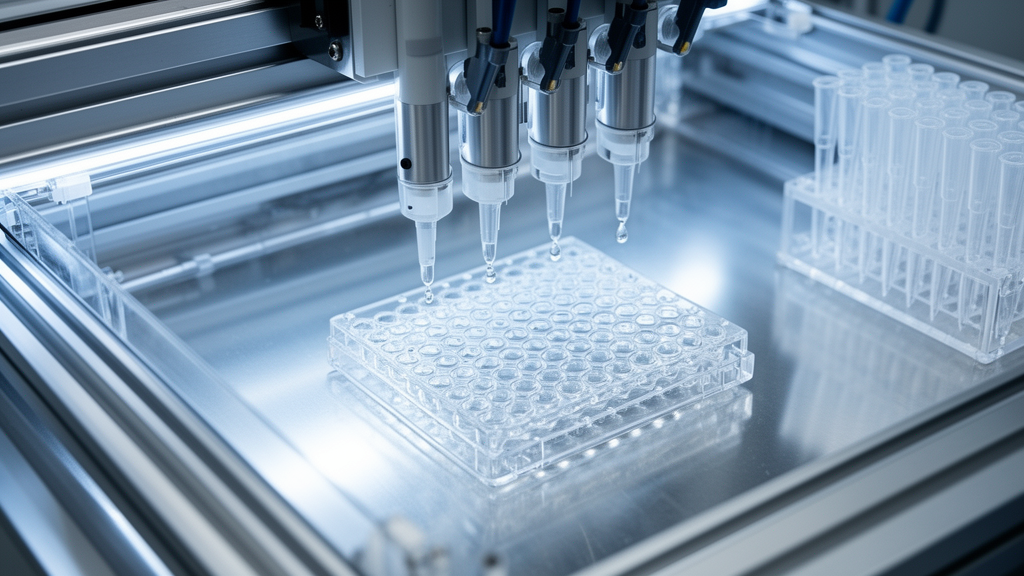
Researchers developing genome engineering tools have demonstrated an automated workflow designed to genotype individual bacterial variants from transposon insertion libraries using an open-source Opentrons OT-2 liquid handler coupled with a custom Python computational package. High-throughput screening serves as a cornerstone of modern synthetic biology and molecular genetics, accelerating foundational research while improving experimental reproducibility across diverse biological platforms. Despite the existence of established population-level screening techniques, pinpointing the exact transposon insertion sites within individual bacterial clones has historically remained a tedious, labor-intensive bottleneck that consumes extensive bench time. Although open-source robotic platforms have begun to democratize access to liquid-handling automation across academic laboratories, implementing reliable experimental pipelines has continued to demand substantial software programming skills or thoroughly pre-validated execution protocols. To resolve these accessibility and operational barriers, the research team constructed an end-to-end, modular automated genotyping protocol that standardizes colony counter-selection, duplicate PCR amplifications, and downstream sequence annotation without requiring end users to perform custom computer programming or complex script modifications during routine wet-lab operations.
Transposon mutagenesis provides an indispensable experimental methodology within genome engineering and synthetic biology research programs, offering an unbiased mechanism for generating extensive mutant libraries to interrogate fundamental cellular systems. In bacterial genetics, random transposon insertion libraries are widely deployed to identify essential genes and map non-essential loci capable of hosting synthetic gene circuits without disrupting host fitness. Because cellular physiology and molecular processes can exhibit profound spatial heterogeneity across bacterial chromosomes, systematically locating individual transposon integration junctions is critical for establishing rigorous mechanistic correlations between physical insertion coordinates and observable cellular phenotypes. Conventional high-throughput methods designed to genotype entire mutant populations in bulk frequently necessitate specialized transposon delivery constructs, costly high-throughput sequencing pipelines, or proprietary microfluidic instrumentation that remains inaccessible to standard academic research groups. Conversely, existing protocols that rely on polymerase chain reaction amplification to genotype individual picked colonies have suffered from severe throughput limits, demanding repetitive manual manipulations that restrict the scale of individual mutant library screens.
Manual polymerase chain reaction genotyping protocols inherently require repetitive, error-prone tasks that rapidly accumulate operational fatigue and procedural variability when scaled to hundreds of candidate clones. Laboratory scientists conducting manual screening must systematically re-streak distinct bacterial colonies onto agar plates, execute labor-intensive dual-antibiotic counter-selection assays, assemble intricate reaction mixtures by hand across multiple microplates, and manually parse raw sequencing chromatograms. By contrast, migrating these procedural stages onto a programmable robotic liquid handler enforces rigorous volumetric accuracy, minimizes human pipetting mistakes, and establishes comprehensive electronic execution records that guarantee experimental portability. The newly reported automated workflow establishes six distinct, modular stages that investigators can run as an integrated sequence or deploy independently across alternative experimental pipelines. These modular stages encompass picking colonies into selective growth media, performing counter-selection against plasmid backbones alongside glycerol stock pre-culture assembly, executing secondary colony counter-selection, conducting quality-control polymerase chain reactions to exclude spurious delivery plasmid integrations, performing two-step arbitrary polymerase chain reactions, and automatically annotating genomic insertion coordinates using dedicated software.
To maximize inter-laboratory reproducibility and streamline adoption across diverse microbial hosts, the automated procedure incorporates standardized plasmid backbones and automation scripting architectures. The workflow specifically relies on delivery plasmids adhering to Standard European Vector Architecture guidelines, demonstrated experimentally using the suicide plasmid pBLAM1-2-TS2m conjugated into the environmental bacterium Pseudomonas putida KT2440. Utilizing standardized vector architecture unifies physical assay conditions across distinct transposase families, ensuring that delivery vectors carrying alternative cargo or transposase systems behave uniformly across downstream liquid-handling steps. Furthermore, the underlying liquid-handling scripts comply with the Lab Automation Protocol standard, an open framework designed to generate modular, portable, and user-friendly automation routines compatible with various robotic instruments. To eliminate the need for manual code editing at the lab bench, each protocol script references a dedicated Microsoft Excel spreadsheet containing run-specific parameters, such as well counts, antibiotic types, and plate coordinates, allowing wet-lab microbiologists familiar with standard terminal commands to execute the pipeline seamlessly.
The operational pipeline begins in the laboratory with initial colony isolation before transitioning into fully automated microplate handling on the deck of the Opentrons OT-2. Individual bacterial colonies obtained from conjugation plates are picked into ninety-six-well culture plates containing minimal M9-citrate selective growth medium supplemented with fifty micrograms per milliliter of kanamycin to maintain selective pressure on the integrated transposon cargo. Following overnight culture incubation at thirty degrees Celsius with continuous shaking, the robot replicates the primary cultures into secondary microplates containing selective media supplemented with either the cargo antibiotic kanamycin or the plasmid backbone antibiotic ampicillin at five hundred micrograms per milliliter. After a second overnight growth cycle at thirty degrees Celsius, optical density values at six hundred nanometers are recorded across both plates and imported into the automated counter-selection script to evaluate genuine transposition against unwanted plasmid retention. During experimental validation with Pseudomonas putida KT2440, only one out of ninety-six sampled colonies grew in the presence of ampicillin, confirming a minimal rate of non-transposition plasmid persistence.
Colonies exhibiting robust growth under kanamycin selection alongside complete sensitivity to ampicillin are automatically flagged by the software and transferred into ninety-six-well storage plates containing thirty percent glycerol, as well as separate reaction plates filled with molecular-grade water for immediate genetic analysis. The liquid handler generates an output plate map that documents the spatial coordinates of each validated clone, creating an indexed reference plate for subsequent molecular assays. To ensure that selected clones do not harbor spurious integrations where the plasmid backbone erroneously inserted into the host chromosome, the workflow directs the liquid handler to perform targeted quality-control polymerase chain reactions. Working across forty-six selected clones alongside negative control wells inoculated with wild-type Pseudomonas putida KT2440 and positive control wells containing naked plasmid DNA, the robot sets up reactions using primer pairs PS3 and PS4 to amplify the backbone antibiotic resistance marker and transposase gene, alongside primer pairs PS5 and PS6 targeting the non-integrative plasmid origin of replication.
Rigorous inclusion of negative and positive control samples remains essential during control polymerase chain reactions because crude colony amplifications frequently generate non-specific background banding patterns on diagnostic agarose gels. In the experimental trial, the control reactions successfully yielded the expected reference amplicons—specifically a 2494-base-pair product for the PS3 and PS4 primer set and a 665-base-pair product for the PS5 and PS6 primer set—solely in positive control wells containing plasmid template. Agarose gel electrophoresis revealed an absolute absence of detectable backbone amplicons across all forty-six test variants, verifying that the biological library exhibited clean, authentic transposition without spurious genomic incorporation of non-integrative plasmid sequences. The authors note that when colonies harbor authentic spurious events, the resulting control amplicons appear as the predominant bands on agarose gels, whereas an absence of amplification across all targets typically indicates excess template mass that inhibited the polymerase enzymes, necessitating a simple re-assay using diluted colony suspensions.
Following successful validation in the quality-control polymerase chain reaction stage, the selected variants advance to two consecutive rounds of arbitrary polymerase chain reaction designed to amplify unknown flanking chromosomal sequences adjacent to the transposon insertion. In the first amplification round, the OT-2 liquid handler mixes bacterial lysates with Phire Green Hot Start II PCR Master Mix, combining the arbitrary primer ARB6 with the external transposon-specific primer ME-O-Km-Ext-F. The resulting reaction products, which typically appear as diffuse DNA smears rather than discrete bands due to random arbitrary annealing, serve as direct template material for the second amplification stage. For arbitrary round two, the robot transfers aliquots from the initial reaction plate into fresh tubes containing Phire Hot Start II PCR Master Mix, the nested arbitrary primer ARB2, and the internal transposon primer ME-O-Km-Int-F. Diagnostic gel electrophoresis confirmed robust amplification smears across randomly sampled reaction wells, verifying sufficient yield for downstream Sanger sequencing.
For final sequence determination and genomic annotation, ten-microliter aliquots of the secondary arbitrary polymerase chain reaction products were combined with the internal sequencing primer ME-O-Km-Int-F and dispatched to Macrogen Spain for standard Sanger sequencing. The resulting sequence data files were parsed and annotated automatically using the custom command-line tool tnfind, which is packaged within the open-source Python library TnAtlas. Running locally in a Python environment equipped with BLASTN, fastqc, and sickle, the tnfind utility automates quality trimming, filters low-quality reads, and performs local alignment against the annotated Pseudomonas putida KT2440 TIGR reference genome. In the reported validation experiment, the software successfully resolved unique, unambiguous chromosomal insertion coordinates for forty out of forty-six evaluated variants. The remaining six variants failed to yield definitive insertion sites due to compromised sequencing read quality stemming from poor arbitrary amplification efficiency or minor colony impurities, rather than mechanical liquid-handling errors on the robotic deck.
Comparing robotic execution to manual human performance reveals key operational trade-offs and substantial workflow advantages that become pronounced when scaling throughput across large mutant repositories. When processing a single ninety-six-well plate, the robotic liquid handler operates at a slower pace than an experienced human technician: step two required nine minutes and thirty-seven seconds on the robot versus four minutes and twenty-five seconds manually; step three took twelve minutes and six seconds versus nine minutes and fifty-five seconds; and the combined polymerase chain reaction setup took fifty-five minutes and fourteen seconds versus fourteen minutes and fourteen seconds by hand. Nevertheless, the automated system removes nearly all hands-on bench labor, eliminating human fatigue and preventing sample transfer errors during intricate dual-plate counter-selection steps. Furthermore, the robot executes runs with absolute consistency across multiple plates, generating detailed digital audit logs and plate maps. Although the current protocol relies on manual colony picking into the primary growth plate, the authors highlight that integrating adapted mechanical colony pickers can transition the platform into a completely autonomous, high-throughput transposon genotyping engine.
Subject of Research: Automated liquid-handling workflow for genotyping individual bacterial transposon insertion library variants
Article Title: Automated workflow for genotyping individual transposon library variants
Article References: Alejaldre, L., Anhel, A.-M., Grozinger, L., & Goñi-Moreno, Á. (2026). Automated workflow for genotyping individual transposon library variants. BMC Methods, 3(1), Article 3. https://doi.org/10.1186/s44330-025-00054-3
Image Credits: AI Generated
DOI: 10.1186/s44330-025-00054-3
Keywords: Transposon insertion libraries, Pseudomonas putida KT2440, Opentrons OT-2, Liquid handling automation, Lab Automation Protocol, Standard European Vector Architecture, Colony counter-selection, Arbitrary PCR, Control PCR, TnAtlas, tnfind, BLASTN genome annotation, Synthetic biology, Genome engineering, Variant genotyping, Spurious integration screening, Bacterial conjugation, High-throughput screening
News Source: Gregory Coleman. (November 12, 2026). Automated Liquid Handling Workflow Genotypes Pseudomonas Transposon Variants Within Five Days. Scienmag.