Researchers have shown that pairing deep convolutional autoencoders with multilayer perceptrons creates a non-intrusive reduced-order model that outclasses traditional modal decomposition in predicting mechanical strain fields during additive manufacturing. In a study published in Advanced Modeling and Simulation in Engineering Sciences, authors Shubham Chaudhry, Azzedine Abdedou, and Azzeddine Soulaïmani evaluated two data-driven surrogate frameworks for selective laser melting: proper orthogonal decomposition combined with an artificial neural network, and a convolutional autoencoder coupled with a multilayer perceptron. Both frameworks operate non-intrusively, mapping process parameters directly to full-field strain distributions without altering finite element solvers. Tested against metal additive manufacturing benchmarks, both strategies achieved high predictive fidelity, but the convolutional autoencoder model demonstrated superior accuracy by resolving complex spatial variations that linear bases struggle to capture. By compressing high-fidelity numerical simulation snapshots into low-dimensional latent spaces, these surrogate pipelines deliver rapid, accurate full-field predictions, offering engineering workflows a robust data-driven alternative to prohibitive finite element calculations.
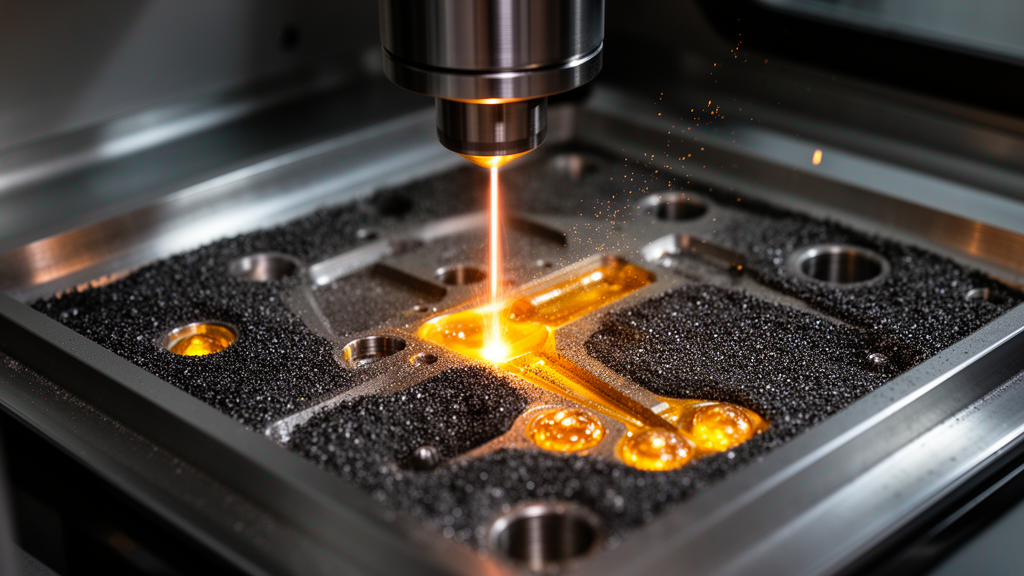
Selective laser melting represents a major technique within laser powder bed fusion, fabricating dense metallic components by selectively consolidating successive layers of metal powder with a high-energy laser beam. Although this advanced manufacturing method allows the production of complex geometries with minimal material waste and reduced manufacturing costs, the underlying process remains prone to severe physical defects. The intense thermal energy deposited by the laser generates a molten melt pool reaching thousands of degrees Celsius, bordered by solidified regions at ambient or preheat temperatures. These steep thermal gradients induce significant residual stresses that cause part distortion, dimensional inaccuracies, and premature build failure. Accurately simulating these thermomechanical responses poses severe computational hurdles because selective laser melting spans multiple length and time scales. Rapid phase transformations and latent heat effects occur within milliseconds inside the melt pool, while full part fabrication and cooling cycles extend over hours or days, requiring finely meshed, highly nonlinear numerical models.
Machine learning models offer an appealing surrogate modeling approach for selective laser melting by evaluating thermal and stress fields without repeatedly solving demanding numerical equations. However, standard deep neural networks encounter substantial scalability bottlenecks when scaled to large additive manufacturing domains. Expanding prediction grids to tens of thousands of spatial nodes triggers an explosion in trainable parameters, which can reach millions or billions of weights depending on network depth and layer sizing. Reduced-order modeling offers an established alternative by projecting large numerical snapshot matrices onto lower-dimensional subspaces while retaining critical physical information. Proper orthogonal decomposition is widely used to construct these reduced representations through linear modal decomposition. Nevertheless, the linearity and global spatial support of proper orthogonal decomposition modes hinder their ability to resolve localized, transient phenomena. In addition, the mathematical orthogonality constraint placed on linear basis functions often fails to reflect real physical interactions in complex systems, highlighting the need for expressive nonlinear dimensionality reduction techniques.
Proper orthogonal decomposition constructs a snapshot matrix from high-fidelity numerical solutions and applies singular value decomposition to extract optimal deterministic basis vectors. These orthogonal modes exhibit energy optimality, meaning the leading modes capture maximum kinetic or strain energy relative to any alternative linear decomposition. Truncation criteria based on singular values determine the exact number of dominant modes retained, balancing projection accuracy against computational economy. During the offline phase, eighty percent of the snapshot data is used to compute modal projection coefficients, while a multilayer artificial neural network is trained using the Adam optimizer to map physical input parameters to these coefficients. In the subsequent online phase, the trained network predicts modal coefficients for novel input variables, and the static proper orthogonal decomposition modes reconstruct the high-dimensional spatial output without requiring additional solver evaluations.
To overcome the constraints of linear modal decomposition, the authors formulated an alternative deep learning framework using a one-dimensional convolutional autoencoder linked to a multilayer perceptron. An autoencoder performs nonlinear dimensionality reduction using an encoder to compress spatial snapshot matrices into a compact latent space, while a decoder reconstructs original spatial dimensions from that latent space. By using one-dimensional convolution kernels, localized connections, and pooling layers, the convolutional autoencoder extracts hierarchical spatial features while curbing trainable parameter counts. In this framework, the spatial dimension of the snapshot matrix is encoded into a reduced latent vector using rectified linear unit activations. A multilayer perceptron is trained to map physical input parameters to this latent representation. During online inference, the perceptron predicts latent vectors for new operating conditions, and the decoder reconstructs the full three-dimensional spatial field, allowing nonlinear feature learning to capture localized physical gradients effectively.
Before tackling complex manufacturing simulations, the authors evaluated both algorithmic approaches on a two-dimensional steady-state heat conduction problem across a flat plate of thickness e. Thermal transport was governed by the linear heat equation with conductive flux defined by Fourier’s law and convective cooling along edges. Thermal conductivity and convection coefficients served as variable input parameters, sampled uniformly using Latin Hypercube Sampling across specified intervals. An in-house finite element code solved three hundred configurations across a mesh of two hundred and eighty-nine nodes, split into eighty percent training and twenty percent testing data. When tested against five thousand unseen realizations generated via Latin Hypercube Sampling, both surrogate frameworks reproduced the temperature distributions accurately. Proper orthogonal decomposition captured system dynamics with three modes, whereas the convolutional autoencoder compressed spatial dimensions to five latent variables. The relative L2 error norm for the autoencoder reached 5.76e-08, outperforming the orthogonal decomposition error norm of 2.88e-07.
Following preliminary verification, the researchers applied both reduced-order frameworks to the stochastic thermomechanical analysis of a selective laser melting benchmark designated AMB2018-01, released by the National Institute of Standards and Technology. The benchmark consists of an IN625 nickel-base alloy bridge measuring seventy-five by five by twelve point five millimeters, built on a substrate measuring eighty-one by twelve point seven by eleven millimeters. High-fidelity numerical simulations were performed using Workbench Additive software, requiring approximately one hour per simulation across thirty-two processor cores. The finite element mesh contained ninety-seven thousand three hundred and sixty nodes, with boundary nodes excluded to prevent edge errors and reduce computation. Five manufacturing and material variables served as inputs: layer thickness, hatch spacing, laser speed, Young’s modulus, and Poisson’s ratio. Latin Hypercube Sampling generated three hundred and sixty parameter combinations, producing three separate snapshot matrices sized three hundred and sixty by ninety-seven thousand three hundred and sixty for normal strains in the x, y, and z directions.
The structural setup of both reduced-order architectures addressed the demands of full-field strain prediction over the ninety-seven thousand node domain. Proper orthogonal decomposition modal truncation criteria retained nineteen modes for x-strain, forty-two modes for y-strain, and sixty-six modes for z-strain. In parallel, the spatial convolutional autoencoder used one-dimensional convolution layers with ten and fifteen channels, max-pooling layers, and rectified linear unit activations to reduce spatial dimensions to nineteen, forty, and sixty latent dimensions. Both models were trained on eighty percent of the initial snapshot matrices and evaluated on twenty percent testing data using TensorFlow and the Adam optimizer. When evaluated against five thousand newly generated parameter realizations, both frameworks captured the mean and standard deviation profiles of the snapshot matrices, correctly identifying zones of mechanical compression and expansion. However, the convolutional autoencoder model achieved lower L2 relative error norms across all directional strains, demonstrating superior capability in modeling complex spatial variations despite requiring longer training and prediction times.
To validate their predictions against physical measurements, the researchers benchmarked both reduced-order models against experimental strain data collected from the physical AMB2018-01 bridge using neutron diffraction and X-ray diffraction methods. Comparisons of normal strain distributions at elevation z equals 9.536 millimeters showed close agreement between model predictions and experimental measurements. Furthermore, comparing these results with an earlier deep neural network model developed by Chaudhry and colleagues revealed substantial performance improvements. That earlier neural network had been trained exclusively on an isolated cross-section containing two hundred and fifty-one nodes, whereas the new reduced-order models constructed over the entire geometry improved prediction accuracy by sixty to eighty percent.
Despite the demonstrated strengths of the convolutional autoencoder and multilayer perceptron approach, the authors identified key operational boundaries and computational trade-offs. The convolutional autoencoder requires more training and prediction time than proper orthogonal decomposition, but its higher accuracy offsets these slower prediction times and can accelerate convergence in optimization loops. However, because both surrogate models rely on training data within a defined parameter space, their accuracy decreases when attempting to extrapolate beyond sampled bounds. To address this limitation, future research aims to incorporate uncertainty quantification techniques, such as Bayesian neural networks and ensemble methods, to provide confidence intervals and enhance reliability in extrapolative settings. In addition, recent developments in physics-informed neural networks offer promising opportunities to combine data-driven reduced-order models with physical governing equations. Merging physics-based constraints with convolutional autoencoders could improve generalization and physical interpretability, paving the way for scalable, real-time surrogate modeling across industrial additive manufacturing workflows.
Subject of Research: Non-intrusive reduced-order modeling of selective laser melting additive manufacturing
Article Title: Data-driven non-intrusive reduced order modelling of selective laser melting additive manufacturing process using proper orthogonal decomposition and convolutional autoencoder
Article References: Chaudhry, S., Abdedou, A., & Soulaïmani, A. (2025). Data-driven non-intrusive reduced order modelling of selective laser melting additive manufacturing process using proper orthogonal decomposition and convolutional autoencoder. Advanced Modeling and Simulation in Engineering Sciences, 12(1), Article 22. https://doi.org/10.1186/s40323-025-00305-6
Image Credits: AI Generated
DOI: 10.1186/s40323-025-00305-6
Keywords: selective laser melting, additive manufacturing, reduced-order modeling, convolutional autoencoders, proper orthogonal decomposition, multilayer perceptron, laser powder bed fusion, finite element simulation, residual strain, AMB2018-01 benchmark, IN625 superalloy, surrogate modeling, Latin Hypercube Sampling, singular value decomposition, thermal gradients, deep neural networks, physics-informed neural networks
News Source: Denise Maddox. (November 12, 2026). Convolutional Autoencoders Improve Strain Prediction Accuracy in Selective Laser Melting Surrogates. Scienmag.