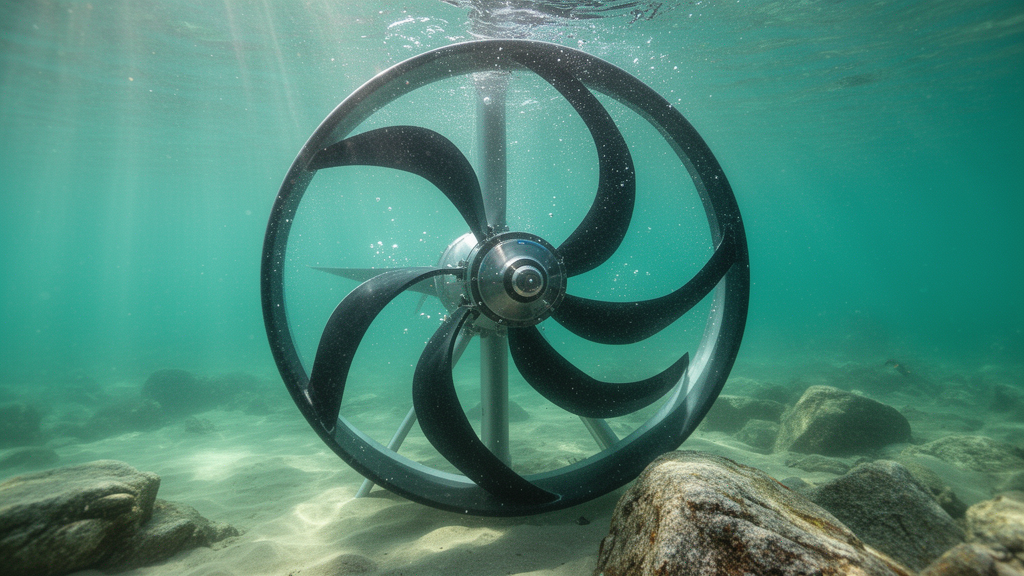
Fitting tidal stream turbines with flexible rubber blades enables the devices to produce as much electricity as conventional designs while significantly reducing structural fatigue, according to an experimental study published in the journal Nature. Developed by engineers from the University of Edinburgh and Michelin, the passive shape-shifting blades bend naturally in fast-moving water to shed excess mechanical stress, eliminating the complex and failure-prone motorized mechanisms historically required for ocean power generation.
Fast-flowing tidal channels represent some of the most hostile environments on Earth for mechanical infrastructure. In these waters, turbulence, large waves, and shifting currents continuously subject turbine blades to intense, fluctuating hydrodynamic forces.
To withstand these severe marine conditions, conventional commercial-scale tidal turbines depend on active pitch control systems. These mechanisms use a sophisticated network of internal motors, sensors, and mechanical bearings to twist rigid blades away from the incoming flow when water currents become excessively strong. However, active pitch systems are expensive to manufacture, exceptionally difficult to service and maintain underwater, and represent one of the leading points of mechanical failure in modern tidal installations.
Seeking a simpler and more durable alternative, the engineering team drew inspiration from natural structures, noting how fish and flexible trees bend passively to survive powerful water and wind currents without rigid mechanical intervention. Using this biological principle, the researchers designed composite blades constructed from flexible rubber reinforced with a stiff internal steel spar running continuously from the blade root to its tip.
The resulting blade architecture regulates hydrodynamic forces automatically through its material flexibility. As the surrounding ocean current strengthens, the flexible trailing edge bends back and flattens the blade’s curved profile, immediately shedding excess hydrodynamic loads. This passive deformation occurs smoothly and continuously across varying flow velocities without requiring any mechanical hinges, bearings, or motorized pitch actuators.
When combining hydrodynamic tank measurements with computational simulations of an entire tidal cycle, the researchers found that the flexible rubber-bladed turbine generated the same amount of electrical energy as a conventional turbine equipped with active mechanical pitch control under identical flow conditions. The self-deforming geometry managed to regulate power capture effectively across the full operating cycle without sacrificing total energy generation.
Crucially, the flexible blades reduced the rapid, high-frequency load fluctuations that drive mechanical fatigue by up to 29 per cent. Conventional motorized pitch control systems struggle to respond quickly enough to these rapid turbulence-induced load swings. In addition, because industrial rubber has a physical density very close to that of seawater, the blades can be manufactured to be neutrally buoyant, which further suppresses damaging load variations as the blades rotate through the water column.
By removing heavy mechanical control components and moderating peak fatigue stresses, the shape-shifting blade concept could support the development of lighter overall blade structures, lighter seabed support frames, larger electrical generators, and less frequent maintenance cycles. Together, these mechanical simplifications have the potential to substantially decrease the levelized cost of electricity generated from tidal streams.
The enhanced durability offered by passive load shedding could also unlock highly energetic and turbulent marine channels that have previously been considered too punishing for existing tidal energy machinery. Unlike solar and wind generation, tidal energy offers predictable power production years in advance, supporting United Kingdom goals to deploy 1 gigawatt of tidal stream capacity by 2035—powering roughly 1 million homes—as well as international projections forecasting more than 300 gigawatts of global tidal generation by 2050.
Computational simulations evaluating a full commercial-scale 20-metre turbine indicate that the flexible rubber blade concept remains similarly effective at utility scale. Initial calculations suggest that commercial-sized rubber blades could potentially exceed the 20-year operational service lifetime currently expected of marine energy installations, according to the research team.
The research was co-led by Professor Ignazio Maria Viola and co-first authored by Dr Zhehong Zhang at the University of Edinburgh’s School of Engineering, alongside Bertrand Daval, vice president of research and development composite solutions at Michelin. The work was supported by Michelin, the Engineering and Physical Sciences Research Council, and Edinburgh Innovations; Michelin has filed a patent on the technology and the university holds related intellectual property.
Discussing the implications of the study, Professor Ignazio Maria Viola of the University of Edinburgh’s School of Engineering highlighted the dual challenge of harnessing marine currents while enduring the destructive forces of the sea. Professor Viola, who co-led the investigation, noted that tidal energy represents one of the most reliable and predictable renewable resources currently available, standing apart from weather-dependent alternatives because ocean movements can be modeled and anticipated years in advance. However, the unforgiving marine environment has historically forced developers to equip underwater generating systems with elaborate, delicate mechanical assemblies merely to ensure their survival beneath the surface. According to Viola, the newly designed flexible blades perform this protective function autonomously. By bending in response to heightened flow, the blades shed surplus hydrodynamic forces and smooth out destructive load fluctuations while maintaining uninterrupted energy generation. Viola emphasized that eliminating mechanical components that are inherently expensive to manufacture and prone to breakdown under water is essential if tidal power is to become a fully cost-competitive pillar within a secure, net zero energy system.
Dr Zhehong Zhang, also of the University of Edinburgh’s School of Engineering and co-first author of the peer-reviewed paper, pointed to the fundamental engineering philosophy underpinning the project. Rather than engineering increasingly intricate motorized control mechanisms to resist the severe, dynamic forces of energetic ocean channels, the research team sought an approach where the turbine blades naturally adapt their physical geometry to incoming currents. Dr Zhang explained that the core concept is straightforward: allowing the flexible structure to respond passively to fluid movement removes the need for active mechanical intervention while preserving overall power capture. By demonstrating that passive structural deflection reduces damaging peak fatigue loads without lowering electricity output, the research establishes a viable path toward deploying turbines in exceptionally turbulent, high-energy tidal locations. Many of these marine sites feature powerful currents that could provide substantial clean electricity but have long been considered too punishing and mechanically hazardous for existing commercial equipment to endure.
The collaborative venture relied heavily on material science expertise contributed by tire and composite manufacturer Michelin. Bertrand Daval, vice president of research and development composite solutions at Michelin and co-leader of the investigation, framed the partnership as a direct translation of specialized industrial knowledge to solve a major renewable energy obstacle. Daval noted that Michelin’s engineering background centers on analyzing how rubber performs under heavy, repeated loads in demanding operational environments. Applying this established understanding of elastomeric behavior to ocean energy enabled the team to evaluate flexible composite structures capable of enduring relentless marine currents. Daval pointed out that deploying resilient rubber compounds in marine turbines addresses one of the most persistent bottlenecks in clean power engineering by developing turbines capable of withstanding demanding marine conditions, with the genuine potential to reduce costs across the sector.
Subject of Research: Flexible rubber turbine blades for passive load shedding in tidal energy systems
Article Title: Shape-shifting rubber blades could make tidal power cheaper
Article References: Shape-shifting rubber blades could make tidal power cheaper. Original publication (Bibliographic details unavailable.)
Image Credits: AI Generated
DOI: Not provided
Keywords: tidal energy, tidal turbines, flexible blades, rubber materials, University of Edinburgh, Michelin, FloWave facility, active pitch control, load shedding, fatigue reduction, renewable power, ocean engineering, Nature, EPSRC, Edinburgh Innovations, clean energy technology
News Source: Denise Maddox. (November 12, 2026). Flexible Rubber Blades Match Tidal Power Output While Cutting Fatigue Damage. Scienmag.