Researchers at the University of Tsukuba have demonstrated that auditory cues alone can generate a tangible sensation of resistance to hand movement, even in the complete absence of physical force. This peer-reviewed study, published in the journal Applied Acoustics, explores the potential of sound to simulate tactile feedback, a capability that is particularly significant for making virtual and augmented reality environments accessible to individuals with visual impairments. By manipulating specific acoustic parameters, the team showed that participants can perceive sensations of movement against a water current.
Virtual reality and augmented reality strongly rely on visual information, making them inaccessible to individuals with visual impairments. Previous attempts to create illusions of touch or force without physical contact have primarily focused on visual manipulations, such as altering the apparent position of objects on a screen. The University of Tsukuba team sought to investigate whether auditory perception could independently support the illusion of force, specifically by recreating the experience of a hand moving through flowing water.
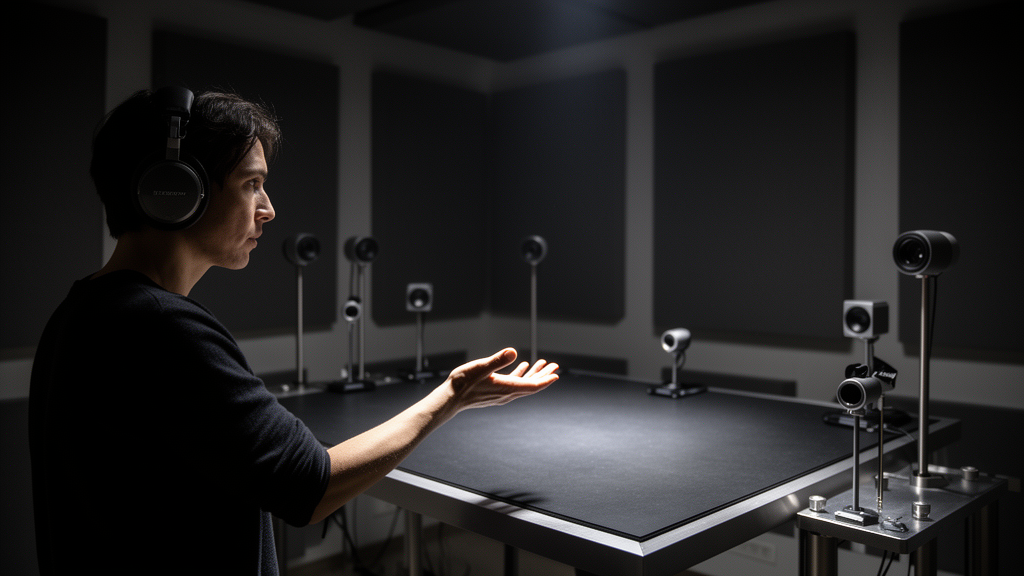
To test this hypothesis, the researchers designed a psychophysical experiment set within a simulated virtual environment referred to as “Hand-in-River.” Participants were blindfolded to eliminate visual input and were provided with headphones that delivered multiple auditory stimuli. Their hand movements were tracked using a smartphone camera. The participants were asked to report their perceptions based on the ease or difficulty of their hand movements, effectively measuring the subjective sensation of resistance or assistance provided by the virtual water current.
The experimental design focused on two primary auditory variables: the pitch of the sound and its spatial location relative to the participant’s hand. The researchers manipulated these factors to observe how changes in frequency and auditory displacement influenced the perceived force.
The results indicated that sound variations alone were sufficient to create user biases toward sensations of movement against a water current. The perceived resistance was particularly enhanced when the pitch of the sound was increased. Furthermore, this effect was strengthened when the higher pitch was combined with an auditory displacement that shifted the perceived location of the sound away from the participant’s hand.
In contrast, the study found that lowering the pitch or shifting the sound in the direction of movement did not reliably produce sensations of assistance or forward motion by the current. This asymmetry in the results highlights a significant difference in how auditory cues influence perceptions of resistance versus assistance. The resistance-related effects emerged more robustly than the assistance-related effects.
The implications of these findings extend beyond basic perceptual research, offering potential pathways for the development of sound-based assistive technologies. The researchers suggest that these auditory cues could be used to alert people with visual impairments to the boundaries of virtual spaces or the presence and approach of obstacles.
The study was supported by JSPS KAKENHI and JST SPRING, and the original paper, titled “Hand-in-River: Design of Direction-Dependent Virtual Cues of Assistive/Resistive Force via Auditory Displacement and Pitch Variation,” was published in Applied Acoustics. The work was led by Associate Professor Keiichi Zempo from the Institute of Systems and Information Engineering at the University of Tsukuba.
Subject of Research: Auditory cues for simulating tactile resistance in virtual environments
Article Title: Sound without physical force can create a sense of resistance to hand movement
Article References: Sound without physical force can create a sense of resistance to hand movement. Original publication (Bibliographic details unavailable.)
Image Credits: AI Generated
DOI: Not provided
Keywords: University of Tsukuba, Applied Acoustics, Auditory Displacement, Pitch Variation, Virtual Reality, Augmented Reality, Visual Impairments, Tactile Feedback, Psychophysical Experiment, Hand-in-River, Sound-Based Technology, Perceived Resistance, Haptic Illusion, Keiichi Zempo, Institute of Systems and Information Engineering, JSPS KAKENHI, JST SPRING, Human-Computer Interaction, Auditory Perception, Virtual Environment
News Source: Bethany Barker. (November 12, 2026). Sound Pitch and Location Create Perceived Hand Resistance Without Force. Scienmag.