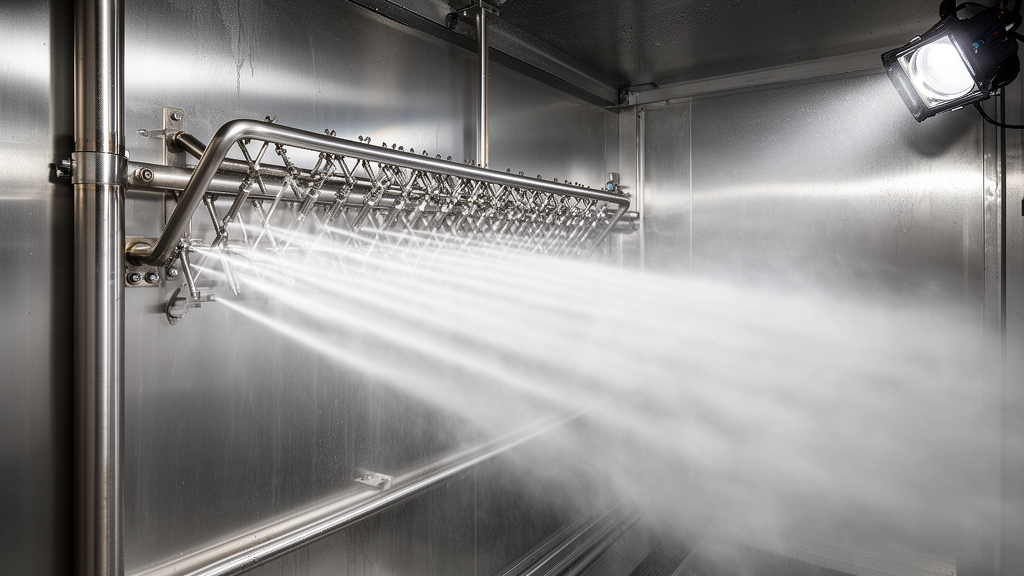
Researchers investigating aerodynamic icing conditions have quantified how structural components within wind tunnel spray systems alter the distribution of supercooled water droplets and airflow temperatures. Using a two-way coupled numerical simulation modeled on the three-meter by two-meter Icing Wind Tunnel at the China Aerodynamics Research and Development Center, the study evaluated the aerodynamic and thermodynamic influence of spray rake configurations. The central finding demonstrates that incorporating a middle vertical plate adjacent to nozzle arrays noticeably reduces the liquid water content uniformity index within the test section, particularly for larger droplets. Conversely, the presence of this structural plate exerts an essentially negligible effect on droplet cooling rates and the overall temperature distribution of the airflow. These numerical results provide precise physical data to guide decisions regarding whether wind tunnel operators should retain or eliminate intermediate vertical support structures within large-scale icing spray rakes.
The simulated facility, established in 2014, represents China’s pioneering large-scale closed-loop icing wind tunnel capable of replicating both icing conditions and altitude flight environments. In aeronautical development, such experimental facilities provide vital test data required for aircraft airworthiness certification under adverse weather conditions. The facility reproduces atmospheric icing by spraying water droplets into an expanding settling chamber, where airflow propels the moisture cloud through a horizontal contraction section measuring 15.83 meters before entering a test section measuring five meters in length. Throughout this trajectory, droplets undergo complex dynamic and thermodynamic changes until approaching equilibrium in the test section, which measures three meters wide by two meters high. Achieving stable, uniform distributions of supercooled water droplets and airflow temperatures across this test cross-section is essential for reliable experimental outcomes, especially when simulating supercooled large droplets that present distinct physics compared to conventional small cloud droplets.
To capture multiphase flow dynamics within the tunnel, researchers implemented an Eulerian-Lagrangian computational framework. The continuous airflow phase was modeled using Eulerian mass, momentum, and energy conservation equations. The governing equations incorporated density, dynamic viscosity, turbulent viscosity, gravitational acceleration, and exchange source terms accounting for mass, momentum, and energy transferred between air and dispersed water droplets. Turbulence closure was achieved through the Shear-Stress Transport k-omega model, which solves transport equations for turbulence kinetic energy and specific dissipation rate to balance computational efficiency with boundary layer resolution. Within the Lagrangian reference frame, individual droplet trajectories were tracked by solving particle force balance equations combining aerodynamic drag, gravitational forces, buoyancy derived from the density difference between water and air, and additional flow forces. Droplet drag coefficients were determined using empirical piecewise relations based on the relative Reynolds number, while droplets were assumed to behave as rigid spheres.
The interaction between the dispersed liquid spray and continuous airflow was resolved through a two-way coupling iteration approach. Rather than assuming droplets follow precomputed flow streamlines without feedback, the numerical model traces momentum, mass, and energy exchanges occurring between discrete particles and surrounding air. In the momentum balance formulation, momentum transfer depends on the relative velocity difference between droplets and airflow, drag coefficient, droplet diameter, fluid dynamic viscosity, and particle mass flow rate over discrete time steps. For thermal interactions, droplet energy equations calculate convective heat transfer between droplet surface area and local airflow temperature based on convective heat transfer coefficients and specific heat capacity. Concurrently, energy source terms added to the continuous phase energy equation account for sensible heat changes, latent heat from phase variations, and mass transfer resulting from droplet evaporation. These coupled quantities are repeatedly integrated back into continuous phase calculations to establish dynamic equilibrium.
A central objective was comparing two distinct geometric models of the wind tunnel spray rake to isolate the aerodynamic effect of its vertical structural members. The complete physical spray rake consists of twenty horizontal airfoil-shaped steel plates and seven vertical airfoil-shaped steel plates. Across horizontal rows, the system incorporates a staggered arrangement of one thousand A-type nozzles and five hundred B-type nozzles. Because the central vertical plate aligns directly with columns of B-type nozzles, turbulent vortices shedding from its trailing edge were hypothesized to alter droplet dispersion trajectories downstream. To investigate this effect with high computational efficiency, the authors established Model-I, representing a configuration without the middle vertical plate obstructing spray outlets, and Model-II, representing the configuration retaining the middle vertical plate. Both geometric configurations simulated discharge from the five hundred B-type nozzle locations using a plain-orifice atomizer model that specified droplet ejection directions, velocity vectors, spray angles, temperatures, and mass flow rates.
The overall computational geometry extended across a total length of approximately 43 meters, beginning with an airflow inlet measuring 11 meters long and 8 meters wide, tapering through the 15.83-meter contraction section, and concluding across the 5-meter test section. The computational domain applied a velocity inlet boundary condition at the entrance, a pressure outlet boundary condition at the test section exit, non-slip conditions along solid wind tunnel walls, and an escape boundary condition for droplets reaching external boundaries. Simulations incorporated gravitational acceleration and tracked 250,000 discrete rigid droplet particles, corresponding to 500 particles emitted per nozzle. Mesh independence was established using polyhedral grids evaluated at three refinement levels comprising approximately 5.23 million, 8.97 million, and 13.04 million elements. Comparisons of velocity, temperature, and liquid water content along the model centerline demonstrated that the intermediate grid density of 8,965,089 polyhedral elements for Model-I and 9,115,473 polyhedral elements for Model-II yielded converged numerical solutions.
Analysis of droplet flow trajectories revealed distinct aerodynamic interactions between structural plates and droplet dispersion patterns. For 20-micrometer droplets moving at a test section velocity of 80 meters per second, aerodynamic forces cause droplet clouds to align rapidly with converging airflow, covering approximately 95 percent of the test section exit area. However, while Model-I produced uniform droplet clusters across central nozzle rows, Model-II generated a significantly wider droplet cluster from the central nozzle. Velocity vector calculations showed that as airflow passes over the horizontal plate, a symmetrical vortex forms behind the nozzle, creating a localized low-pressure recirculation zone. Concurrently, the central vertical plate introduces a flow obstruction that establishes a localized high-pressure zone behind its trailing edge. The resulting lateral pressure gradient exerts transverse aerodynamic forces on exiting droplets, pushing them outward toward the periphery and broadening the central spray jet width before the cloud enters the contraction section.
The spatial uniformity of the resulting cloud field was evaluated using an area-weighted average and a dimensionless uniformity index, where a value of unity represents absolute spatial homogeneity across the test cross-section. Numerical calculations at an airflow velocity of 80 meters per second revealed that the middle vertical plate systematically reduces liquid water content uniformity, with the penalty scaling directly with droplet diameter. For 20-micrometer droplets, Model-II exhibited a modest 0.58 percent decrease in cloud uniformity index compared to Model-I. For 100-micrometer droplets, the uniformity index decreased by 0.40 percent, while cloud coverage reached roughly 90 percent of the outlet cross-section. Conversely, for 500-micrometer supercooled large droplets, atomization coverage dropped to roughly 25 percent of the exit area. Because large droplets possess greater inertia and undergo pronounced gravitational sedimentation, many particles impact the lower contraction wall, creating a distinct water-free strip in the center and causing a 2.21 percent reduction in uniformity for Model-II.
When simulated test section airflow velocity was doubled from 80 meters per second to 160 meters per second, the distribution of liquid water content underwent substantial modification. Higher flow speeds intensified turbulent pulsations, which reduced local peak concentrations of water and promoted a more diffuse grid-like distribution across the outlet section for 20-micrometer and 100-micrometer droplets. However, elevated velocities also caused global liquid water content uniformity indices to deteriorate across all droplet sizes. For Model-I, raising velocity from 80 to 160 meters per second reduced the uniformity index by 7.6 percent for 20-micrometer droplets, 11.5 percent for 100-micrometer droplets, and 23.9 percent for 500-micrometer droplets. Similarly, Model-II exhibited uniformity reductions of 4.2 percent, 10.7 percent, and 20.7 percent across the same sizes. Comparing the two configurations at 160 meters per second confirmed that adding the middle vertical plate further degraded uniformity by 3.0 percent at 20 micrometers, 0.45 percent at 100 micrometers, and 1.9 percent at 500 micrometers.
In contrast to the clear aerodynamic disturbances observed in droplet spatial trajectories, thermal field analysis indicated that spray rake structural variations exert minimal influence on temperature distributions. Along the flow path from nozzle ejection to the test section exit, droplets exchange heat rapidly through convection with surrounding cold airflow. Because small droplets have a high surface-area-to-volume ratio, 20-micrometer and 100-micrometer droplets quickly reach thermodynamic equilibrium, displaying virtually identical temperature reduction curves that differ by only 0.12 Kelvin at the outlet cross-section. In contrast, 500-micrometer droplets cool much more slowly due to reduced specific surface area, resulting in an outlet temperature discrepancy of approximately 5.24 Kelvin. Nevertheless, comparing Model-I and Model-II showed that droplet temperature profiles remained virtually coincident regardless of whether the middle vertical plate was present, while the overall airflow temperature uniformity index consistently achieved a value of 0.99 under both structural configurations. Ultimately, these numerical findings demonstrate that while intermediate structural plates do not perturb thermal equilibrium, their wake-induced lateral dispersion measurably degrades liquid water content uniformity, providing essential data-driven guidance for optimizing spray rake geometries in aeronautical icing facilities.
Subject of Research: Aerodynamic and thermodynamic effects of icing wind tunnel spray rake configurations
Article Title: Study on the influence of spray rake configuration on the uniformity of cloud field and temperature field in a large-scale icing wind tunnel
Article References: Li, T., Yang, Q., Wang, Q., & Yi, X. (2025). Study on the influence of spray rake configuration on the uniformity of cloud field and temperature field in a large-scale icing wind tunnel. Advances in Aerodynamics, 7(1), Article 21. https://doi.org/10.1186/s42774-025-00210-x
Image Credits: AI Generated
DOI: 10.1186/s42774-025-00210-x
Keywords: icing wind tunnel, aerodynamics, cloud field uniformity, droplet trajectory, liquid water content, computational fluid dynamics, two-phase flow, supercooled droplets, influence, spray, rake, configuration
News Source: Audrey Campbell. (November 12, 2026). How Spray Rake Structures Impact Cloud Uniformity in Icing Wind Tunnels. Scienmag.