• HOME
  • NEWS
  • EXPLORE
    • CAREER
      • Companies
      • Jobs
    • EVENTS
    • iGEM
      • News
      • Team
    • PHOTOS
    • VIDEO
    • WIKI
  • BLOG
  • COMMUNITY
    • FACEBOOK
    • INSTAGRAM
    • TWITTER
Friday, November 20, 2026
BIOENGINEER.ORG
No Result
View All Result
  • Login
  • HOME
  • NEWS
  • EXPLORE
    • CAREER
      • Companies
      • Jobs
        • Lecturer
        • PhD Studentship
        • Postdoc
        • Research Assistant
    • EVENTS
    • iGEM
      • News
      • Team
    • PHOTOS
    • VIDEO
    • WIKI
  • BLOG
  • COMMUNITY
    • FACEBOOK
    • INSTAGRAM
    • TWITTER
No Result
View All Result
Bioengineer.org
No Result
View All Result
Home NEWS Science News Technology

Enhanced U-Net Architecture Improves Crack Detection in Operational Railway Tunnels

by
November 12, 2026
in Technology
Reading Time: 2 mins read
0
Enhanced U-Net Architecture Improves Crack Detection in Operational Railway Tunnels

Enhanced U-Net Architecture Improves Crack Detection in Operational Railway Tunnels

Share on FacebookShare on TwitterShare on LinkedinShare on RedditShare on Telegram

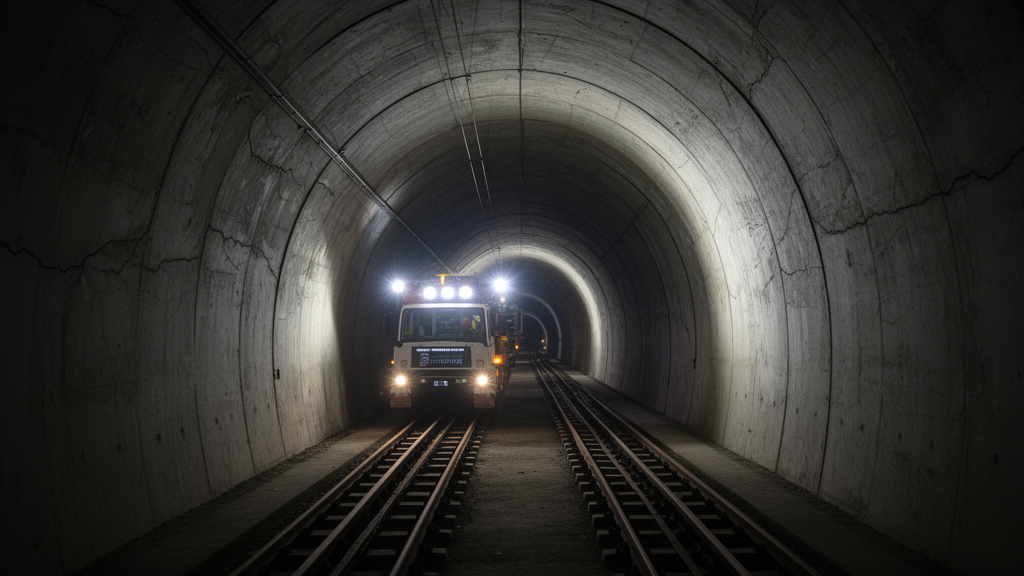
Researchers have introduced an enhanced deep learning architecture named CSwinUKAN to advance automated tunnel lining crack segmentation and significantly reduce missed detections during safety-critical infrastructure inspections. While automatic detection of tunnel lining fractures has been widely studied to protect infrastructure safety, reliable recognition in real operating tunnels remains difficult due to environmental complexities. The newly developed model integrates a pretrained Swin Transformer and a Tokenized Kolmogorov–Arnold Network within an enhanced U-Net framework to resolve these structural monitoring challenges. In experimental evaluations, the proposed architecture outperformed multiple established baseline models, delivering stronger overall segmentation performance and notably higher recall.

Visual interference from glare, shadows, and seepage traces can obscure fine or discontinuous cracks. In addition, segment joints and textured backgrounds can obscure fine or discontinuous cracks. This visual interference makes missed detection a major practical risk.

To overcome these visual impediments, the proposed CSwinUKAN model incorporates specialized algorithmic modifications into an enhanced U-Net segmentation framework. The model combines a pretrained Swin Transformer to capture long-range crack context. The model also incorporates a Tokenized Kolmogorov–Arnold Network module to strengthen nonlinear feature representation. Furthermore, Swin-based decoding is utilized to improve crack continuity recovery, while Focal Loss is adopted during training to address the extreme pixel imbalance between narrow crack targets and massive background areas, thereby reducing false negatives.

The experimental research team validated the segmentation capabilities of CSwinUKAN on an integrated dataset containing 10,422 inspection images. This extensive image collection combined publicly accessible crack datasets with real-world metro shield-tunnel imagery collected from operating transit systems in Ningbo and Shanghai, China. In head-to-head performance evaluations, CSwinUKAN outperformed multiple established deep learning baselines, including standard U-Net, Swin-U-Net, U-KAN, and YOLO-based segmentation models. The experimental results demonstrated that the model achieved stronger segmentation performance and recall.

By delivering higher recall and mitigating missed detections, the CSwinUKAN architecture provides a promising approach for high-accuracy tunnel crack inspection across civil infrastructure networks. The work also lays a foundation for future lightweight and real-time deployment. The complete peer-reviewed study, titled “CSwinUKAN: An Enhanced U-Net Architecture with Swin-Transformer and Kolmogorov–Arnold Network Modification for Tunnel Lining Cracks Segmentation,” was officially published in the Journal of Railway Science and Technology in June 2026.

Subject of Research: Deep learning architecture for tunnel lining crack segmentation

Article Title: Advancing tunnel crack detection with AI for safer infrastructure inspection and monitoring

Article References: Advancing tunnel crack detection with AI for safer infrastructure inspection and monitoring. Original publication (Bibliographic details unavailable.)

Image Credits: AI Generated

DOI: Not provided

Keywords: CSwinUKAN, tunnel lining cracks, crack segmentation, Swin Transformer, Kolmogorov–Arnold Network, Tokenized KAN, U-Net architecture, Focal Loss, infrastructure inspection, metro shield tunnels, Ningbo metro, Shanghai metro, visual interference, crack continuity recovery, missed detection reduction, Journal of Railway Science and Technology, long-range crack context

News Source: Denise Maddox. (November 12, 2026). Enhanced U-Net Architecture Improves Crack Detection in Operational Railway Tunnels. Scienmag.


Tags: crack continuity recoverycrack segmentationCSwinUKANfocal lossinfrastructure inspectionJournal of Railway Science and TechnologyKolmogorov–Arnold Networklong-range crack contextmetro shield tunnelsmissed detection reductionNingbo metroShanghai metroSwin TransformerTokenized KANtunnel lining cracksU-Net++ architecturevisual interference
Share12Tweet7Share2ShareShareShare1

Related Posts

Recycled Concrete Powder Geopolymer Grout Achieves High Strength and Fast Setting

Recycled Concrete Powder Geopolymer Grout Achieves High Strength and Fast Setting

November 20, 2026
Customer Social Responsibility Amplifies How Internal Workplace Support Drives Employee Engagement

Customer Social Responsibility Amplifies How Internal Workplace Support Drives Employee Engagement

November 20, 2026

Reconstruction Framework Improves Path Length and Optimality in Grid Navigation

November 20, 2026

Multi-Region Spot Provisioning Exploits Regional Cloud Price Gaps Up to 80 Percent

November 20, 2026

POPULAR NEWS

  • One Distal Screw Matches Two in Humeral Nailing Functional Outcomes

    One Distal Screw Matches Two in Humeral Nailing Functional Outcomes

    29 shares
    Share 12 Tweet 7
  • Adipose CD248 Rises in Obesity and Responds Directly to Glucocorticoids

    29 shares
    Share 12 Tweet 7
  • Predictable Human Food Prompts Alpine Choughs to Undertake Daily Routine Altitudinal Flights

    29 shares
    Share 12 Tweet 7
  • Alien Plant Spatial Metrics Vary in Reliability Under Simulated Incomplete Sampling

    29 shares
    Share 12 Tweet 7

About

We bring you the latest biotechnology news from best research centers and universities around the world. Check our website.

Follow us

Recent News

Alcohol Attributable Conditions Drove Thirty Percent of Working Age Russian Male Deaths

Eurasian Woodcocks in Northwestern TĂĽrkiye Host Diverse Helminth Parasite Communities

Acellular Corneal Allografts Aid Epithelial Healing Across Diverse Nonectatic Ocular Disorders

Subscribe to Blog via Email

Enter your email address to subscribe to this blog and receive notifications of new posts by email.

Join 89 other subscribers
  • Contact Us

Bioengineer.org © Copyright 2023 All Rights Reserved.

Welcome Back!

Login to your account below

Forgotten Password?

Retrieve your password

Please enter your username or email address to reset your password.

Log In
No Result
View All Result
  • Homepages
    • Home Page 1
    • Home Page 2
  • News
  • National
  • Business
  • Health
  • Lifestyle
  • Science

Bioengineer.org © Copyright 2023 All Rights Reserved.