• HOME
  • NEWS
  • EXPLORE
    • CAREER
      • Companies
      • Jobs
    • EVENTS
    • iGEM
      • News
      • Team
    • PHOTOS
    • VIDEO
    • WIKI
  • BLOG
  • COMMUNITY
    • FACEBOOK
    • INSTAGRAM
    • TWITTER
Monday, March 30, 2026
BIOENGINEER.ORG
No Result
View All Result
  • Login
  • HOME
  • NEWS
  • EXPLORE
    • CAREER
      • Companies
      • Jobs
        • Lecturer
        • PhD Studentship
        • Postdoc
        • Research Assistant
    • EVENTS
    • iGEM
      • News
      • Team
    • PHOTOS
    • VIDEO
    • WIKI
  • BLOG
  • COMMUNITY
    • FACEBOOK
    • INSTAGRAM
    • TWITTER
  • HOME
  • NEWS
  • EXPLORE
    • CAREER
      • Companies
      • Jobs
        • Lecturer
        • PhD Studentship
        • Postdoc
        • Research Assistant
    • EVENTS
    • iGEM
      • News
      • Team
    • PHOTOS
    • VIDEO
    • WIKI
  • BLOG
  • COMMUNITY
    • FACEBOOK
    • INSTAGRAM
    • TWITTER
No Result
View All Result
Bioengineer.org
No Result
View All Result
Home NEWS Science News Medical Technology

Organic electronics could lead to cheap, wearable medical sensors

Bioengineer by Bioengineer
December 11, 2014
in Medical Technology
Reading Time: 2 mins read
0
Share on FacebookShare on TwitterShare on LinkedinShare on RedditShare on Telegram

Future fitness trackers could soon add blood-oxygen levels to the list of vital signs measured with new technology developed by engineers at UC Berkeley.
Organic electronics could lead to cheap

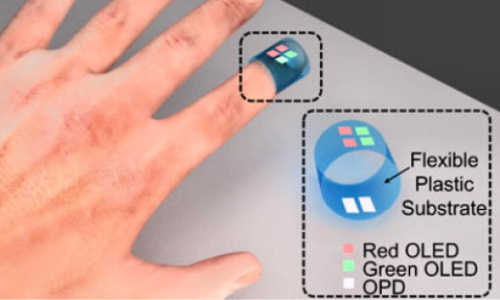
UC Berkeley engineers have created a pulse oximeter sensor composed of all-organic optoelectronics that uses red and green light. The red and green organic light-emitting diodes (OLED) are detected by the organic photodiode (OPD). The device measures arterial oxygen saturation and heart rate as accurately as conventional, silicon-based pulse oximeters. Photo Credit: Yasser Khan

“There are various pulse oximeters already on the market that measure pulse rate and blood-oxygen saturation levels, but those devices use rigid conventional electronics, and they are usually fixed to the fingers or earlobe,” said Ana Arias, an associate professor of electrical engineering and computer sciences and head of the UC Berkeley team that is developing a new organic optoelectronic sensor.

By switching from silicon to an organic, or carbon-based, design, the researchers were able to create a device that could ultimately be thin, cheap and flexible enough to be slapped on like a Band-Aid during that jog around the track or hike up the hill.

The engineers put the new prototype up against a conventional pulse oximeter and found that the pulse and oxygen readings were just as accurate.

The research team reported its findings today (Wednesday, Dec. 10) in the journal Nature Communications.

Giving silicon a run for its money

A conventional pulse oximeter typically uses light-emitting diodes (LEDs) to send red and infrared light through a fingertip or earlobe. Sensors detect how much light makes it through to the other side. Bright, oxygen-rich blood absorbs more infrared light, while the darker hues of oxygen-poor blood absorb more red light. The ratio of the two wavelengths reveals how much oxygen is in the blood.

For the organic sensors, Arias and her team of graduate students – Claire Lochner, Yasser Khan and Adrien Pierre – used red and green light, which yield comparable differences to red and infrared when it comes to distinguishing high and low levels of oxygen in the blood.

Using a solution-based processing system, the researchers deposited the green and red organic LEDs and the translucent light detectors onto a flexible piece of plastic. By detecting the pattern of fresh arterial blood flow, the device can calculate a pulse.

“We showed that if you take measurements with different wavelengths, it works, and if you use unconventional semiconductors, it works,” said Arias. “Because organic electronics are flexible, they can easily conform to the body.”

Arias added that because the components of conventional oximeters are relatively expensive, healthcare providers will choose to disinfect them if they become contaminated. In contrast, “organic electronics are cheap enough that they are disposable like a Band-Aid after use,” she said.

Story Source:

The above story is based on materials provided by University of California – Berkeley.

Share13Tweet8Share2ShareShareShare2

Related Posts

Designing better medical implants

May 18, 2015

A Nano-transistor Assesses Your Health Via Sweat

May 16, 2015

Researchers develop custom artificial membranes to study the molecular basis of disease

May 8, 2015

Thermometer-like device could help diagnose heart attacks

May 7, 2015
Please login to join discussion

POPULAR NEWS

  • blank

    Revolutionary AI Model Enhances Precision in Detecting Food Contamination

    96 shares
    Share 38 Tweet 24
  • Imagine a Social Media Feed That Challenges Your Views Instead of Reinforcing Them

    1005 shares
    Share 397 Tweet 248
  • Promising Outcomes from First Clinical Trials of Gene Regulation in Epilepsy

    51 shares
    Share 20 Tweet 13
  • Advancements in EV Battery Technology to Surpass Climate Change-Induced Degradation

    45 shares
    Share 18 Tweet 11

About

We bring you the latest biotechnology news from best research centers and universities around the world. Check our website.

Follow us

Recent News

Tetracenomycin Y: Rare Actinomycete’s Plant Growth Booster

Advancing Precision Medicine: Boosting Genetic Diagnoses for More Patients

Self-Evolving AI Transforms Autonomous Biomedical Data Analysis

Subscribe to Blog via Email

Enter your email address to subscribe to this blog and receive notifications of new posts by email.

Join 78 other subscribers
  • Contact Us

Bioengineer.org © Copyright 2023 All Rights Reserved.

Welcome Back!

Login to your account below

Forgotten Password?

Retrieve your password

Please enter your username or email address to reset your password.

Log In
No Result
View All Result
  • Homepages
    • Home Page 1
    • Home Page 2
  • News
  • National
  • Business
  • Health
  • Lifestyle
  • Science

Bioengineer.org © Copyright 2023 All Rights Reserved.