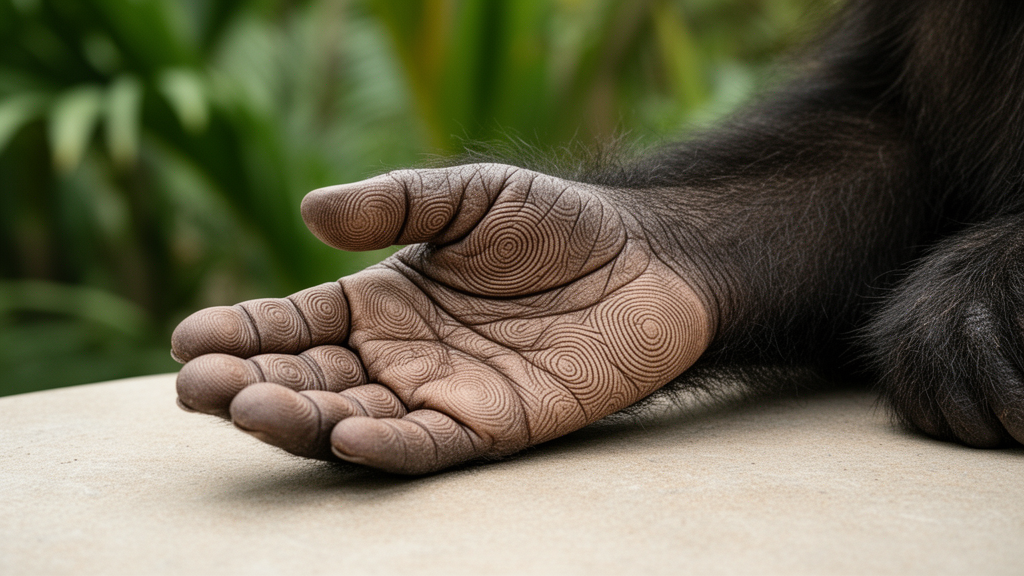
In an observational study examining dermatoglyphic features in non-human primates, researchers found that the complex patterns of friction ridges on the feet and palms vary distinctly between individual monkeys, displaying differences analogous to human fingerprints. The peer-reviewed investigation, led by Juliana Vieira Flores Sales and colleagues at the Universidade de Brasília in Brazil and published in the open-access journal PLOS One, analysed palmar and plantar prints across three separate monkey species to evaluate both individual distinctiveness and broader taxonomic variations.
Friction ridges represent the microscopic ridges present on the surfaces of primate hands and feet, which biologically function to improve traction when grasping slippery surfaces. While the unique ridge configurations formed on human fingertips have long served as established forensic identification markers, these anatomical structures are also shared by other primate taxa. Prior preliminary research had indicated that non-human primates also demonstrate individual variation in friction ridge architecture, raising the prospect that dermatoglyphic documentation could assist in animal identification.
To rigorously examine these patterns, the research team gathered palmar and plantar impressions from a total of 116 captive monkeys housed at research and care facilities in Brazil. The sampling encompassed captive owl monkeys (Aotus infulatus) and squirrel monkeys (Saimiri collinsi) situated at the National Primate Center in Pará. In addition, the scientists sampled capuchin monkeys (Sapajus species) that were either held as permanent residents at the Universidade de Brasília Primate Center or had been received as patients at the University of Brasília’s Veterinary Hospital.
The researchers conducted structural analyses of each collected print by evaluating specific dermatoglyphic configurations, systematically identifying pattern types such as arches, loops, and whorls alongside minute ridge details. Across the entire sample of 116 individual animals examined in the study, no two monkeys possessed identical palm or foot impressions, confirming that friction ridge arrangements differ at the level of the individual in the assessed cohorts.
Beyond individual-level divergence, the comparative analysis documented consistent structural distinctions between species that may align with their respective ecological adaptations. Owl monkeys, which represent a nocturnal lineage, exhibited a higher frequency of deltas and whorls while demonstrating lower overall variability in ridge patterns when contrasted with diurnal primates. Conversely, the diurnal squirrel monkeys and capuchins displayed greater pattern variety across their palmar and plantar surfaces.
Lead author Juliana Vieira Flores Sales highlighted that these documented ridge patterns provide valuable insights into primate biology, stating: “Our findings show that palm and foot ridge patterns vary among non-human primates and reveal differences that may be associated with their ecological characteristics. Beyond their potential applications in individual identification, these patterns offer an opportunity to explore how dermatoglyphic traits develop and vary across primate species. Further research will help us understand their biological significance and potential applications in conservation.”
The study authors emphasize that while these findings demonstrate individual-level print variation in non-human primates, further investigation remains necessary to establish whether such dermatoglyphic patterns are sufficiently unique to enable reliable, standardized individual identification in real-world contexts.
The observational animal investigation was conducted by lead author Juliana Vieira Flores Sales alongside fellow researchers R. M. de Barros, P. H. G. de Castro, A. R. Souza, and L. Q. L. Hirano from Brazil.
According to the research disclosures published alongside the study in the open-access journal PLOS One, the authors conducted their observational animal investigation without any specific external funding and declared that no competing interests exist regarding the work.
Subject of Research: Individual and species-level variation in non-human primate palmar and plantar friction ridge patterns
Article Title: Monkey foot and palm prints differ between individuals, as they do in humans
Article References: Monkey foot and palm prints differ between individuals, as they do in humans. Original publication (Bibliographic details unavailable.)
Image Credits: AI Generated
DOI: Not provided
Keywords: dermatoglyphic traits, friction ridges, Aotus infulatus, Saimiri collinsi, Sapajus, owl monkeys, squirrel monkeys, capuchin monkeys, palm prints, plantar impressions, wildlife forensics, primate ecology, individual identification, National Primate Center, Universidade de Brasília, PLOS One, primate conservation
News Source: Margaret Porter. (November 11, 2026). Monkey Palm and Foot Ridge Patterns Differ by Individual Across Three Species. Scienmag.