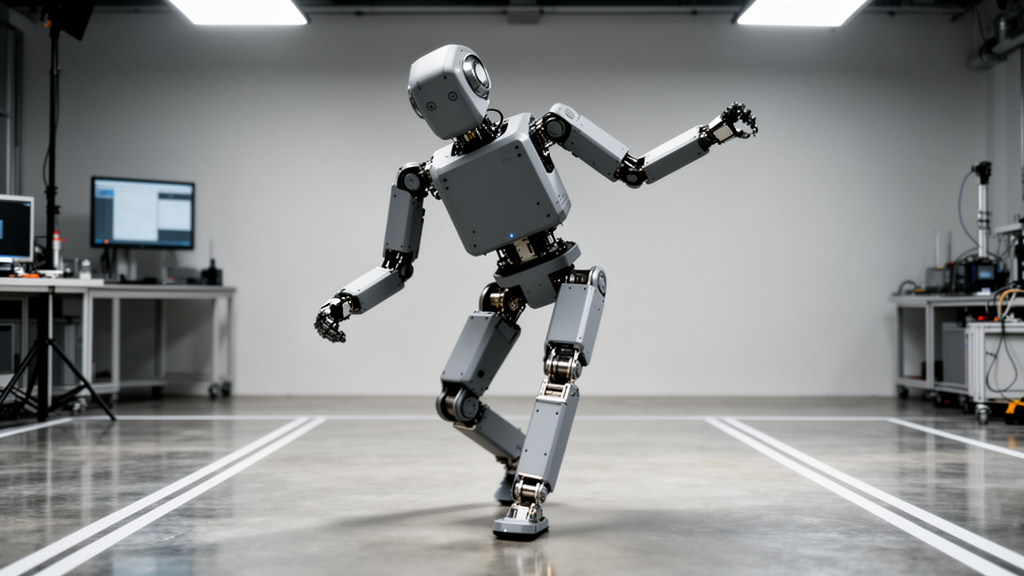
In a simulated biomechanical investigation of robotic balance, researchers evaluated how feedforward humanoid locomotion controllers endure severe, one-sided command degradation without adaptive retraining. Testing eight independently trained reinforcement learning policies for the Unitree G1 humanoid robot within physics simulation, the study identified a precise quantitative threshold where unilateral motor attenuation triggers catastrophic loss of stability. When motor commands driving all thirteen actuated joints on one side were scaled down by a factor alpha, walking stability did not degrade gradually across the operating spectrum. Instead, the simulated robot maintained balance near eighty percent output, but experienced a steep rise in falls as remaining motor commands dropped between seventy-five and fifty-five percent. In single-rollout tests at 0.5 meters per second, per-policy thresholds ranged between sixty-five and seventy-five percent for right-side attenuation and sixty to seventy percent for left-side attenuation, providing a reproducible measure of robotic control margins.
Modern robotic control frequently relies on deep reinforcement learning to synthesize dynamic walking gaits across multi-jointed humanoid platforms. Typically, these locomotion controllers are trained in massively parallel physics simulations using proximal policy optimization before hardware transfer. However, standard evaluation protocols assess trained controllers almost exclusively while all actuators, sensor streams, and command channels remain intact. Little was previously known regarding how an unadapted policy degrades when its motor commands are weakened, or whether failure occurs past a sharp margin. The experimental design drew inspiration from acute hemiparesis, where human stroke patients experience sudden unilateral weakness prior to neural recovery or motor relearning. Unlike musculoskeletal simulation studies that re-optimize or retrain controllers after introducing weakness, this investigation applied immediate command attenuation without retraining, forcing each policy to handle asymmetric deficits using only its pre-existing control strategy.
All experiments were conducted entirely in simulation using the MuJoCo physics engine version 3.5.0 and its GPU implementation MuJoCo Warp version 3.6.0 through the mjlab framework. The researchers utilized the Unitree G1 humanoid model, which possesses a mass of 33.3 kilograms and twenty-nine actuated joints, including twelve leg, three waist, and fourteen arm joints. Each joint is driven by a position-controlled proportional-derivative actuator with torque limits between 5 and 139 Newton-meters. Eight feedforward locomotion policies were trained with proximal policy optimization on a flat-terrain velocity-tracking task over 3,000 iterations across 2,048 parallel environments, differing only in their learning seed. Each policy network received ninety-nine inputs, passed through three hidden layers of 512, 256, and 128 units with exponential linear unit activations, and concluded with a twenty-nine-unit linear output layer running at fifty Hertz.
Unilateral command degradation was implemented by multiplying the output-layer weights and biases of targeted joints by a common scaling factor alpha. This linear attenuation scaled the commanded deviation from the default standing posture by exactly alpha while leaving non-targeted outputs untouched. Numerical tests on the trained checkpoints confirmed targeted outputs equaled alpha times original actions within a maximum difference of 5.96 times ten to the negative eighth power. Crucially, attenuation did not reduce actuator torque limits or alter proportional-derivative stiffness and damping gains. The manipulation represents a reduction in descending command amplitude rather than a loss of physical actuator force capacity. The attenuation factor was applied simultaneously to all thirteen actuated joints on one side, comprising six leg joints and seven arm joints, while leaving the three waist joints completely unattenuated throughout testing.
Evaluation episodes lasted five seconds, corresponding to 250 control steps at fifty Hertz, during which a constant forward velocity command was re-asserted at each step. Trials incorporated task startup randomization, including foot friction from 0.3 to 1.2, joint encoder biases within 0.015 radians, and center-of-mass displacements up to 2.5 centimeters horizontally and 3 centimeters vertically. A fall was strictly defined as a pelvis tilt exceeding seventy degrees from the vertical axis within the five-second window, marking an unrecoverable loss of balance before ground impact. To record the exact physical state at fall onset, the automated environment reset was disabled in the analysis code, applying the identical angle criterion without prematurely resetting episode dynamics. In single-rollout experiments, environmental parameters and starting positions were fixed by a single seed, evaluating policies deterministically.
Initial exploration utilized a coarse sweep across alpha values of 1.0, 0.8, 0.6, 0.4, 0.2, and 0.0 at a forward speed of 0.5 meters per second. In this coarse assessment, all eight policies walked successfully without falling at 100 percent and 80 percent remaining output on either side. Conversely, every policy suffered complete balance failure and fell when commands were attenuated to 40 percent or below. A distinct performance split emerged at sixty percent remaining output: right-side attenuation caused all eight policies to fall, whereas left-side attenuation caused four of the eight policies to fall. A bisection search within the sixty to eighty percent interval confirmed that the primary transition zone fell between fifty-five and seventy-five percent, establishing the boundaries for high-resolution evaluation.
A subsequent fine-grid sweep evaluated remaining motor output in increments of 0.05 from 0.75 down to 0.55 at 0.5 meters per second. At seventy-five percent output, zero falls occurred on either side. At seventy percent, right-side attenuation produced one fall among eight policies while left-side attenuation produced none. At sixty-five percent, right-side falls climbed to 62.5 percent while left-side falls stood at 12.5 percent. At sixty percent, right-side falls reached one hundred percent whereas left-side falls reached 37.5 percent, with both sides experiencing universal failure at fifty-five percent. Across individual policies, single-rollout thresholds averaged 68.75 percent for right-side attenuation and 62.5 percent for left-side attenuation. An exact sign test revealed the right side was significantly more fragile in six of eight policies with zero reversals, yielding a p-value of 0.031.
Because the GPU-accelerated simulator is not bitwise deterministic across runs, identical conditions near the threshold can produce variable outcomes. To capture within-policy variability, the researchers tested each policy across ten randomized conditions at each fine-sweep level, totaling eight hundred trials. Substantial variability emerged near the threshold, where fall rates for individual policies spanned ten to eighty percent for left-side attenuation at alpha 0.65, and zero to ninety percent for right-side attenuation at alpha 0.70. Variance decomposition showed between-policy differences accounted for twenty-two to forty-five percent of outcome variance near critical thresholds, with within-policy variability accounting for the majority. Repeated-trial fifty percent fall thresholds averaged 68.4 percent for right-side and 64.6 percent for left-side attenuation, with an exact Wilcoxon signed-rank test confirming a significant right-side vulnerability across seven of eight policies at p equals 0.039.
To investigate the origin of this directional disparity, researchers analyzed the unattenuated policies during steady walking. The baseline controllers exhibited a modest right-dominant asymmetry across all tested walking speeds, commanding 4.0 to 7.7 percent greater deviation and generating 4.9 to 5.4 percent higher torque and 7.7 to 12.1 percent greater mechanical power on the right side. However, correlation analyses between baseline asymmetry metrics and threshold discrepancies showed no consistent explanatory relationship, with nineteen of twenty comparisons failing to reach significance. Across commanded forward walking speeds of 0.3, 0.5, 0.7, and 0.9 meters per second, group-level right-side thresholds were never lower than left-side thresholds. Nonetheless, per-policy left-right threshold asymmetry was statistically significant only at 0.5 meters per second, with exact sign test p-values reaching 0.22 at 0.3 meters per second and 0.125 at higher speeds.
Detailed joint kinematic analysis of thirty-four falling episodes during the fine sweep clarified the mechanical progression leading to loss of balance. In normal, unattenuated walking, joint angles deviated from the default posture by only 2.4 to 3.0 degrees. Preceding a fall, joint angles did not collapse toward the default keyframe; instead, they diverged progressively outward over the final 0.6 seconds before fall onset. At the moment the pelvis tilted past seventy degrees, mean absolute joint deviations reached 10.7 to 21.1 degrees on the attenuated side and 16.8 to 26.5 degrees on the unattenuated side. Commanded targets diverged even further, spanning 15.8 to 38.0 degrees. Unattenuated joints exhibited larger deviations than attenuated joints in thirty-one of thirty-four falls, demonstrating that balance failure resulted from active, divergent corrective attempts rather than passive collapse.
The authors detailed several essential limitations regarding the scope and generalizability of their results. All evaluations were conducted purely within rigid-body physics simulation without physical robot validation, leaving findings subject to discrepancies in contact dynamics, actuator latency, and sensor noise. Furthermore, uniform command attenuation represents an idealized computational perturbation rather than a direct model of human biological stroke. Clinical post-stroke fall risks in human patients involve multifaceted cognitive, perceptual, and bilateral sensory deficits, including spatial hemineglect, rather than isolated command scaling. The observed thresholds reflect specific balance margins of simulated feedforward neural policies in a 33.3-kilogram robot. Future research directions include repeated-trial speed assessments in larger policy cohorts, joint-specific attenuation sweeps, muscle-driven musculoskeletal modeling, and exploring adaptive retraining paradigms to evaluate how humanoid policies might recover functional stability following persistent unilateral command impairment.
Subject of Research: Robotic locomotion robustness under simulated unilateral motor-command degradation
Article Title: A quantitative fall threshold for graded unilateral motor-command attenuation in a simulated feedforward humanoid locomotion policy
Article References: Obaru, K. (2026). A quantitative fall threshold for graded unilateral motor-command attenuation in a simulated feedforward humanoid locomotion policy. Frontiers in Robotics and AI, 13, Article 1959239. https://doi.org/10.3389/frobt.2026.1959239
Image Credits: AI Generated
DOI: 10.3389/frobt.2026.1959239
Keywords: humanoid robotics, feedforward locomotion policy, reinforcement learning, proximal policy optimization, Unitree G1, MuJoCo simulation, motor-command attenuation, unilateral weakness, fall threshold, balance control, locomotion robustness, pelvis orientation, gait asymmetry, proportional-derivative actuator, dynamic stability, variance decomposition, hemiparesis analogy
News Source: Denise Maddox. (November 11, 2026). Simulated Humanoid Robot Policies Fail Under Graded One-Sided Motor Command Degradation. Scienmag.