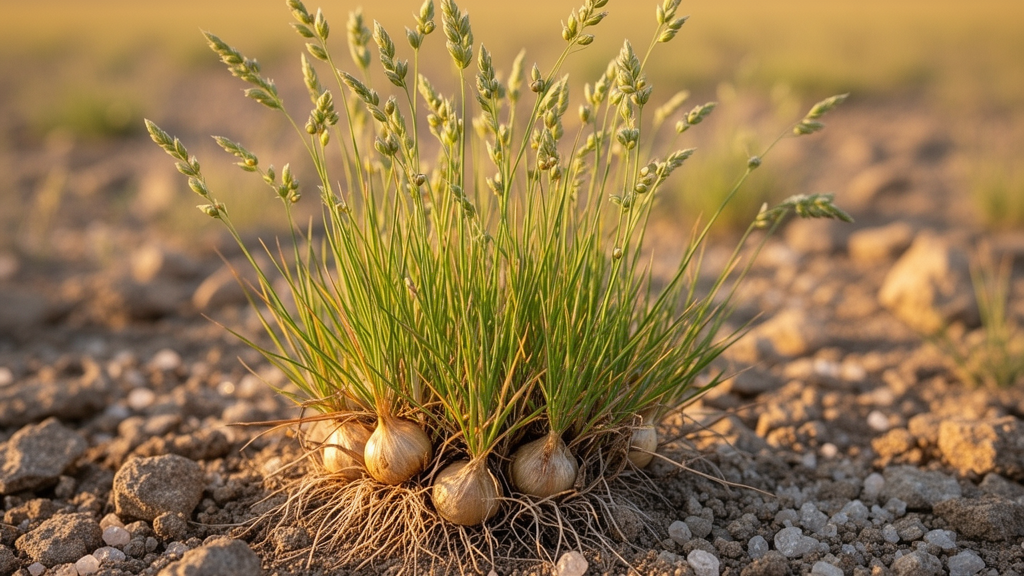
Phylogenetic analyses of Turkish bluegrasses in the genus Poa have demonstrated that bulb formation evolved independently across at least four distinct lineages, revealing that the broadly circumscribed Poa bulbosa complex is polyphyletic. Published in PhytoKeys, the taxonomic and phylogenetic investigation by Robert J. Soreng, Evren Cabi, and Lynn J. Gillespie focuses on twenty bulbous species endemic to Western Eurasia and North Africa. By evaluating the morphology, evolution, ecology, and geographic distribution of bulbs and bulbifery, the authors established a comprehensive evolutionary framework for the genus in Turkey and surrounding regions.
To resolve lineage relationships and genetic structure within the genus, the research team analyzed both plastid and nuclear ribosomal DNA sequences. The molecular dataset integrated three plastid regions—matK, trnC-rpoB, and trnT-L-F—alongside the external transcribed spacer and internal transcribed spacer regions of nuclear ribosomal DNA (ETS and ITS). These combined phylogenetic assessments uncovered a strongly supported clade structure throughout Poa, clarifying how bulb-forming habits arose multiple times across divergent evolutionary branches rather than originating from a single common ancestor.
A major evolutionary finding of the study centers on the occurrence of asexual reproductive strategies within these lineages. The authors determined that reproduction through bulbifery is prevalent in two of the four independent bulb-bearing clades. Furthermore, the molecular data revealed limited DNA sequence divergence and explicit evidence of reticulation within the lineage containing Poa alpina and Poa bulbosa. This pattern of evolutionary reticulation indicates complex genetic interactions shaping the diversification of these temperate grasses.
To accommodate the limited genetic divergence and reticulate evolution identified in the Poa alpina and Poa bulbosa lineage, the researchers formally proposed a new subgenus, Poa subgenus Alpinae. Under this taxonomic arrangement, Poa subgenus Alpinae encompasses all members of the Poa bulbosa complex sensu stricto, previously classified under Poa section Arenariae sensu stricto. It also incorporates all members of Poa section Alpinae, which the authors organized into two distinct taxonomic series within the section.
The taxonomic revision also establishes new infrageneric names and circumscriptions across Poa section Iconiae, Poa section Oreopoa, and the newly established Poa subgenus Alpinae. Beyond infrageneric realignments, the authors introduced several new species and infraspecific combinations. These combinations include Poa bactriana subsp. nevskii, Poa bactriana var. tzveleviana, Poa bulbosa var. perligulata, Poa bulbosa var. scholziana, and Poa sinaica subsp. reuteriana, refining previous classifications to reflect lineage relationships.
In addition to recombining existing taxa, the investigators described and diagnosed entirely new grass taxa discovered during their systematic review. Newly described taxa comprise the species Poa girdevensis, as well as several infraspecific taxa including Poa bulbosa var. cabiana, Poa sinaica subsp. pamphyliensis, Poa sinaica var. pamphyliensis, and Poa sinaica var. prolifera. To resolve nomenclature, the authors also published replacement names for Poa bactriana var. spicata and Poa balansae.
The study presents a complete taxonomic account for all bulbous Poa taxa found within Turkey, accompanied by detailed botanical descriptions, morphological diagnoses, and illustrations for several Turkish taxa. To facilitate identification, the authors constructed a comprehensive identification key covering the bulbous taxa of Turkey and Greece. Their survey also documents notes on taxa belonging to the broader Poa bulbosa complex occurring outside Turkey, reporting new native distribution records and introduction occurrences across several countries.
To stabilize historical nomenclature across Western Eurasian and North African bulbous grasses, the authors designated an epitype and twenty-four lectotypes for previously published names. An epitype was formally designated for Poa bulbosa var. vivipara alongside a lectotype. Lectotypes were also established for Poa alpina var. polystachya, Poa bulbosa var. elanata, Poa controversa, Poa desertorum, Poa diversifolia var. crassipes, Poa diversifolia var. hartmannii, Poa dshilgensis, Poa eigii, Poa glabriflora fo. albida, and Poa glabriflora fo. sericea.
Additional lectotypifications completed by the team include Poa gracilis, Poa hackelii, Poa longifolia subsp. meyeri, Poa macroglossa, Poa montana, Poa nevskii fo. subglabra, Poa paryadrica, Poa pseudobulbosa, and Poa vaginata. Type designations were likewise established for several variants of Poa sinaica, specifically Poa sinaica, Poa sinaica var. aegyptica, Poa sinaica var. glabrescens, and Poa sinaica subsp. moabitica. Together, these formal designations and phylogenetic findings clarify the evolutionary history of the polyphyletic Poa bulbosa complex.
Subject of Research: Phylogeny and taxonomy of bulbous Poa species in Turkey
Article Title: Phylogeny and taxonomy of Poa (Poaceae, Pooideae, Poeae, Poinae) in Turkey (Part I): The Poa bulbosa complex, polyphyly, lineage relationships, and a new subgenus Alpinae
Article References: Soreng, R. J., Cabi, E., & Gillespie, L. J. (2026). Phylogeny and taxonomy of Poa (Poaceae, Pooideae, Poeae, Poinae) in Turkey (Part I): The Poa bulbosa complex, polyphyly, lineage relationships, and a new subgenus Alpinae. PhytoKeys, 281, 159–279. https://doi.org/10.3897/phytokeys.281.209638
Image Credits: AI Generated
DOI: 10.3897/phytokeys.281.209638
Keywords: Poa, Poa bulbosa, Poa alpina, Poa subg. Alpinae, Poa sect. Arenariae, Poa sect. Iconiae, Poa sect. Oreopoa, bulbifery, polyphyly, plant phylogeny, Turkish flora, nrDNA, plastid DNA, Poa girdevensis, Poa sinaica, Poa bactriana, lectotypification
News Source: Drew Townsend. (November 11, 2026). Poa Bulbosa Complex Is Polyphyletic Across Four Independent Lineages. Scienmag.