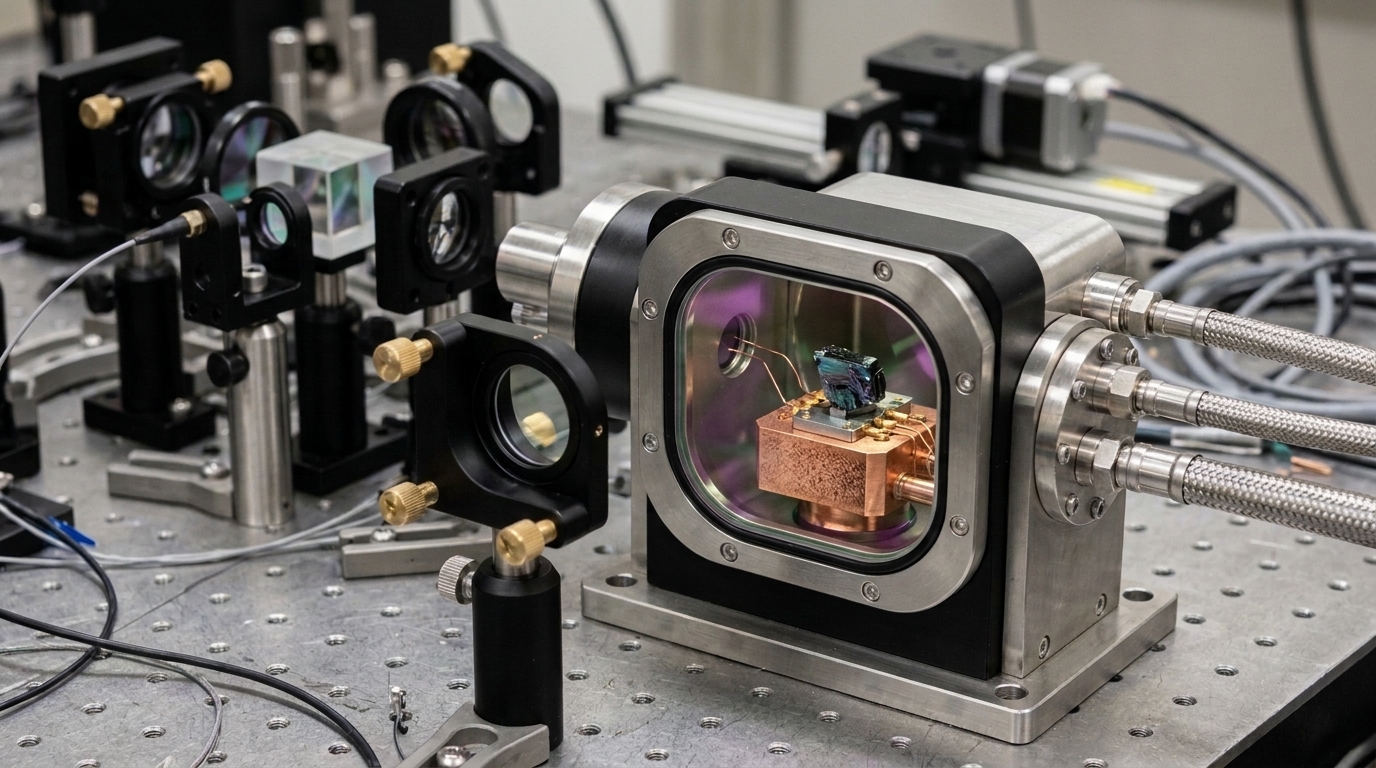
Splitting laser energy into two timed light pulses can amplify the sliding motion of atomic layers in the quantum material WTe₂, overcoming the saturation limits of single-pulse excitation, according to a peer-reviewed study published in Nature Physics by researchers from the Universities of Würzburg and Rostock and ETH Zurich.
In quantum materials, many functional properties depend directly on how atoms are arranged within the crystal lattice. Targeted structural alterations can be achieved using ultrashort laser pulses, where the light first excites electrons within femtoseconds—a millionth of a billionth of a second—and the altered electronic energy and dynamics exert forces that set the atomic nuclei into motion.
The researchers investigated this excitation mechanism in WTe₂, an ultrathin sliding ferroelectric in which neighbouring atomic layers can slide against each other like two pressed palms. As Gerrit Horstmann, first author of the study and head of an Emmy Noether junior research group at the University of Würzburg, noted, the relative displacement of these atomic layers can directly influence critical material properties, including ferroelectricity and topology.
While increasing the energy of a single laser pulse might appear to be the straightforward way to shift atomic layers further, the study demonstrated that this strategy encounters physical limits. Under very strong excitation, electrons are promoted into high-energy states that counteract the directed motion of the atoms, causing the additional light energy to effectively slow the layers down rather than producing a larger displacement.
To overcome this barrier, the research team divided the light energy into two weaker pulses separated by a deliberate time delay, allowing the electronic system time to partially relax before the second pulse arrived. Horstmann explained that timing the excitation to match the material’s internal dynamics acts like pushing a child on a swing, making optimal use of the interaction between electrons and atomic motion.
In the long term, the researchers suggest these findings could help switch technologically relevant properties such as ferroelectric polarization in an energy-efficient manner. The approach is considered especially promising for ultrathin materials consisting of only a few atomic layers, opening up new prospects for compact electronic devices through precisely tuned optical control.
The research highlights a fundamental principle for controlling quantum materials with light: decisive material control is achieved not through greater pulse energy, but through a better-tuned excitation sequence.
Subject of Research: Light-driven atomic layer dynamics in sliding ferroelectric materials
Article Title: Controlling quantum materials with light: why two pulses can be better than one
Article References: Controlling quantum materials with light: why two pulses can be better than one. Original publication (Bibliographic details unavailable.)
Image Credits: AI Generated
DOI: Not provided
Keywords: quantum materials, sliding ferroelectrics, WTe2, ultrashort laser pulses, ferroelectricity, topology, atomic motion, Controlling, quantum, materials, light, pulses
News Source: Katie Riggs. (November 11, 2026). Two Timed Light Pulses Enhance Atomic Motion in Quantum Materials. Scienmag.