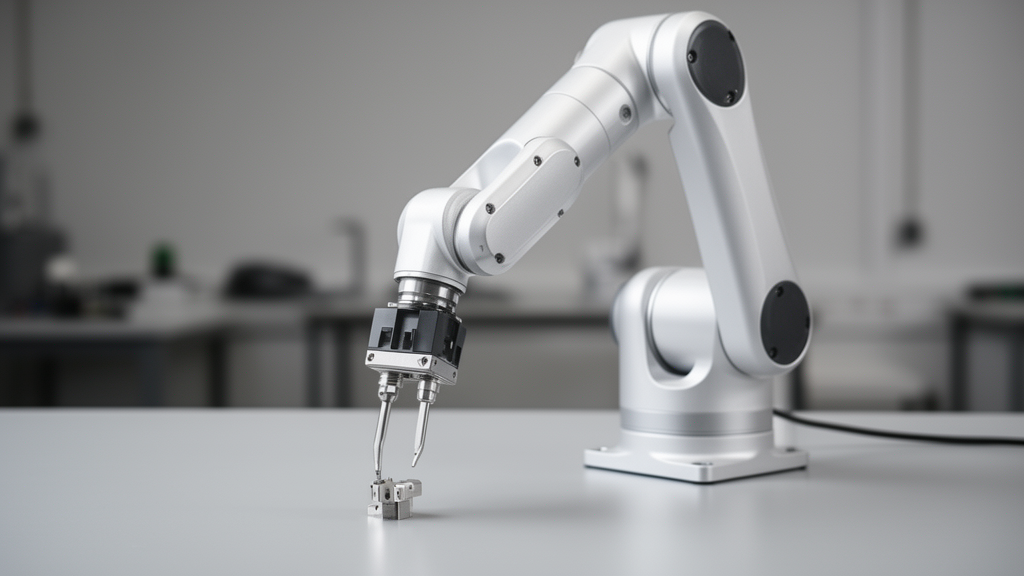
Researchers have developed an intelligent computational modeling framework that integrates genetic algorithms, neural networks, and reinforcement learning into a unified simulation-to-control pipeline for a six-degree-of-freedom industrial manipulator. Published in Discover Computing, the study presents a systematic approach to addressing the inherent limitations of traditional model-based methods in robotic kinematics, dynamics, and trajectory optimization. The framework repositions these established artificial intelligence techniques as surrogate solvers within a coherent computational workflow, aiming to overcome challenges posed by high-dimensional nonlinearities, kinematic singularities, and real-time computational constraints in industrial robotic applications.
The core technical novelty of the proposed architecture lies not in the individual algorithms, which are well established in their respective fields, but in the unified agent computing layer that couples them through formally defined interfaces. This layer enables end-to-end surrogate-based simulation-to-control deployment by treating the genetic algorithm, neural network, and reinforcement learning agent as computational agents with defined input-output contracts. The framework is implemented in MATLAB/Simulink with real-time deployment capabilities, targeting a specific six-degree-of-freedom articulated manipulator characterized by high-dimensional nonlinear rigid-body dynamics and stringent real-time constraints.
The framework encompasses three primary surrogate modules, each addressing a specific aspect of the robotic control pipeline. The first module is a genetic algorithm-based trajectory optimizer that minimizes total travel time subject to kinematic constraints for joint velocity, acceleration, and jerk. The second module is a feedforward neural network that serves as a surrogate inverse kinematics solver, approximating the mapping from end-effector poses to joint angles. The third module is a reinforcement learning-based adaptive control policy trained via the Deep Deterministic Policy Gradient algorithm to generate corrective torque offsets that augment the nominal proportional-integral-derivative control signal.
Numerical analyses of the genetic algorithm module reveal a formal time complexity of O(N·P·G), where N represents via-points, P is the population size, and G is the number of generations. Empirical convergence validation shows that the optimizer reduces cycle time by 28.8% compared to a manual baseline, achieving a final cycle time of 3.7 seconds versus 5.2 seconds. When benchmarked against sequential quadratic programming under identical constraints, the genetic algorithm surrogate achieved a faster cycle time and demonstrated greater robustness to initialization, although it required significantly more offline computation time. The neural network surrogate achieved a 4.2-fold speedup over analytical inverse kinematics with a mean joint error of 0.41 degrees, outperforming damped least-squares and Levenberg–Marquardt numerical solvers in latency while trading off some precision.
The reinforcement learning agent was trained to observe residual tracking errors and emit corrective torque offsets, achieving adaptive path correction within 0.3 seconds under perturbations of up to 2 millimeters. Comparative analyses against model predictive control, model-reference adaptive control, and sliding-mode control under identical disturbance conditions showed that the reinforcement learning surrogate offered the best tracking performance at an acceptable computational cost. The agent achieved a maximum tracking error of 0.30 degrees, lower than any classical controller tested, without requiring explicit system identification or gain tuning, which are necessary for the traditional control methods.
A quantitative integration ablation study demonstrated that the coupled genetic algorithm, neural network, and reinforcement learning pipeline outperforms any single-module or two-module configuration. The full framework achieved the best performance on all metrics, including cycle time, inverse kinematics latency, correction time, and maximum tracking error. The maximum tracking error of the fully coupled pipeline was lower than any two-module combination, indicating a super-additive benefit in tracking precision derived from the singularity-aware gating interface and cascaded coupling architecture. This integration also reduced the root mean square synchronization error from 0.10 to 0.12 degrees in single or two-module setups to 0.08 degrees in the full pipeline.
The study included a co-simulation validation protocol to quantify numerical synchronization error between virtual and physical platforms. Experiments conducted at various sampling frequencies and discretization steps confirmed linear scaling of synchronization error with the integration step size and inverse scaling with the control sampling frequency. At the nominal operating point of a 1-millisecond integration step and 1000-Hertz control frequency, the root mean square synchronization error was 0.08 degrees, which is within the manipulator’s repeatability specifications. This validation supports the reliability of the surrogate models in a cyber-physical system context, where discrepancies from discretization errors, sensor noise, and communication latency are critical factors.
Extended robustness characterization revealed that the reinforcement learning controller maintains stable tracking below a 2.5 newton-meter disturbance torque, with a success rate exceeding 98%. However, performance degrades abruptly beyond this boundary, with maximum tracking error jumping to 0.62 degrees and success rate dropping to 87% at 3 newton-meters. At higher disturbance levels of 4 and 5 newton-meters, the policy frequently fails to converge, exhibiting torque saturation and limit-cycle behavior. This degradation is consistent with the agent’s training distribution, which included disturbances up to 2 newton-meters, indicating a distributional shift failure mode rather than a fundamental control-theoretic limitation.
The researchers emphasize that the framework should be understood as an integrated agent computing layer rather than a collection of independently fine-tuned algorithms. The singularity-aware gating interface activates the neural network surrogate precisely where the genetic algorithm trajectory passes near singularities, and the reinforcement learning correction then stabilizes the resulting reference. This coupling architecture is identified as the core innovation, providing a systematic integration with rigorous numerical analysis of the coupled system. The study highlights that while individual algorithms are established, their formal integration with shared state representation and explicit inter-module data contracts enables coherent pipeline operation that transcends the capabilities of standalone utilities.
Limitations of the current framework include the offline nature of the genetic algorithm optimization, which limits real-time re-planning capabilities, and the distribution-bound nature of the reinforcement learning controller. The neural network surrogate’s accuracy is contingent on representative training data and may degrade with unmodeled elastic deformation at maximum payload. Future work will focus on extending the framework to open-source platforms, incorporating sim-to-real transfer learning, and integrating explainable AI visualization. The researchers also propose exploring continuous-time neural surrogate solvers for online adaptation and combining the reinforcement learning surrogate with domain randomization and robust control techniques to expand the safety boundary and improve out-of-distribution generalization.
The research team implemented the framework in MATLAB/Simulink, utilizing a six-degree-of-freedom articulated manipulator with specific Denavit-Hartenberg parameters to test the surrogate modeling approach. The physical platform was characterized by high-dimensional nonlinear rigid-body dynamics, which necessitated a modeling framework that could transcend traditional analytical approaches. The authors noted that while closed-form kinematic solutions and classical PID controllers have served as the backbone of robot control for decades, they encounter fundamental limitations when confronted with kinematic redundancy, singular configurations, and time-varying operational constraints. The proposed framework addresses these bottlenecks by constructing computationally efficient approximations of expensive physics-based models, a technique known as surrogate modeling, which has gained traction across computational mechanics and data-driven paradigms.
A key aspect of the neural network surrogate involves the scaling of prediction accuracy with training data. The researchers trained networks on varying datasets ranging from 5,000 to 50,000 samples, observing that the mean joint error follows a power-law relationship. Specifically, the error saturates near 0.41 degrees when the training set reaches 50,000 samples. The exponent in this power-law was found to be 0.38, which is consistent with non-parametric regression in six dimensions but higher due to the parametric structure of the neural network. To ensure the model did not overfit, the team analyzed the generalization error using Rademacher complexity. Additionally, the loss derivative decayed from approximately 4.5 × 10⁻⁵ rad²/epoch at epoch 10 to below 1.0 × 10⁻⁶ rad²/epoch by epoch 150, indicating that the training dynamics did not exhibit the overfitting signature associated with abrupt loss-derivative spikes.
The reinforcement learning component was trained using the Deep Deterministic Policy Gradient algorithm, which was selected after comparative testing against Proximal Policy Optimization and Soft Actor-Critic algorithms. DDPG achieved the highest final reward and the lowest correction time, although Soft Actor-Critic demonstrated the best sample efficiency. The training process required 1.5 million environment steps, with exploration noise decaying linearly from 0.2 to 0.02 over the first million steps. The state space for the reinforcement learning agent included joint positions, velocities, and Cartesian position errors, while the action space consisted of corrective torque offsets bounded by ± 5 newton-meters. The reward function penalized Cartesian position error, torque magnitude, and any violations of obstacle or joint limits. This design allowed the agent to learn a control policy through environment interaction without requiring a parametric plant model, distinguishing it from classical control methods that rely on explicit system identification.
The co-simulation protocol involved comparing a virtual model running in MATLAB/Simulink with a physical real-time controller operating at 1 kHz. Communication between the virtual and physical platforms was managed via UDP with a 1-millisecond period and a typical latency of 0.2 milliseconds. To handle potential jitter, a circular buffer of depth 4 was employed, along with timestamp-based synchronization and linear interpolation for missed packets. The encoder resolution used in the experiments was 17-bit, providing a precision of 0.0027 degrees per least significant bit. The results confirmed that the numerical synchronization error scaled linearly with the integration step size and inversely with the control sampling frequency, validating the discrete formulation of the dynamic equations.
The integration ablation study provided direct evidence that the system-level contribution of the framework is distinct from the individual algorithmic components. The full pipeline achieved a maximum tracking error of 0.30 degrees, which was significantly lower than the best two-module combination, GA plus RL, which resulted in a 0.42-degree error. This super-additive benefit was attributed to the singularity-aware gating interface, which activates the neural network surrogate precisely where the genetic algorithm trajectory passes near singularities. The reinforcement learning correction then stabilizes the resulting reference, creating a cascaded coupling that produces a coherent computational object. The study concludes that the framework should be understood as an integrated agent computing layer, where the shared state representation and explicit inter-module data contracts enable coherent pipeline operation that transcends the capabilities of standalone utilities.
Subject of Research: Integration of genetic algorithms, neural networks, and reinforcement learning in a unified framework for robotic kinematics and control.
Article Title: An intelligent computational modeling framework for robotic kinematics and control using neural networks with genetic optimization and reinforcement learning
Article References: Tao, B., Li, M., Ying, X., Luo, G., Othman, M., Zhang, R., Lei, T., Siakam, D., & Li, L. (2026). An intelligent computational modeling framework for robotic kinematics and control using neural networks with genetic optimization and reinforcement learning. Discover Computing, 29(1), Article 841. https://doi.org/10.1007/s10791-026-10801-x
Image Credits: AI Generated
DOI: 10.1007/s10791-026-10801-x
Keywords: robotics, reinforcement learning, genetic algorithms, neural networks, kinematics, trajectory optimization, industrial automation, surrogate modeling, control systems, intelligent, computational, modeling
News Source: Denise Maddox. (November 11, 2026). Unified AI Framework Cuts Robot Cycle Time and Error. Scienmag.