A collaborative team of researchers from Stanford University, Technische Universität Berlin, and Queen’s University has developed a theoretical framework based on quantized quasinormal modes to accurately model quantum dissipation in strongly coupled optical cavity systems across broad interaction bandwidths. Published in Light: Science & Applications, the study introduces an efficient first-principles approach that retains the simplicity and utility of earlier models while resolving their inability to predict experimental outcomes when light is confined to increasingly small volumes.
Optical cavities are engineered structures designed to confine electromagnetic fields, thereby substantially enhancing interactions between light and matter. Combining these resonant structures with emitters such as atoms, molecules, or other light-emitting media forms the foundation of numerous proposed quantum technologies, including quantum information processing and enhanced sensing platforms. However, as advances in cavity fabrication enable ever tighter spatial confinement, the frequency range across which light and matter interact expands significantly. Under these conditions, conventional theoretical formulations begin to break down, particularly standard quantum models governing how photons leak from an open cavity into the surrounding environment.
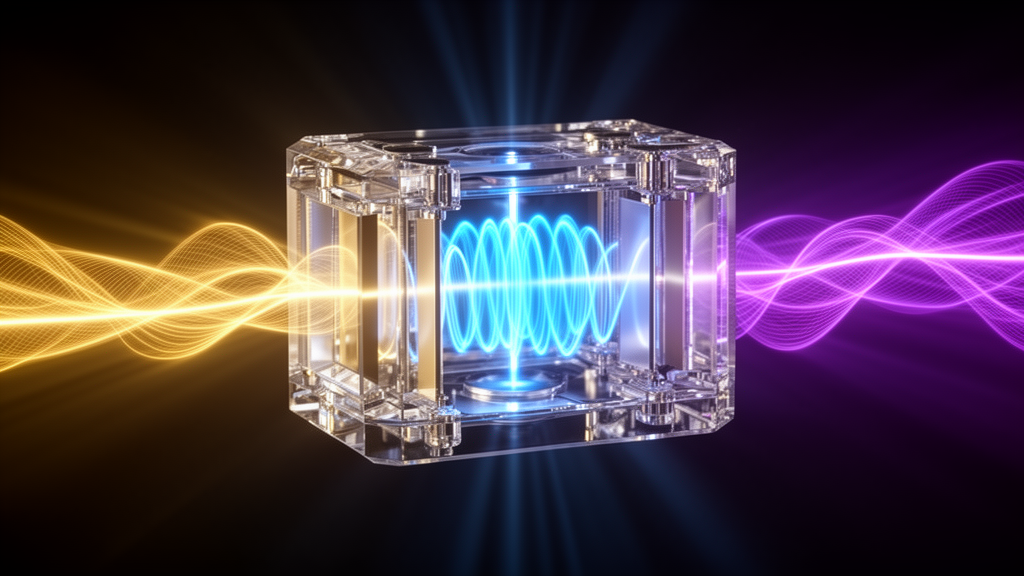
To overcome these limitations, the researchers formulated an approach grounded in quasinormal modes, which represent the fundamental physical resonances of open, lossy optical cavities. By employing recent theoretical techniques to treat these open modes within a rigorous quantum mechanical framework, the team derived an accurate dissipative quantum model for broadband light-matter interactions in a single-mode platform. This analytical structure enables the precise prediction of key system behaviors, such as frequency-dependent dissipation rates in strongly coupled emitter-cavity systems.
A primary finding of the investigation is the identification of what the authors designate as the broadband dissipative regime of cavity quantum electrodynamics (QED). In this operational regime, the bandwidth of the light-matter interaction is sufficiently wide that the corrective terms derived in the researchers’ theory become necessary to describe the underlying physical dynamics accurately. While this regime encompasses the well-known ultrastrong coupling regime of cavity-QED—a major research focus over the past two decades—the study reveals that broadband dissipative behavior can also occur at coupling strengths far weaker than those required for ultrastrong coupling.
The study demonstrates that within the broadband dissipative regime, system dynamics depend not solely on the coupling strength between light and the emitter, but also on the spatial phase of the cavity field mode evaluated at the emitter position. Standard cavity-QED models typically omit this spatial phase parameter entirely. Because this phase can be determined directly by solving Maxwell’s equations for a specific cavity geometry, the new model establishes an ab initio calculation pathway that bypasses empirical adjustments.
As the authors report, this ab initio formulation significantly generalizes previous single-mode quantum models in the ultrastrong coupling regime for open cavity systems by granting direct access to coupling constants and cavity-environment spectral density from the quasinormal mode and geometric scattering properties without requiring phenomenological fitting parameters. Consequently, the theory provides a practical benchmark to test the fundamental limits and validity of single-mode approximations commonly assumed in quantum information devices relying on strong light-matter interactions.
To evaluate the practical relevance of the framework, the authors investigated realistic cavity architectures that support dominant quasinormal modes, examining both experimentally motivated dielectric and plasmonic examples. Their analysis indicates that many of the predicted broadband dissipation effects are directly relevant to emerging experimental platforms and should in principle be observable using current or near-future laboratory technology, marking a key advance in the fundamental description of photon leakage from engineered quantum structures.
Subject of Research: Broadband quantum dissipation theory in open optical cavity electrodynamics
Article Title: Theory of broadband dissipation in cavity quantum electrodynamics
Article References: Theory of broadband dissipation in cavity quantum electrodynamics. Original publication (Bibliographic details unavailable.)
Image Credits: AI Generated
DOI: Not provided
Keywords: cavity quantum electrodynamics, broadband dissipation, quasinormal modes, optical cavities, ultrastrong coupling, quantum dissipation, light-matter interactions, ab initio modeling, plasmonic cavities, dielectric cavities, quantum information processing, open cavities, emitter coupling, Maxwell equations, spatial phase, spectral density, single-mode models
News Source: Katie Riggs. (November 11, 2026). Quasinormal Mode Theory Predicts Broadband Quantum Dissipation in Open Optical Cavities. Scienmag.