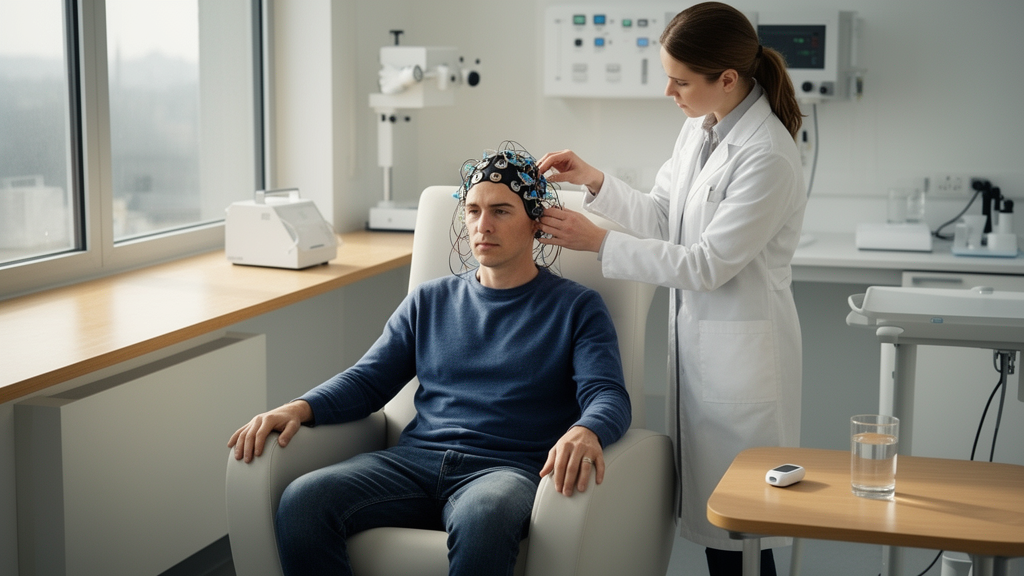
A computational benchmarking study led by researchers at the Shenzhen Institute of Advanced Technology, Chinese Academy of Sciences, and the University of Chinese Academy of Sciences demonstrates that sparse electroencephalography models combined with personalized baseline calibration can accurately identify hypoglycemia in type 1 diabetes while drastically reducing computing overhead. The study investigated the neurodynamic shifts that occur when blood glucose drops, seeking to establish a practical physiological foundation for subject-independent detection systems. By resolving persistent questions surrounding minimum channel requirements and inter-subject baseline variability, the authors established that compact electrophysiological configurations can preserve diagnostic signals while eliminating the excessive computational burdens associated with full-montage monitoring systems.
The clinical translation of electroencephalography, commonly known as EEG, into viable continuous monitoring tools for individuals managing type 1 diabetes has long faced fundamental technological and physiological obstacles. Although hypoglycemia is known to alter cerebral electrophysiological activity in measurable ways, translating these changes into generalized, subject-independent detection models has remained challenging. Key bottlenecks have included uncertainty regarding the minimum input requirements necessary to capture neurodynamic shifts, insufficiently characterized stability among sparse data representations, and substantial baseline variability across different participants. Without individualized calibration, algorithms frequently struggle to separate genuine glycemic responses from idiosyncratic baseline differences among patients.
To address these limitations systematically, the investigative team benchmarked twenty-four distinct algorithmic architectures under a rigorous leave-one-subject-out cross-validation framework. The comprehensive evaluation encompassed three primary modeling approaches: traditional engineered-feature machine learning pipelines, feature-domain deep learning networks, and raw-waveform deep learning architectures. Under this cross-validation design, linear discriminant analysis attained the highest observed balanced accuracy within the engineered-feature paradigm. Meanwhile, the specialized neural network architecture designated as Sinc-SSNET delivered the top performance across both the feature-domain deep learning and raw-waveform deep learning categories, establishing the baseline benchmarks for subsequent optimization.
Following the initial model comparisons, the researchers implemented a targeted Channel-Feature Sparsification protocol governed by a predefined performance-preservation criterion. This sparsification strategy aimed to isolate the most informative electrophysiological inputs while systematically discarding redundant channels and computational complexity. For the linear discriminant analysis framework, the sparsification process successfully reduced the input space down to a single metric: the log-theta descriptor derived from the frontotemporal F7 electrode. For feature-domain Sinc-SSNET, the algorithm condensed the input to the F7 channel row alone, whereas raw-waveform Sinc-SSNET maintained effective classification performance using only two dedicated electrophysiological channels.
The persistent retention of the F7 electrode across all three algorithmic paradigms highlights an underlying physiological consistency in how hypoglycemia alters localized cerebral activity. Specifically, the log-theta descriptor measured at the F7 site exhibited an elevation during hypoglycemic episodes in thirty of the thirty-four evaluated participants, corresponding to an 88.2 percent consistency rate within the cohort. This shared response provides strong empirical support for a reliable frontotemporal electrophysiological association during low blood glucose states. By confirming that sparse channel configurations track genuine biological phenomena rather than arbitrary mathematical artifacts, the analysis validated frontotemporal channels as key targets for compact monitoring architectures.
To resolve the confounding influence of baseline differences across participants, the authors introduced an adaptation technique termed Personal Euglycemic Baseline Adaptation, or PEBA. This normalization procedure utilizes a brief personal euglycemic reference interval to calibrate incoming neural data, eliminating the need to retrain computational models for each individual patient. Implementing this baseline adaptation yielded measurable improvements in diagnostic discrimination across all three leading models. Specifically, balanced accuracy rose from 0.71 to 0.77 for linear discriminant analysis, advanced from 0.68 to 0.83 for feature-domain Sinc-SSNET, and climbed from 0.71 to 0.78 for raw-waveform Sinc-SSNET.
Alongside substantial gains in classification accuracy, the sparsified configurations achieved dramatic reductions in computational overhead compared to their corresponding full-input baseline architectures. Across the evaluated models, parameter counts decreased by between 88.51 percent and 99.88 percent, while parameter storage demands diminished by 87.20 percent to 99.88 percent. In addition, the volume of multiply-accumulate operations plummeted by 94.72 percent to 99.91 percent. These notable reductions indicate that sparse EEG representations can drastically curtail memory footprints and processing demands, resolving a critical engineering bottleneck that has historically impeded the development of lightweight, energy-efficient monitoring devices.
The combination of physiological consistency, baseline-informed normalization, and reduced computational complexity provides a clear translational rationale for further investigating compact electroencephalography in diabetes management. Nevertheless, the research team emphasized several essential milestones that must be reached prior to prospective clinical deployment. The observed findings must be independently validated in broader, separate patient cohorts and tested under continuous glycemic-transition recordings rather than static glycemic states. Furthermore, realizing the practical benefits of these algorithmic advances will require the engineering and validation of native sparse EEG acquisition hardware designed specifically for continuous clinical application.
Subject of Research: Sparse electroencephalography and baseline adaptation for hypoglycemia detection in type 1 diabetes
Article Title: Sparse EEG neurodynamics of hypoglycemia in type 1 diabetes with personal euglycemic baseline adaptation
Article References: Hassan, F., Akbar, Z., Kashif, U. A., Abdullahi, S. S., Li, J., Wang, Z., & Nie, Z. (2026). Sparse EEG Neurodynamics of Hypoglycemia in Type 1 Diabetes With Personal Euglycemic Baseline Adaptation. Frontiers in Bioinformatics, 6, 2008238. https://doi.org/10.3389/fbinf.2026.2008238
Image Credits: AI Generated
DOI: 10.3389/fbinf.2026.2008238
Keywords: Electroencephalography, Hypoglycemia detection, Type 1 diabetes, Sparse EEG representations, Personal Euglycemic Baseline Adaptation, Leave-one-subject-out validation, Linear discriminant analysis, Sinc-SSNET, F7 channel, Log-theta descriptor, Channel-feature sparsification, Deep learning, Engineered features, Frontotemporal neurodynamics, Subject-independent monitoring, Multiply-accumulate operations, Computational neuroscience
News Source: Gavin Prescott. (November 11, 2026). Sparse EEG Models and Baseline Adaptation Detect Hypoglycemia Across Participants. Scienmag.