Credit: Jessie J. Polanco
BUFFALO, N.Y. — People with multiple sclerosis (MS) know all too well the frustration of hearing that success in treating the disease in mice had little or no effect in humans.
Unfortunately, with no large animal models for MS, results that suggest promising new treatments in mice often are ineffective in humans. Now, University at Buffalo researchers have developed and successfully tested a method for determining how relevant to the human disease findings are from mouse models. The research was published Aug. 8 in Stem Cell Reports.
"This is an important resource for the field as it allows us to compare human and rodent cells, and provides a point of reference to understand whether or not gene expression patterns are conserved between species," said Fraser Sim, PhD, senior author and associate professor in the Department of Pharmacology and Toxicology in the Jacobs School of Medicine and Biomedical Sciences at UB. Co-first authors are Suyog U. Pol PhD, now a postdoctoral fellow, and Jessie J. Polanco, a doctoral candidate, both in the medical school.
MS trial failures
"There have been so many failures in clinical trials for MS when promising observations are translated from small animal models to the clinic," Sim said. "Our primary motivation was to try to understand, at a molecular level, how the human cells responsible for synthesizing myelin differ from their much-better-studied mouse counterparts."
MS and some other neurological diseases occur when there is damage to myelin – the fatty sheath that allows nerve cells to communicate. So the myelin-producing cells, called human oligodendrocyte progenitor cells, or OPCs, found in the brain and spinal cord have been a major focus of efforts to better understand MS and develop potential new treatments for it.
Sim explained that undifferentiated OPCs are frequently found in the brain lesions of MS patients, so boosting the differentiation of these cells could lead to myelination and a reduction of symptoms.
From OPCs to oligodendrocytes
One reason why so many clinical trials fail may be because of fundamental differences in the types and levels of genes expressed between mice and humans. Sim and his colleagues addressed this question by performing gene-expression analysis on differentiating human OPCs.
"In this paper, we describe the transcriptional events that underlie how human OPCs develop into oligodendrocytes," said Sim.
To do it, they used a network analysis software tool called weighted gene coexpression network analysis (WCGNA). The software clusters together genes with similar patterns of expression. It also allows for analysis of both conserved and divergent gene expression between humans and rodents. "WCGNA looks at the relationships between genes rather than absolute differences between conditions in any given experiment," Sim said.
He added that the information encoded in levels of gene expression increasing or decreasing is very reliable and reproducible.
"We performed WCGNA in exactly the same manner on cells isolated from mice, rats and humans, and prepared these cells in as close to matched conditions as possible, trying to keep things as similar as possible to facilitate this comparison," said Sim.
It turned out several of the genes the team had identified as relevant to human disease also are involved in mouse development and mouse models of myelin disease.
New myelin-repairing gene
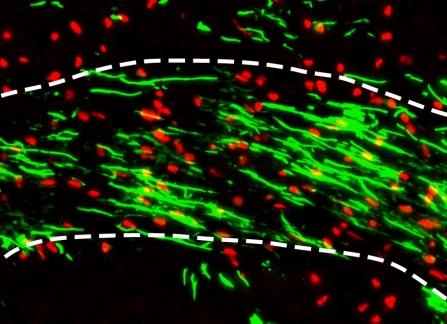
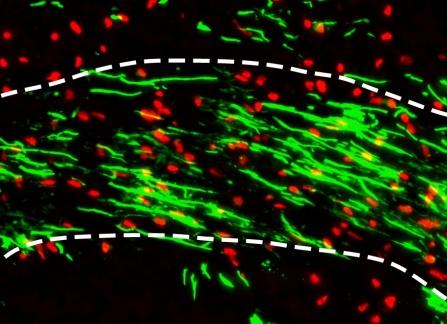
Based on its findings from that analysis, the team had predicted that GNB4, a protein involved in signal transduction, would be involved in the development of OPCs in humans. The researchers found that over-production of GNB4, a protein involved in the transduction of extracellular signals, could cause human OPCs to rapidly undergo myelination when transplanted into a model for human cell therapy in MS.
"So this protein's expression in oligodendrocyte progenitor cells might ultimately become a therapeutic target, potentially promoting oligodendrocyte formation in MS patients," said Sim.
The approach also identified several other important candidates that play key roles in regulating the development of human oligodendrocytes.
###
Other co-authors on the paper are Melanie A. O'Bara, research scientist; Hani J. Shayya, a UB undergraduate and Karen C. Dietz, PhD, research assistant professor, all of the Department of Pharmacology and Toxicology and Richard A. Seidman, a master's candidate in neuroscience.
The research was funded by the National Multiple Sclerosis Soociety, the Kalec Multiple Sclerosis Foundation, the Skarlow Memorial Trust and the Empire State Stem Cell Fund (NYSTEM) through the New York State Department of Health.
Media Contact
Ellen Goldbaum
[email protected]
716-645-4605
@UBNewsSource
http://www.buffalo.edu
Original Source
http://www.buffalo.edu/news/releases/2017/08/013.html