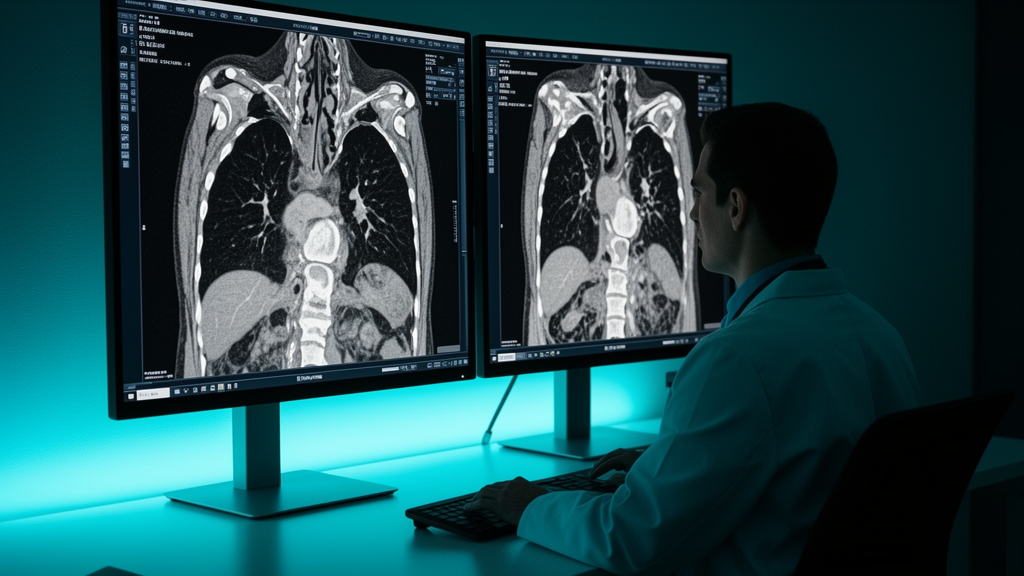
A multimodal computed tomography model integrating habitat radiomics, differential elasticity mapping, and Vision-Mamba deep learning demonstrated strong diagnostic performance for the preoperative risk stratification of thymic epithelial tumors. In an independent external validation test, the combined artificial intelligence model attained an area under the receiver operating characteristic curve of 0.902, markedly outperforming a conventional radiological model that achieved an area under the curve of only 0.612, a difference that was statistically significant (P = 0.007). These multicenter findings demonstrate that combining advanced computational imaging techniques with deep learning can provide meaningful incremental predictive value over standard radiological assessments prior to surgical intervention.
Preoperative differentiation between low-risk and high-risk thymic epithelial tumors remains a major clinical challenge in thoracic oncology because biopsy procedures often fail to capture intratumoral heterogeneity. To overcome these diagnostic constraints, the multicenter retrospective study investigated whether a noninvasive multimodal computed tomography framework—combining habitat radiomics, computed tomography-derived differential elasticity mapping, and Vision-Mamba deep learning—could achieve accurate preoperative risk stratification without relying entirely on invasive tissue biopsies.
The multicenter retrospective investigation evaluated a total of 337 patients with pathologically confirmed thymic epithelial tumors who were diagnosed and treated between 2015 and 2025 across two separate clinical centers. To support model development and external evaluation, the patient cohort was systematically divided between the participating institutions. From the first clinical center, 298 patients were enrolled and randomly assigned to a primary training cohort of 208 patients and an internal validation cohort of 90 patients. To rigorously test model generalization on independent clinical data, 39 patients from the second clinical center constituted an independent external test cohort.
Tumors across all cohorts were categorized according to the 2021 World Health Organization classification scheme into two distinct prognostic risk groups: low risk and high risk. The low-risk category comprised tumors classified pathologically as type A, type AB, and type B1. In contrast, the high-risk category included more aggressive malignancies classified as type B2, type B3, and thymic carcinoma.
The multimodal predictive models were developed using venous-phase contrast-enhanced computed tomography images, computed tomography-derived differential elasticity maps, and habitat radiomics features alongside Vision-Mamba deep learning architectures. The researchers comprehensively evaluated model discrimination, calibration, and clinical utility using the area under the receiver operating characteristic curve, calibration curves, the Hosmer–Lemeshow test, Brier scores, decision curve analysis, and DeLong tests. Throughout the evaluation, a conventional radiological model served as a baseline comparator to determine the incremental diagnostic value of the computational framework.
Across all three cohorts, the combined multimodal model demonstrated high discriminatory performance. In the training cohort of 208 patients, the model achieved an area under the receiver operating characteristic curve of 0.948 with a 95% confidence interval of 0.921 to 0.971, an overall accuracy of 0.851, and a Brier score of 0.120. In the internal validation cohort of 90 patients, it reached an area under the curve of 0.937 with a 95% confidence interval of 0.887 to 0.975, an accuracy of 0.856, and a Brier score of 0.131. In the independent external test cohort of 39 patients, the model recorded an area under the curve of 0.902 with a 95% confidence interval of 0.796 to 0.976, an accuracy of 0.846, and a Brier score of 0.141.
Comparative analyses demonstrated that the combined model outperformed the conventional radiological model across all three cohorts. In the external test cohort, the combined model achieved an area under the curve of 0.902 compared to 0.612 for the conventional radiological model, reflecting a statistically significant improvement (P = 0.007). In that same external cohort, differences between the combined model and individual imaging models were not statistically significant. Furthermore, decision curve analysis confirmed that the combined model delivered greater net clinical benefit across most threshold probabilities compared to alternative evaluation strategies.
Despite the promising diagnostic performance and incremental value over conventional radiological evaluation, the investigators noted important study limitations that must be addressed. The external test cohort was relatively small, including only 39 patients from a single secondary center, and the research was conducted as a retrospective multicenter analysis spanning from 2015 to 2025. Because of the limited size of the external validation cohort, the study authors concluded that larger prospective multicenter studies are required before the multimodal computed tomography and Vision-Mamba model can be recommended for routine clinical implementation.
Subject of Research: Preoperative risk stratification of thymic epithelial tumors using multimodal computed tomography and deep learning
Article Title: Preoperative risk stratification of thymic epithelial tumors using multimodal CT habitat radiomics and Vision-Mamba deep learning: a multicenter retrospective study
Article References: Liang, X., Liu, M., Wen, Y., Zhuang, J., Li, J., Wu, S., Guan, Y., & Liufu, Y. (2026). Preoperative risk stratification of thymic epithelial tumors using multimodal CT habitat radiomics and Vision-Mamba deep learning: a multicenter retrospective study. BMC Cancer. https://doi.org/10.1186/s12885-026-17193-7
Image Credits: AI Generated
DOI: 10.1186/s12885-026-17193-7
Keywords: thymic epithelial tumors, preoperative risk stratification, multimodal computed tomography, habitat radiomics, differential elasticity mapping, Vision-Mamba, deep learning, WHO tumor classification, intratumoral heterogeneity, venous-phase CT, radiological assessment, receiver operating characteristic, Brier score, decision curve analysis, external validation, thoracic oncology
News Source: Nathaniel Bowman. (November 11, 2026). Multimodal CT Model Outperforms Standard Radiology in Thymic Tumor Risk Stratification. Scienmag.