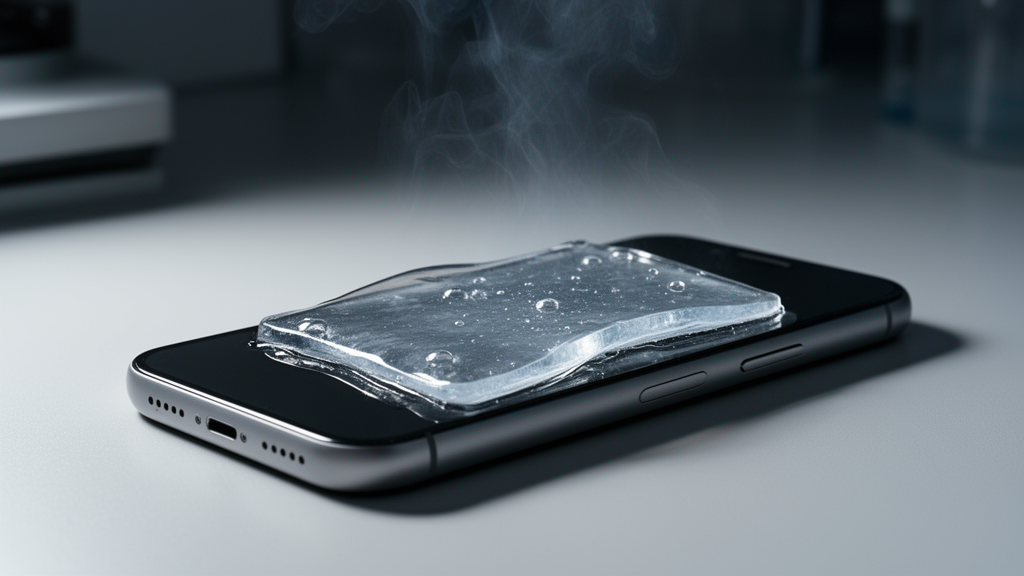
Published in Discover Polymers, the study demonstrates that specific hydrogel formulations, when loaded with magnesium chloride or glycerol, can reduce the temperature of a pre-heated mobile device back panel from 60 or 70 degrees Celsius to near room temperature within 20 seconds. This passive cooling method offers a low-cost alternative to active cooling systems, which typically require additional energy consumption and complex instrumental setups. The primary objective of the research was to create an efficient and cost-effective thermal regulation strategy for portable electronic devices, addressing the common issue of overheating that can cause permanent damage to sensitive electronic components.
The study involved the synthesis of three distinct hydrogel samples, designated HG(15)65, HG(32)65, and HG(47)65, based on the mole fraction of the monomer sodium acrylate. These base hydrogels were crosslinked with 65 micromoles of methylene bisacrylamide. The researchers observed that the equilibrium swelling ratios of these samples were 62.8, 120.8, and 189.6 grams per gram, respectively. The sample with the highest sodium acrylate content, HG(47)65, exhibited the greatest water absorption capacity, a property attributed to the presence of hydrophilic monomers and the osmotic swelling pressure within the polymer matrix. This high water uptake is critical for the hydrogel’s ability to function as a heat sink and facilitate evaporative cooling.
To enhance the anti-dehydration properties of the hydrogels, the researchers loaded the HG(47)65 sample with varying concentrations of salts, including lithium chloride, sodium chloride, calcium chloride, and magnesium chloride, as well as the organic solvent glycerol. The anti-dehydration behavior was investigated by placing the samples in a desiccator with a relative humidity of 43% for 10 days. The native hydrogel sample showed a percent dryness of 41%, indicating significant water loss. In contrast, the samples loaded with 15.0 millimoles of magnesium chloride and glycerol showed minimum percent dryness values of 18.0% and 23.0%, respectively. This improved water retention is crucial for the long-term efficacy of the cooling device, as it allows the hydrogel to remain hydrated and functional for extended periods without frequent recharging.
The mechanism behind the superior water retention in the magnesium chloride-loaded hydrogel involves the formation of octahedral complexes between the central magnesium ions and the carboxylate groups of the polymer chains. These coordination bonds act as additional crosslinks within the hydrogel matrix, not only providing better retention of entrapped water molecules but also rendering the hydrogel with additional mechanical strength. The tensile strength at break for the HG(47)65/Mg(II)15 sample was measured at 39.43 kPa, which is approximately eight times higher than that of the glycerol-loaded sample, which recorded 2.13 kPa. The native hydrogel had a tensile strength of only 1.03 kPa, highlighting the significant structural reinforcement provided by the magnesium ions.
The cooling performance was tested using the back panel of a Realme Narzo 60 5G smartphone, which was pre-heated to 60 and 70 degrees Celsius. The panel was placed on the freshly prepared hydrogel sheets, and the temperature change was monitored over time. The results showed that both the magnesium chloride and glycerol-loaded hydrogels reduced the panel temperature to approximately 27 degrees Celsius within 20 seconds. This is a dramatic improvement compared to the control group, where the panel was left in open air. In the open air control, it took more than 600 seconds to reach 27 degrees Celsius and almost 900 seconds to attain the room temperature of 25 degrees Celsius. The hydrogels were found to be nearly 20 times more efficient than open air in cooling the pre-heated mobile panel.
Quantitative heat transfer analysis revealed that the majority of the heat was dissipated in the initial phase of the cooling process. For a panel pre-heated to 60 degrees Celsius, the total heat delivered was 392.0 Joules, of which 369.4 Joules were transferred to the hydrogels in the first 20 seconds, representing approximately 94% of the total heat loss. Similarly, for a panel pre-heated to 70 degrees Celsius, the total heat delivered was 504.1 Joules, with 473.7 Joules transferred in the first 20 seconds. This rapid initial heat transfer is responsible for the sharp fall in temperature observed in the early stages of cooling. The remaining heat is dissipated more slowly as the temperature difference between the panel and the hydrogel decreases.
The mechanism of cooling involves a combination of surface water evaporation, heat conduction within the hydrogel matrix, and heat radiation into the air. When the pre-heated panel is placed on the hydrogel, heat is immediately transferred to the surface water, causing partial evaporation and absorption of latent heat. Some of the absorbed heat is distributed among the water molecules within the hydrogel matrix through conduction, increasing the temperature of the hydrogel from 25 to 27 degrees Celsius. Finally, the heat absorbed by the hydrogel is radiated into the surrounding air, bringing the matrix back to room temperature. The weight loss of the hydrogels after the cooling experiment was minimal, with the magnesium chloride-loaded sample losing only 0.12 to 0.15 grams, indicating that the water is retained effectively within the matrix.
In addition to thermal performance, the physical properties of the hydrogels were evaluated for their suitability as a practical cooling device. The stickiness of the hydrogels was tested by measuring the detachment pressure required to remove them from the mobile panel. The magnesium chloride-loaded sample required a detachment pressure of 1.823 kPa, while the glycerol-loaded sample required 0.638 kPa. The folding endurance of both samples was found to be excellent, with more than 1150 folding-unfolding cycles before any signs of cracking were observed. This high folding endurance indicates that the hydrogels are flexible and durable enough to withstand the physical stresses associated with handling and use in portable electronic devices.
The study also examined the effect of pH on the equilibrium swelling ratio of the hydrogels. The samples exhibited maximum swelling ratios at pH 6.8, which is attributed to the complete ionization of sodium acrylate molecules into negatively charged carboxylate groups. This ionization encourages extensive relaxation along the polymer chains, promoting water uptake. At lower pH values, the swelling ratio decreased due to additional crosslinking produced via hydrogen bonding interactions between carboxylic acid groups. At higher pH values, the swelling ratio was lower due to the screening of negatively charged acrylate groups by sodium ions entering the gel matrix.
The researchers concluded that the poly(sodium acrylate-co-acrylamide) hydrogels, particularly when loaded with magnesium chloride, show fair anti-dehydration properties and successful cooling performance. The salt-loaded hydrogel HG(47)65/Mg(II)15 was identified as the most suitable candidate for a cooling device for portable electronic devices due to its superior mechanical strength, water retention, and cooling efficiency. The device requires no extra energy consumption or infrastructural setup, and after prolonged use, it can be easily recharged with water if needed. This study provides a promising pathway for the development of passive cooling solutions for the growing market of portable electronic devices, addressing the need for low-cost and efficient thermal management systems.
Subject of Research: Development of anti-dehydration hydrogels for passive thermal regulation of portable electronic devices
Article Title: Performance analysis of efficient and cost effective hydrogels for thermal regulation strategy
Article References: Katulkar, A., Kosta, D. K., Tiwari, S., Bajpai, M., & Bajpai, S. K. (2026). Performance analysis of efficient and cost effective hydrogels for thermal regulation strategy. Discover Polymers, 3(1), Article 4. https://doi.org/10.1007/s44347-026-00042-y
Image Credits: AI Generated
DOI: 10.1007/s44347-026-00042-y
Keywords: hydrogels, thermal regulation, smartphone cooling, passive cooling, polymer science, anti-dehydration, magnesium chloride, glycerol, heat transfer, electronic devices, Performance, analysis
News Source: Bethany Barker. (November 11, 2026). Hydrogels Cool Overheated Smartphones in 20 Seconds. Scienmag.