Credit: Angela Cenci Nilsson
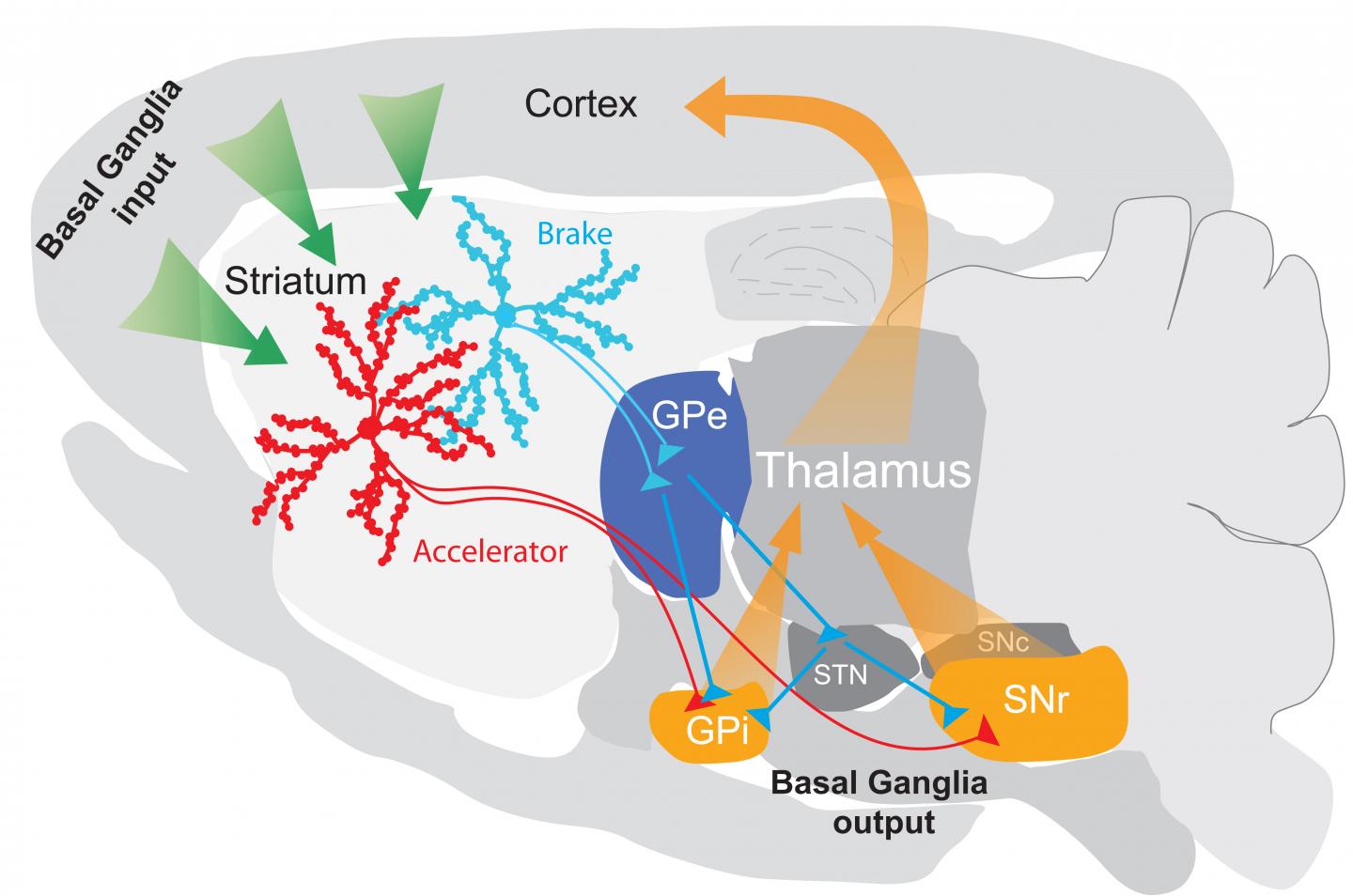
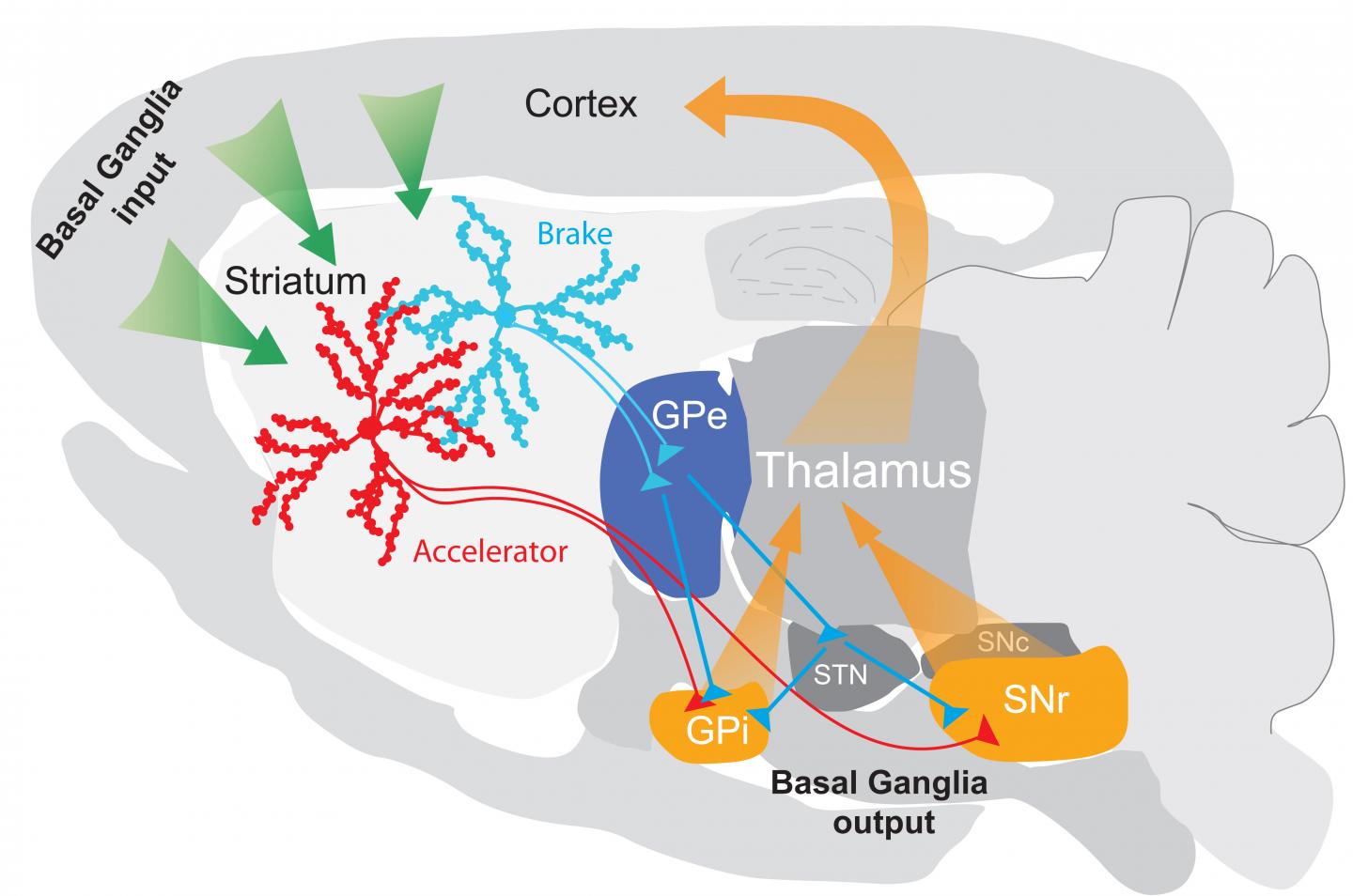
In order to drive a car, you need a good balance between accelerator and brake. The same applies to a part of the brain – the striatum – that controls our movements. Research at Lund University in Sweden has led to new findings on the interaction between the "accelerator" and the "brake" in the striatum. These findings may guide the development of treatments for movement disorders such as those occurring in Parkinson's disease.
In the initial stage of Parkinson's disease, patients' movements are stiff and slow. This can be remedied with the drug L-dopa, but after a few years of treatment, patients usually develop uncontrolled jerking motions known as dyskinesias. Other diseases, such as Huntington's disease and several hereditary conditions, are also associated with movement disorders of this kind.
"We know that the striatum plays an important role in movement control. But which neural pathways are most important has been hotly debated", says Parkinson's researcher Angela Cenci Nilsson in Lund.
An innovative approach
The striatum has two principal types of cells forming distinct neural pathway, termed "direct pathway" and "indirect pathway", respectively. The research debate has centred on whether both pathways are equally important in all situations, and whether they need to cooperate or can work independently. To address this question, the Lund researchers applied a method called chemogenetics. Using a harmless virus, they introduced a new gene into one or the other type of striatal cell in laboratory mice. The gene coded for the production of a receptor protein activating the relevant neural pathway. However, the receptor became stimulated only when the animal was administered a particular substance whose effect lasted a couple of hours. Using this method, the researchers were able to control the activity of cells forming the direct or indirect pathway while studying the animals' behaviour. Studies were conducted on both normal mice and animals with a Parkinson's-like injury, and both with or without L-dopa.
The results showed that all types of movements were controlled by both pathways, which proved to function as a sort of "accelerator" (the direct pathway) and "brake" (the indirect pathway), respectively. In Parkinson's mice treated with L-dopa, activation of the direct pathway produced faster movements but also more severe dyskinesias, mimicking both the advantages and the disadvantages of Parkinson's therapy. On the other hand, activation of the indirect pathway gave slower movements but also eased the dyskinesias caused by L-dopa.
"We interpret these results to mean that the pathways need to interact in all situations, even in Parkinson's-like conditions and upon L-dopa treatment. You can't have only acceleration and no braking, but must instead balance both functions in a precise manner", says Angela Cenci Nilsson.
The results could inform both basic and therapeutic research
She believes that L-dopa therapy gives complications when it "inactivates the brake" by strongly inhibiting the indirect pathway, while "pressing too hard on the accelerator" by overstimulating the direct pathway such that dyskinesias can occur.
These new findings could explain why it has been difficult to develop new drugs for Parkinson's disease. Drug development in recent years has been directed towards one or the other neural pathway, whereas this study points to a need to intervene on both pathways using either a drug that regulates both of them or two complementary drugs.
"Our results could be of great significance both for basic research and for therapeutic research", says Angela Cenci Nilsson.
###
Media Contact
Angela Cenci Nilsson
[email protected]
46-462-221-431
@lunduniversity
http://www.lu.se