Credit: Max Planck Research Unit for Neurogenetics
The first symptom of Parkinson's disease is often an impaired sense of smell. This neurodegenerative disease primarily causes irreparable damage to nerve cells in a brain area involved in movement control. How it affects the olfactory system has been unclear. Researchers at the Max Planck Research Unit for Neurogenetics in Frankfurt and the University of Auckland in New Zealand have now carried out a study comparing the olfactory bulbs of individuals with and without Parkinson's disease. The researchers found that the total volume occupied by the functional units in the olfactory bulb – the so-called glomeruli – is in Parkinson's cases only half that in normal individuals. Moreover, the distribution of the glomeruli within the olfactory bulb is altered in Parkinson's cases.
Nine out of ten patients with Parkinson's disease suffer from defects of the sense of smell in the early stages of the disease – often years before the appearance of the motor symptoms that are characteristic of the disease. The motor symptoms are caused by a loss of nerve cells in the region of the substantia nigra in the brain that is responsible for controlling movement. What causes this cell death has not yet been fully clarified, but a key role appears to be played by Lewy bodies. These are inclusions, inside the cells, that contain a misfolded, defective version of the alpha-synuclein protein. Lewy bodies are found in the olfactory bulb before they appear in the substantia nigra.
The so-called olfactory vector hypothesis for Parkinson's disease proposes that environmental factors, such as viruses, heavy metals or pesticides, are risk factors or even causes of the condition. No other sensory system than the olfactory system is in such close contact with the external environment – the inhaled air. The hypothesis posits that the disease-causing agent is introduced from the nasal cavity into the olfactory bulb, where Parkinson's disease is triggered and gradually spreads through other parts of the brain.
Intact tissue samples required
The human olfactory bulb remains poorly studied. Research on this brain structure depends critically on the availability of pristine samples, which are typically procured post mortem, from brain donors. The Neurological Foundation of New Zealand Douglas Human Brain Bank in Auckland, New Zealand works closely with families of patients suffering from neurodegenerative diseases to ensure ethical and effective collection of post mortem brain samples from diseased and non-diseased cases. The precarious location of the olfactory bulb below the bulk of the brain and the many axons that connect it to the olfactory mucosa mean that special efforts must be made to protect the morphology of the olfactory bulb when collecting the samples.
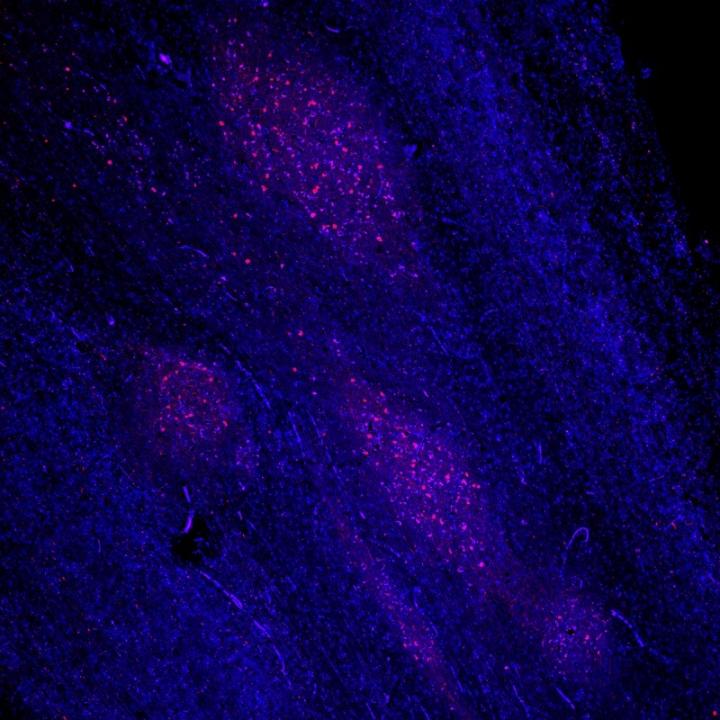
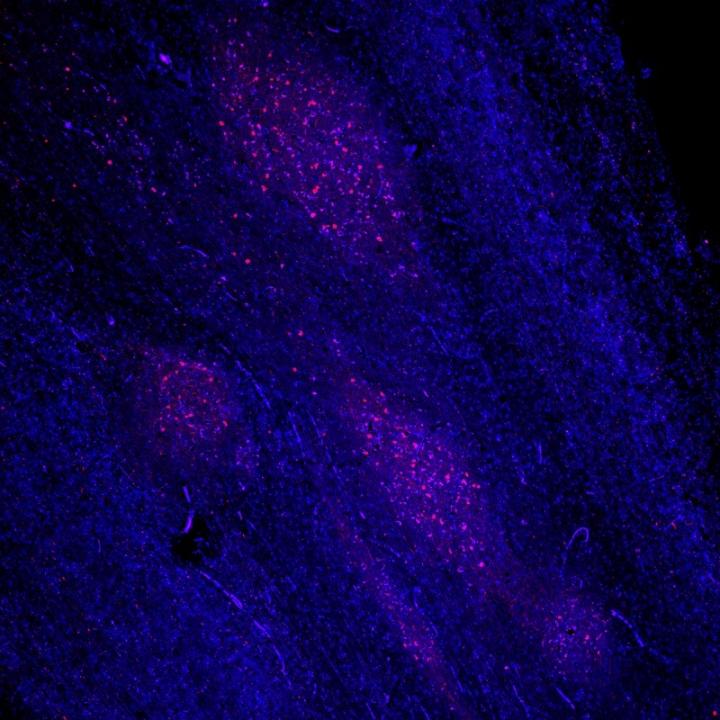
The New Zealand-based researchers were able to collect olfactory bulbs fit for an in-depth quantitative study. In a globe-spanning project, the researchers processed the post mortem olfactory bulbs chemically, cut ten-micrometer thin sections throughout its entire length, and stained the sections with fluorescently labeled antibodies. The labeled sections were then scanned in Frankfurt, and the images reconstructed in 3D allowing for quantitative whole-olfactory bulb analyses.
New quantitive parameter
As glomeruli of the human olfactory bulb are difficult to count unambiguously, the researchers came up with a new, quantitative parameter: the global glomerular voxel volume. This quantity is the sum of the volume of all glomeruli. These are formed by the coalescence of axons of olfactory sensory neurons making synapses with olfactory bulb neurons. Having defined this new parameter, the researchers compared the values between olfactory bulbs from normal and Parkinson's disease cases, and found that it was reduced by more than half. Whether the decrease is the result of Parkinson's disease cases having fewer or smaller glomeruli, or is due to a combination of these two effects, remains to be seen.
In addition, the distribution of the glomeruli was altered. The olfactory bulbs of normal cases had 70 percent of their glomerular component in the bottom half of the olfactory bulb, but the olfactory bulbs of Parkinson's disease cases contained only 44 percent in the bottom half. "The preferential deficit of the glomerular component in the bottom half of the olfactory bulb, close to the olfactory mucosa, is consistent with the olfactory vector hypothesis of Parkinson's disease", states Peter Mombaerts, M.D., Ph.D., director of the Max Planck Research Unit for Neurogenetics. The scientists also discovered that the greater the number of Lewy bodies with aggregated alpha synuclein, the smaller the glomerular component of the olfactory bulb. "This relationship could be an indication that the Lewy bodies are the cause of the reduction in glomerular volume," explains Dr. Bolek Zapiec, first author of the paper.
The question now is which type of neurons in the olfactory bulb is affected first or foremost in Parkinson's disease. Next the researchers would like to identify the neurons in the olfactory bulb that are the most vulnerable.
###
Original publication
Bolek Zapiec, Birger V. Dieriks, Sheryl Tan, Richard L. M. Faull, Peter Mombaerts, Maurice A. Curtis
A ventral glomerular deficit in Parkinson's disease revealed by whole olfactory bulb reconstruction.
Brain; 3 September, 2017
Media Contact
Peter Mombaerts
[email protected]
49-698-500-334-000
@maxplanckpress
http://www.mpg.de
Original Source
https://www.mpg.de/11484476/parkinson-olfactory-system http://dx.doi.org/10.1093/brain/awx208