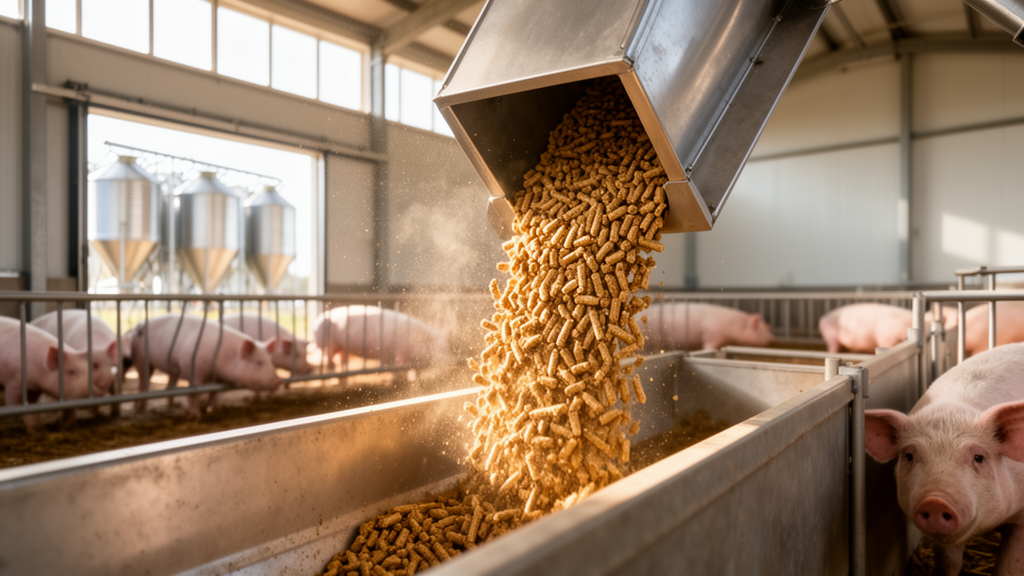
Published in Agricultural and Food Economics, the study utilizes a novel time-frequency network approach to demonstrate that tail risk spillovers are not uniform but rather asymmetric, intensifying significantly during market downturns and crisis periods. This finding challenges static models of commodity transmission by revealing that the direction and intensity of risk contagion depend heavily on the specific market state and the time horizon of the shock.
The investigation focuses on the recurrent phenomena of price decoupling and risk resonance within the hog-feed industrial chain. The authors argue that traditional static frameworks, such as linear mean models and the classical hog-to-grain price ratio rule, have repeatedly failed to interpret the time-varying characteristics of transmission pathways. By integrating multi-timescale analysis with advanced extreme-risk identification methods, the team aimed to uncover the nonlinear mechanisms governing price transmission and risk spillovers along the chain, particularly under extreme events and policy shocks.
To address these gaps, the study constructs a three-dimensional analytical framework combining time-varying parameter vector autoregression with spectral decomposition and quantile vector autoregression with the Diebold-Yilmaz spillover index. This integrated approach allows for the simultaneous capture of time-varying parameter evolution, band-wise heterogeneity, and quantile-dependent asymmetric tail risk contagion. The methodology is specifically designed to parse the complex dynamics of a real-economy value chain characterized by biological cycles, policy interventions, and complex physical supply structures.
The empirical analysis relies on monthly data spanning from June 2010 to July 2025, encompassing 182 observations. The dataset includes nine core variables selected to represent macroeconomic, financial-market, industry-specific, and exogenous-shock dimensions. These variables range from macro-inflation terminus and financial liquidity indicators to upstream feed inputs like soybean meal and corn, and downstream terminal products such as pork. All raw price series were converted to log returns to ensure stationarity and to sharpen the detection of extreme tail risks triggered by policy shocks or exchange-rate movements.
The results reveal pronounced cyclical heterogeneity in price dynamics across different time horizons. In the short term, defined as one to five months, feed cost shocks primarily drive fluctuations, manifesting as a rapid cost-price feedback loop. In the medium term, spanning five to twenty months, capacity corrections and production adjustments constrain the transmission of prices. Over the long term, exceeding twenty months, global grain prices and macroeconomic fundamentals shape the underlying trends. This frequency-domain heterogeneity is driven by the incompressible biological cycles of swine production, such as the four-month gestation period and six-month fattening period, which dictate rigid time lags in cost shock transmission.
A central finding of the study is the asymmetric nature of tail risk propagation. The hog-to-feed price ratio serves as the pivotal nexus in this transmission network. During market downturns and crisis periods, spillovers from feed to hog intensify more rapidly and strongly than during upswings. This asymmetry is attributed to the dynamic reversal of net risk spillover directions between upstream and downstream sectors under extreme conditions. Specifically, during periods of severe losses, risks flow back from the downstream farming stage to the upstream feed sector, forming a negative feedback loop that amplifies panic sentiment.
The study further identifies the role of policy uncertainty and international grain price volatility in amplifying cross-market tail-risk resonance. Chinese policy uncertainty and international grain price fluctuations interact through the hog-to-feed ratio, particularly during events such as the African Swine Fever outbreak. The analysis shows that policy shocks display horizon-specific heterogeneity, generating abrupt jump-like disruptions in the short term and manifesting as persistent, cumulative effects in the long term. This interaction highlights the vulnerability of the industrial chain to exogenous shocks that reshape market linkages through a cross-cycle logic of short-term disconnection, medium-term capacity imbalance, and long-term expectation distortion.
Wavelet coherence analysis provided additional statistical verification for the frequency-band divisions used in the study. The analysis confirmed that the short-term band is characterized by high coherence between feed raw materials, while the medium and long-term bands show significant coherent clustering between the hog-to-grain price ratio and feed prices. The phase relationships clarified the transmission directions, with feed prices leading the hog-to-grain price ratio, consistent with cost-push theory. This cross-method verification enhances the robustness of the identification results and supports the reliability of the TVP-VAR-BK model’s frequency-decomposition findings.
The dynamic evolution of aggregate spillover intensity aligns with major industry cycles. Feed cost returns consistently function as net spillover transmitters, with their intensity increasing notably during the trough of the 2015-2016 hog cycle and the 2021-2022 commodity price surge. Conversely, the hog-corn price ratio acts primarily as a net receiver, with its net spillover dropping sharply during the 2020 African swine fever outbreak. This period was characterized by extreme profit compression, which increased the ratio’s sensitivity to absorbing upstream shocks. The dynamic analysis reveals that financial liquidity and economic policy uncertainty also play significant roles, with their influence shifting depending on the specific policy interventions and market conditions.
The findings have important implications for the design of stage-specific regulatory and scenario-based emergency risk-management policies. The study suggests that short-term measures should focus on establishing rapid response mechanisms for extreme events, such as epidemics and international grain price fluctuations, to prevent market panic. Medium-term strategies need to strengthen the dynamic monitoring of production capacity, tracking changes in the inventory of breeding sows and feed stocks. Long-term solutions should build a macro-coordination system that deepens the understanding of the international grain price cycle and uses pre-adjustment measures to mitigate external shocks.
Despite the comprehensive framework, the study acknowledges several limitations. The use of monthly-frequency data, while sufficient for capturing medium and long-term cyclical characteristics, may not reveal more subtle short-term adjustment dynamics that higher-frequency data could provide. Additionally, the proxy variables used to depict policy and financial dimensions, though common in the academic community, may have room for improvement in accuracy. The models employed, while effective in depicting time-varying and nonlinear dependency relationships, are simplified systems with inherent boundaries in identifying deep structural parameters and the behavioral motivations of heterogeneous agents.
The research contributes to the broader understanding of risk transmission in complex industrial chains by demonstrating that the direction and intensity of tail risk spillovers are contingent on industrial chain position and profit-loss status. The proposed impact absorption-critical trigger-collaborative collapse model offers a new theoretical perspective for understanding industrial chain vulnerability. By elucidating the interactive mechanisms between heterogeneous agent behaviors and policy interventions, the study provides a refined theoretical basis for the risk governance of the feed-swine value chain, emphasizing the need for dynamic and adaptive regulatory approaches.
The study’s empirical results provide specific quantitative evidence for the proposed hypotheses regarding pricing power and transmission hubs. Frequency-domain decomposition identified scale heterogeneity in price transmission, confirming that the short term is dominated by soybean meal cost shocks, while hog price dynamics and capacity competition anchor the medium term. In the long term, global grain prices and macroeconomic trends govern the system. The hog-to-grain price ratio functions as a core transmission hub, with its linkage strength tracing a U-shaped temporal trajectory. This pattern is most intense in the short term, attenuates in the medium term, and re-intensifies in the long term, offering a mechanistic explanation for the failure of the traditional static hog-to-grain price ratio rule during periods of extreme volatility.
Impulse response analyses at specific historical time points illustrate how different shock types reshape market linkages. During the African swine fever outbreak in August 2018, an endogenous supply shock, live-pig prices showed a significant positive instantaneous response, while the pig-grain price ratio rose rapidly, indicating that price increases far exceeded feed costs and expanded profit margins. In contrast, the Russia-Ukraine conflict in February 2022, an external international cost shock, caused international grain prices to rise sharply and transmit to domestic corn and soybean meal markets. In this scenario, the pig-grain price ratio response was relatively weak, suggesting that live-pig price increases failed to fully cover rising feed costs, thereby squeezing farming profit margins. These distinct responses highlight how the nature of the shock determines the core logic of instantaneous transmission within the chain.
The QVAR-DY framework further quantifies the asymmetric nature of tail risk spillovers under extreme market conditions. During downside risk periods, corresponding to the 0.05 quantile, the connection weight between the hog-corn price ratio and international food prices surged to 17.02 during the 2020 pandemic shock. Simultaneously, the transmission path from soybean meal prices to pork prices escalated from 39.42 to 45.12, demonstrating the amplification effect of panic sentiment under extreme loss expectations. This period was characterized by a negative feedback loop where risks flowed from feed to live hogs, then to the price ratio, and finally to macroeconomic inflation and policy uncertainty. Conversely, during upside risk periods at the 0.95 quantile, international grain price shocks drove risk transmission through resonance effects, with the connection strength between the price ratio and corn prices rising from 13.00 to 15.23 during the 2022 grain price crisis.
Time-varying Granger causality tests confirm the dynamic switching of causal relationships within the industrial chain. In 2016–2017, a significant predictive relationship was identified from soybean meal returns to pork prices, consistent with cost pressures transmitting to terminal prices during overcapacity. However, in 2021–2022, this predictive relationship reversed, with pork prices predicting soybean meal returns, corresponding to demand-pull effects during price surges. The pig-to-grain ratio also demonstrated dynamic hub functionality, transitioning from a cost integrator in 2018–2019 to a policy trigger in 2020–2021, where its causal effects on economic policy uncertainty and the consumer price index strengthened. These findings underscore that the direction of risk transmission is not static but evolves with market states and specific policy interventions.
Subject of Research: Asymmetric tail risk spillovers in feed-swine value chains: a time-frequency network approach
Article Title: Asymmetric tail risk spillovers in feed-swine value chains: a time-frequency network approach
Article References: Jiang, C., Li, X., Wang, Y., & Ding, R. (2026). Asymmetric tail risk spillovers in feed-swine value chains: a time-frequency network approach. Agricultural and Food Economics, 14(1), Article 42. https://doi.org/10.1186/s40100-026-00486-7
Image Credits: AI Generated
DOI: 10.1186/s40100-026-00486-7
Keywords: Asymmetric, tail, risk, spillovers, feed-swine, value, chains, time-frequency, network, approach, scientific research
News Source: Alan Morgan. (November 10, 2026). Swine Feed Risk Spillovers Show Asymmetric Patterns. Scienmag.